


The associations of maternal and paternal obesity with latent patterns of offspring BMI development between 7 and 17 years of age: pooled analyses of cohorts born in 1958 and 2001 in the United Kingdom
- PMID: 36357563
- PMCID: PMC9834052
- DOI: 10.1038/s41366-022-01237-6
The associations of maternal and paternal obesity with latent patterns of offspring BMI development between 7 and 17 years of age: pooled analyses of cohorts born in 1958 and 2001 in the United Kingdom
Abstract
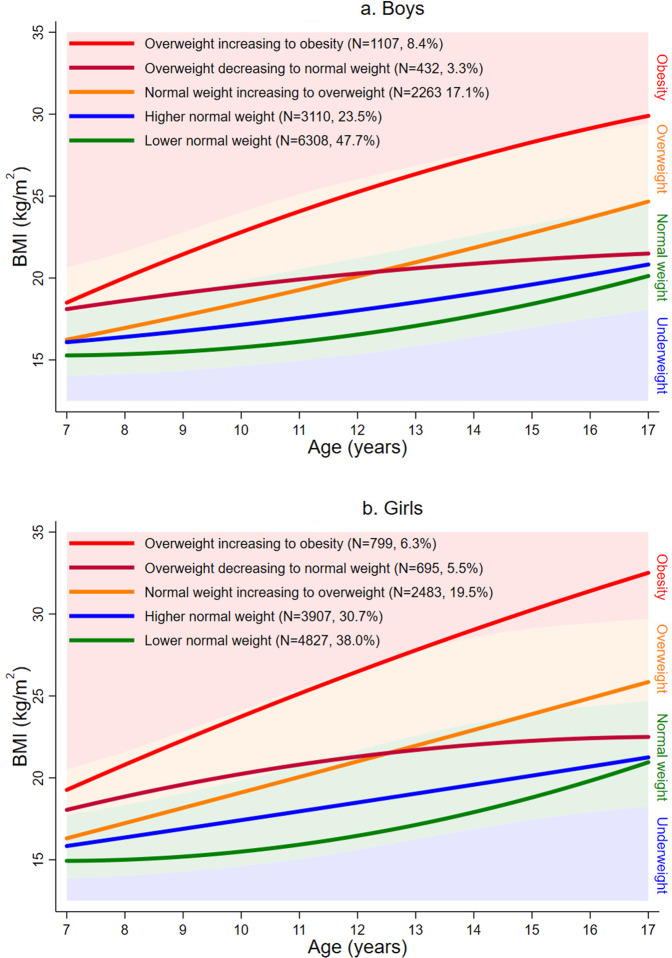
Objective: We aimed to 1) describe how the UK obesity epidemic reflects a change over time in the proportion of the population demonstrating adverse latent patterns of BMI development and 2) investigate the potential roles of maternal and paternal BMI in this secular process.
Methods: We used serial BMI data between 7 and 17 years of age from 13220 boys and 12711 girls. Half the sample was born in 1958 and half in 2001. Sex-specific growth mixture models were developed. The relationships of maternal and paternal BMI and weight status with class membership were estimated using the 3-step BCH approach, with covariate adjustment.
Results: The selected models had five classes. For each sex, in addition to the two largest normal weight classes, there were "normal weight increasing to overweight" (17% of boys and 20% of girls), "overweight increasing to obesity" (8% and 6%), and "overweight decreasing to normal weight" (3% and 6%) classes. More than 1-in-10 children from the 2001 birth cohort were in the "overweight increasing to obesity" class, compared to less than 1-in-30 from the 1958 birth cohort. Approximately 75% of the mothers and fathers of this class had overweight or obesity. When considered together, both maternal and paternal BMI were associated with latent class membership, with evidence of negative departure from additivity (i.e., the combined effect of maternal and paternal BMI was smaller than the sum of the individual effects). The odds of a girl belonging to the "overweight increasing to obesity" class (compared to the largest normal weight class) was 13.11 (8.74, 19.66) times higher if both parents had overweight or obesity (compared to both parents having normal weight); the equivalent estimate for boys was 9.01 (6.37, 12.75).
Conclusions: The increase in obesity rates in the UK over more than 40 years has been partly driven by the growth of a sub-population demonstrating excess BMI gain during adolescence. Our results implicate both maternal and paternal BMI as correlates of this secular process.
© 2022. The Author(s).
Conflict of interest statement
The authors declare no competing interests.
Figures
References
-
- The Health and Social Care Information Centre. The National Child Measurement Programme: England, 2019/20 school year. London, UK: The Health and Social Care Information Centre; 2020.
-
- Fuller E, Mindell J, Prior G. Health survey for England 2018. London, UK: NHS Digital; 2018.
Publication types
MeSH terms
Grants and funding
LinkOut - more resources
Full Text Sources
Medical
