


Association of muscle strength and body mass index with risk factors for metabolic syndrome and its prevalence in Korean adult women
- PMID: 36357875
- PMCID: PMC9650810
- DOI: 10.1186/s12889-022-14520-y
Association of muscle strength and body mass index with risk factors for metabolic syndrome and its prevalence in Korean adult women
Abstract
Background: The aim of this study was to investigate the effects of muscle strength and BMI (body Mass Index) on Metabolic syndrome (MetS) risk factors and prevalence in Korean adult women, using data from the Korea National Health and Nutrition Examination Survey.
Methods: A total of 3189 Korean adults women participated in the cross-sectional study. Participants were measured BMI, MetS risk factors including waist-circumference (WC), fasting glucose (FG), triglyceride (TG), high density lipoprotein cholesterol (HDL-C), and handgrip strength as muscle strength.
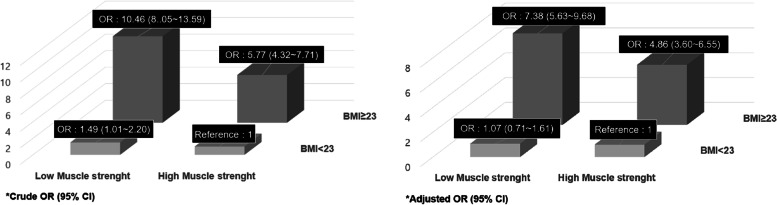
Results: As a result 'high BMI & Low muscle strength', 'low BMI & low muscle strength', and 'high BMI & high muscle strength' groups had a significantly higher prevalence of Mets [OR (Odd ratio): 1.49, 95% CI (confidence interval): 1.01 2.20; OR: 5.77, 95% CI: 4.32 7.17; OR: 10.46, 95% CI: 8.05 13.59] than 'low BMI & high muscle strength' group; and after adjusting smoking, menstruation status, and drinking rate, the OR were 1.07 (95% CI: 0.71-1.61), 4.89 (95% CI: 3.60-6.55), and 7.38 (95% CI: 5.63-9.68), respectively.
Conclusions: These findings indicated that increasing muscle strength and lowering BMI through regular physical activity and exercise are effective methods to reduce the prevalence of risk factors for Mets.
Keywords: Adult women population; BMI (body mass index); Exercise; Handgrip strength; Metabolic syndrome (MetS); Physical activity.
© 2022. The Author(s).
Conflict of interest statement
There are no conflicts of interest to declare.
Figures
References
-
- World Health Organization(WHO). Obesity and overweight. 2021. Availavble from: https://www.who.int/news-room/fact-sheets/detail/obesity-and-overweight.
-
- Philip W, James T. Obesity—a modern pandemic: the burden of disease. Endocrinol Nutr. 2013;60:3–6. - PubMed
-
- Ahirwar R, Mondal PR. Prevalence of obesity in India: a systematic review. Diabetes Metab Syndr. 2019;13(1):318–321. - PubMed
-
- Chooi YC, Ding C, Magkos F. The epidemiology of obesity. Metabolism. 2019;92:6–10. - PubMed
-
- Malone JI, Hansen BC. Does obesity cause type 2 diabetes mellitus (T2DM)? Or is it the opposite? Pediatr Diabetes. 2019;20(1):5–9. - PubMed
MeSH terms
LinkOut - more resources
Full Text Sources
Medical
Research Materials
Miscellaneous
