


Utility of illness symptoms for predicting COVID-19 infections in children
- PMID: 36357876
- PMCID: PMC9647749
- DOI: 10.1186/s12887-022-03729-w
Utility of illness symptoms for predicting COVID-19 infections in children
Abstract
Background: The Centers for Disease Control and Prevention and the American Academy of Pediatrics recommend that symptomatic children remain home and get tested to identify potential coronavirus disease 2019 (COVID-19) cases. As the pandemic moves into a new phase, approaches to differentiate symptoms of COVID-19 versus other childhood infections can inform exclusion policies and potentially prevent future unnecessary missed school days.
Methods: Retrospective analysis of standardized symptom and exposure screens in symptomatic children 0-18 years tested for SARS-CoV-2 at three outpatient sites April to November 2020. Likelihood ratios (LR), number needed to screen to identify one COVID-19 case, and estimated missed school days were calculated.
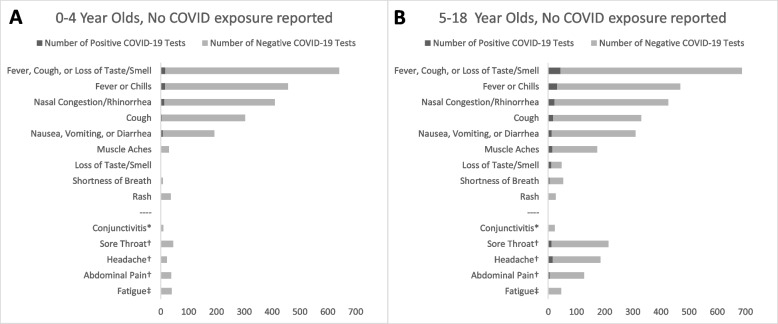
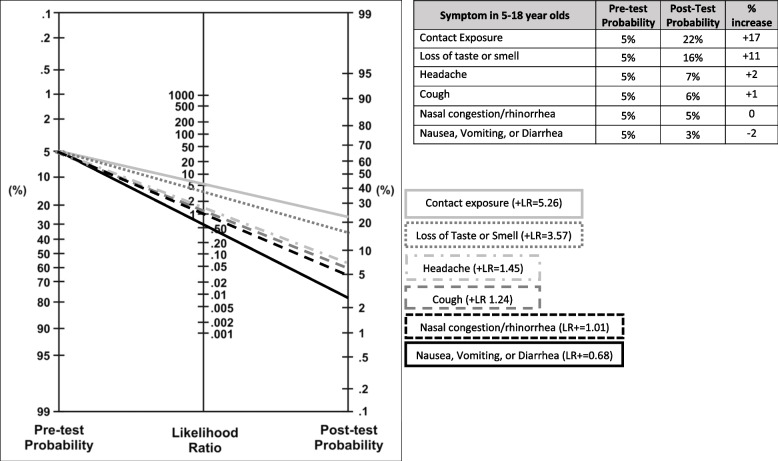
Results: Of children studied (N = 2,167), 88.9% tested negative. Self-reported exposure to COVID-19 was the only factor that statistically significantly increased the likelihood of a positive test for all ages (Positive LR, 5-18 year olds: 5.26, 95% confidence interval (CI): 4.37-6.33; 0-4 year olds: 5.87, 95% CI: 4.67-7.38). Across ages 0-18, nasal congestion/rhinorrhea, sore throat, abdominal pain, and nausea/vomiting/diarrhea were commonly reported, and were either not associated or had decreased association with testing positive for COVID-19. The number of school days missed to identify one case of COVID-19 ranged from 19 to 48 across those common symptoms.
Conclusions: We present an approach for identifying symptoms that are non-specific to COVID-19, for which exclusion would likely lead to limited impact on school safety but contribute to school-days missed. As variants and symptoms evolve, students and schools could benefit from reconsideration of exclusion and testing policies for non-specific symptoms, while maintaining testing for those who were exposed.
Keywords: COVID-19; School; Screening; Symptoms; Testing; Testing and exclusion.
© 2022. The Author(s).
Conflict of interest statement
The authors declare no competing interests.
The authors declare that they have no competing interests.
Figures
References
-
- CDC. “COVID-19 and Your Health.” Centers for Disease Control and Prevention, February 11, 2020. https://www.cdc.gov/coronavirus/2019-ncov/symptoms-testing/symptoms.html. - PubMed
-
- CDC. Guidance for COVID-19 Prevention in K-12 Schools and ECE Programs. Centers for Disease Control and Prevention. Published January 13, 2022. https://www.cdc.gov/coronavirus/2019-ncov/community/schools-childcare/k-.... Accessed 4 Apr 2022.
-
- COVID-19 Testing Guidance. http://www.aap.org/en/pages/2019-novel-coronavirus-covid-19-infections/c.... Accessed 4 Apr 2022
-
- CDC. Healthcare Workers. Centers for Disease Control and Prevention. Published February 11, 2020. https://www.cdc.gov/coronavirus/2019-ncov/hcp/pediatric-hcp.html. Accessed 4 Apr 2022.
Publication types
MeSH terms
LinkOut - more resources
Full Text Sources
Medical
Research Materials
Miscellaneous
