


Mapping Neuroscience in the Field of Education through a Bibliometric Analysis
- PMID: 36358380
- PMCID: PMC9688185
- DOI: 10.3390/brainsci12111454
Mapping Neuroscience in the Field of Education through a Bibliometric Analysis
Abstract
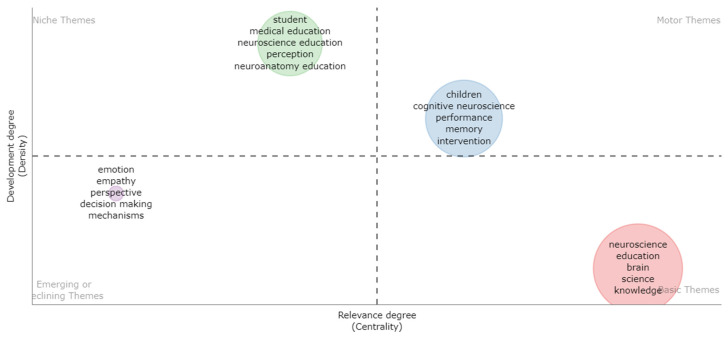
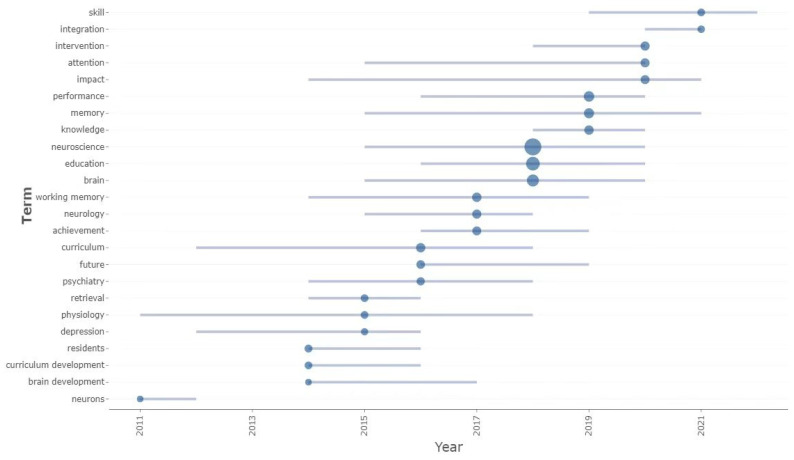
This study aimed to explore the core knowledge topics and future research trends in neuroscience in the field of education (NIE). In this study, we have explored the diffusion of neuroscience and different neuroscience methods (e.g., electroencephalography, functional magnetic resonance imaging, eye tracking) through and within education fields. A total of 549 existing scholarly articles and 25,886 references on neuroscience in the field of education (NIE) from the Web of Science Core Collection databases were examined during the following two periods: 1995-2013 and 2014-2022. The science mapping software Vosviewer and Bibliometrix were employed for data analysis and visualization of relevant literature. Furthermore, performance analysis, collaboration network analysis, co-citation network analysis, and strategic diagram analysis were conducted to systematically sort out the core knowledge in NIE. The results showed that children and cognitive neuroscience, students and medical education, emotion and empathy, and education and brain are the core intellectual themes of current research in NIE. Curriculum reform and children's skill development have remained central research issues in NIE, and several topics on pediatric research are emerging. The core intellectual themes of NIE revealed in this study can help scholars to better understand NIE, save research time, and explore a new research question. To the best of our knowledge, this study is one of the earliest documents to outline the NIE core intellectual themes and identify the research opportunities emerging in the field.
Keywords: bibliometric analysis; education; neuroscience; research topics; research trends.
Conflict of interest statement
The authors declare that the research was conducted in the absence of any commercial or financial relationships that could be construed as a potential conflict of interest.
Figures
References
-
- Eskine K.E. Evaluating the three-network theory of creativity: Effects of music listening on resting state EEG. Psychol. Music. 2022 doi: 10.1177/03057356221116141. - DOI
-
- Cozolino L. The Social Neuroscience of Education: Optimizing Attachment and Learning in the Classroom (the Norton Series on the Social Neuroscience of Education) WW Norton & Company; New York, NY, USA: 2013.
Publication types
Grants and funding
LinkOut - more resources
Full Text Sources
