Review
. 2022 Oct 25;12(11):1554.
doi: 10.3390/biom12111554.

Interferon Signaling in the Endometrium and in Endometriosis

Affiliations
Review

Interferon Signaling in the Endometrium and in Endometriosis

Yuri Park et al. Biomolecules. .

Abstract

Endometriosis is an estrogen-dependent inflammatory disease that develops in reproductive-aged women who experience pelvic pain and infertility. Even though endometriosis is not a new disease, its molecular etiology has not been clearly elucidated. Defects in the immune system might be one of the factors that promote endometriosis progression. For example, elevated levels of proinflammatory cytokines are associated with endometriosis. Interferon is one of the cytokines that is elevated in endometriotic tissues compared with normal endometrium. Therefore, high interferon levels play a crucial role in endometriosis progression. In addition to endometriosis, however, interferon has a critical role in endometrial function, particularly in the initiation and maintenance of pregnancy. Therefore, this review describes the double-edged sword of interferon signaling in normal endometrial function versus endometriosis progression and also discusses interferon targeting as a new nonhormonal therapy for endometriosis. This approach may increase the efficacy of endometriosis treatment and reduce the adverse effects associated with current hormonal therapy for this disease.

Keywords: cytokine; endometriosis; endometrium; inflammatory disease; interferon.


Conflict of interest statement

The authors declare that the research was conducted in the absence of any commercial or financial relationship that could be construed as a potential conflict of interest.

Figures
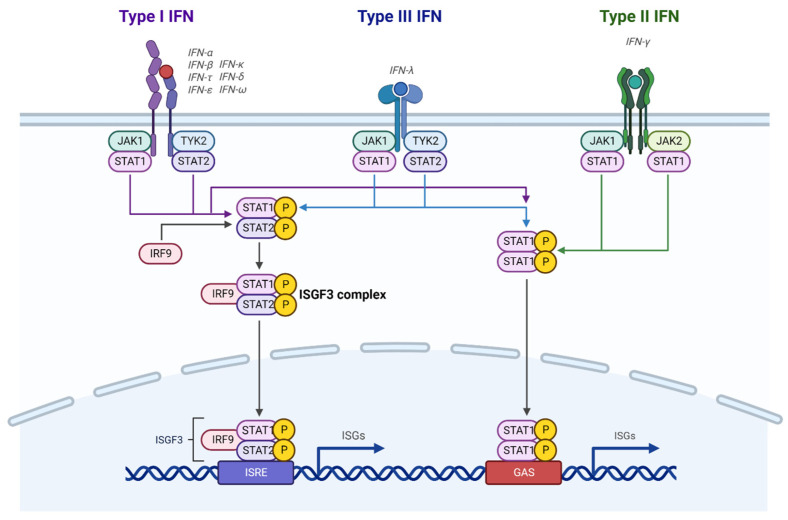
Figure 1
Figure 1
Canonical IFN signaling. Type I and Type III IFNs activate JAK1 and TYK2, which phosphorylates STAT1 and STAT2. Type II IFNs activate JAK1 and JAK2, which only phosphorylates STAT1. The activated STATs either form a complex with IRF9 or homodimer to stimulate ISG expression. This figure was created with BioRender.com.
Figure 2
Figure 2
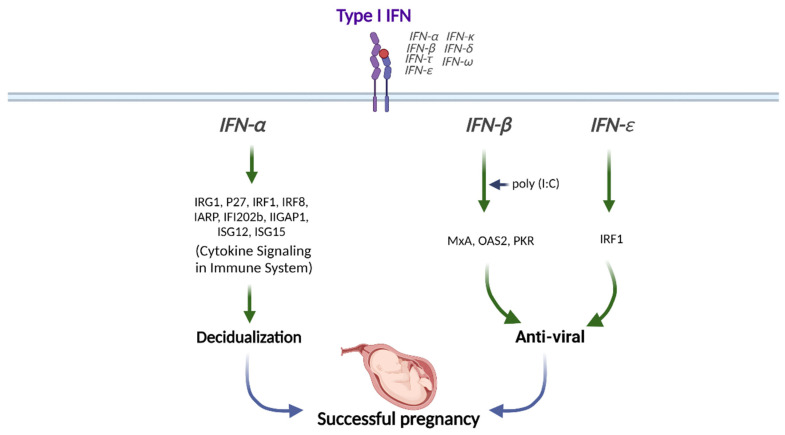
Role of Type I IFN in human pregnancy. Type I IFNs (IFNα, IFNβ, and IFNε) differentially modulate the downstream signals for successful pregnancy. This figure was created with BioRender.com.
Figure 3
Figure 3
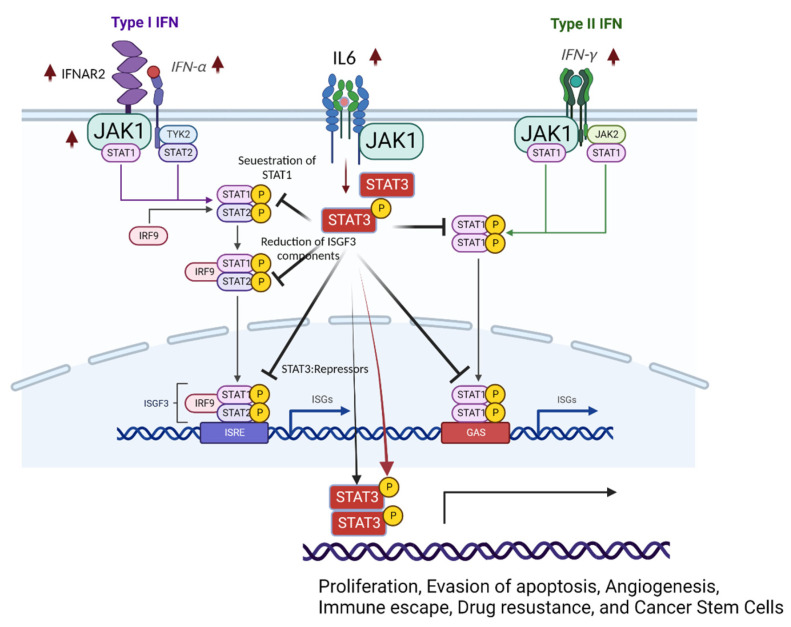
Dysregulation of IFN signaling in endometriotic lesions. Type 1 and Type II IFNs, JAK1, and IFNAR2 are elevated in endometriotic lesions compared with normal endometrium. In addition, the IL-6/STAT3 axis is activated in endometriotic lesions. Activated STAT3 negatively regulates STAT1 signaling in endometriotic lesions and increases the expression of STAT3 target genes to enhance endometriosis. This figure was created with BioRender.com.

References

    1. Zondervan K.T., Becker C.M., Missmer S.A. Endometriosis. N. Engl. J. Med. 2020;382:1244–1256. doi: 10.1056/NEJMra1810764. - DOI - PubMed
    1. Nisolle M., Donnez J. Peritoneal endometriosis, ovarian endometriosis, and adenomyotic nodules of the rectovaginal septum are three different entities. Fertil. Steril. 1997;68:585–596. doi: 10.1016/S0015-0282(97)00191-X. - DOI - PubMed
    1. Cornillie F.J., Oosterlynck D., Lauweryns J.M., Koninckx P.R. Deeply infiltrating pelvic endometriosis: Histology and clinical significance. Fertil. Steril. 1990;53:978–983. doi: 10.1016/S0015-0282(16)53570-5. - DOI - PubMed
    1. Saunders P.T.K., Horne A.W. Endometriosis: Etiology, pathobiology, and therapeutic prospects. Cell. 2021;184:2807–2824. doi: 10.1016/j.cell.2021.04.041. - DOI - PubMed
    1. Guo S.W. Recurrence of endometriosis and its control. Hum. Reprod. Update. 2009;15:441–461. doi: 10.1093/humupd/dmp007. - DOI - PubMed

Publication types