


Insulin-like Growth Factor-2 (IGF-2) in Fibrosis
- PMID: 36358907
- PMCID: PMC9687531
- DOI: 10.3390/biom12111557
Insulin-like Growth Factor-2 (IGF-2) in Fibrosis
Abstract
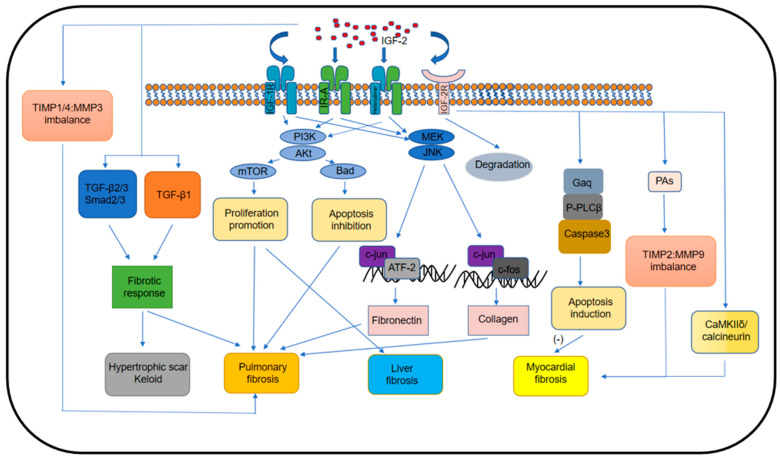
The insulin family consists of insulin, insulin-like growth factor 1 (IGF-1), insulin-like growth factor 2 (IGF-2), their receptors (IR, IGF-1R and IGF-2R), and their binding proteins. All three ligands are involved in cell proliferation, apoptosis, protein synthesis and metabolism due to their homologous sequences and structural similarities. Insulin-like growth factor 2, a member of the insulin family, plays an important role in embryonic development, metabolic disorders, and tumorigenesis by combining with three receptors with different degrees of affinity. The main pathological feature of various fibrotic diseases is the excessive deposition of extracellular matrix (ECM) after tissue and organ damage, which eventually results in organic dysfunction because scar formation replaces tissue parenchyma. As a mitogenic factor, IGF-2 is overexpressed in many fibrotic diseases. It can promote the proliferation of fibroblasts significantly, as well as the production of ECM in a time- and dose-dependent manner. This review aims to describe the expression changes and fibrosis-promoting effects of IGF-2 in the skin, oral cavity, heart, lung, liver, and kidney fibrotic tissues.
Keywords: IGF-1R; IR; extracellular matrix (ECM); fibrosis; insulin-like growth factor 2 (IGF-2).
Conflict of interest statement
The authors declare no conflict of interest.
Figures
References
-
- Liu X., Chen X., Zeng K., Xu M., He B., Pan Y., Sun H., Pan B., Xu X., Xu T., et al. DNA-methylation-mediated silencing of miR-486-5p promotes colorectal cancer proliferation and migration through activation of PLAGL2/IGF2/beta-catenin signal pathways. Cell Death Dis. 2018;9:1037. doi: 10.1038/s41419-018-1105-9. - DOI - PMC - PubMed
Publication types
MeSH terms
Substances
LinkOut - more resources
Full Text Sources
Research Materials
Miscellaneous
