


Challenging Occam's Razor: Dual Molecular Diagnoses Explain Entangled Clinical Pictures
- PMID: 36360260
- PMCID: PMC9690221
- DOI: 10.3390/genes13112023
Challenging Occam's Razor: Dual Molecular Diagnoses Explain Entangled Clinical Pictures
Abstract
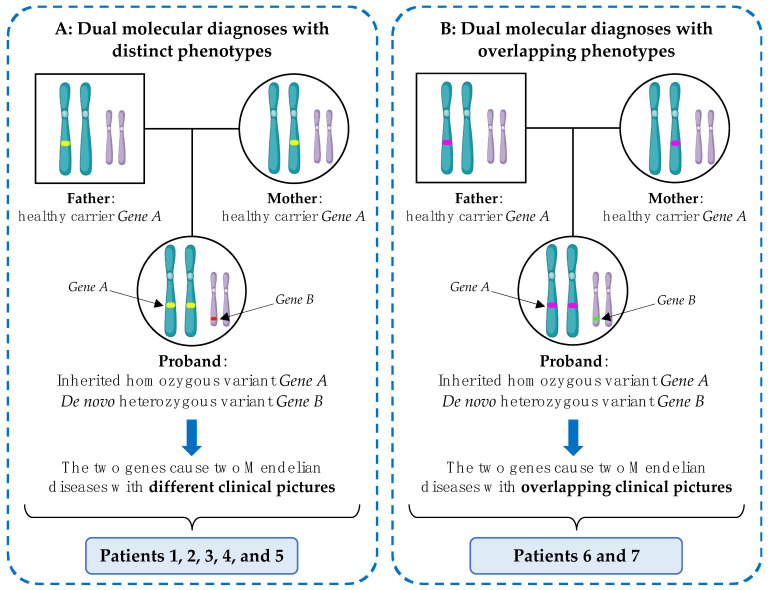
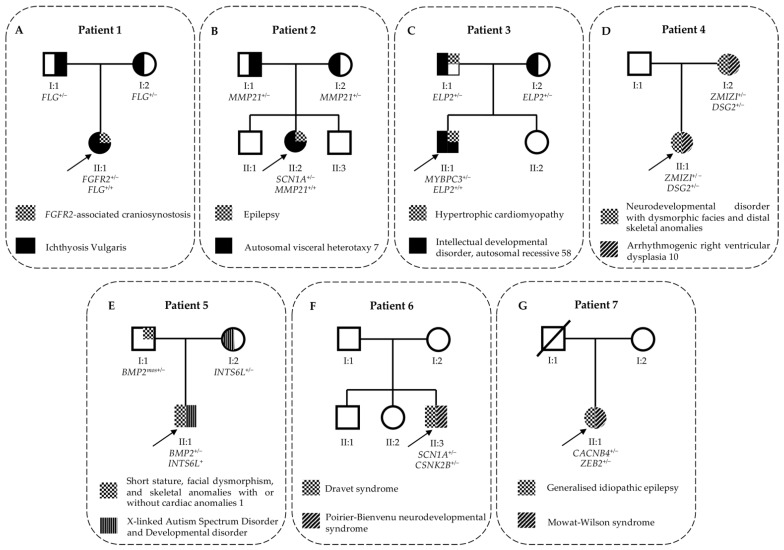
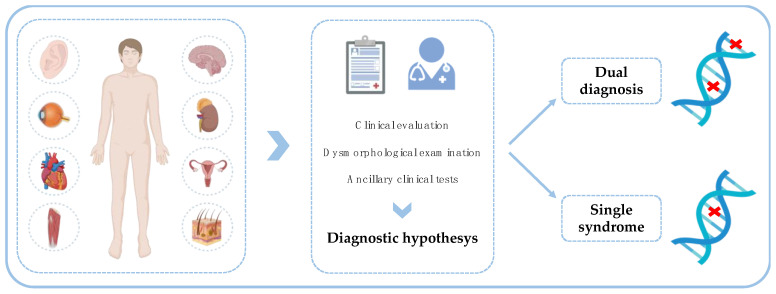
Dual molecular diagnoses are defined as the presence of pathogenic variants at two distinct and independently segregating loci that cause two different Mendelian conditions. In this study, we report the identification of double genetic disorders in a series of patients with complex clinical features. In the last 24 months, 342 syndromic patients have been recruited and clinically characterised. Whole Exome Sequencing analysis has been performed on the proband and on both parents and identified seven patients affected by a dual molecular diagnosis. Upon a detailed evaluation of both their clinical and molecular features, subjects are able to be divided into two groups: (A) five patients who present distinct phenotypes, due to each of the two different underlying genetic diseases; (B) two patients with overlapping clinical features that may be underpinned by both the identified genetic variations. Notably, only in one case a multilocus genomic variation was already suspected during the clinical evaluation. Overall, our findings highlight how dual molecular diagnoses represent a challenging model of complex inheritance that should always be considered whenever a patient shows atypical clinical features. Indeed, an accurate genetic characterisation is of the utmost importance to provide patients with a personalised and safe clinical management.
Keywords: dual molecular diagnosis; multilocus genomic variation; whole exome sequencing.
Conflict of interest statement
The authors declare no conflict of interest.
Figures
References
-
- Matis T., Michaud V., Van-Gils J., Raclet V., Plaisant C., Fergelot P., Lasseaux E., Arveiler B., Trimouille A. Triple Diagnosis of Wiedemann-Steiner, Waardenburg and DLG3-Related Intellectual Disability Association Found by WES: A Case Report. J. Gene Med. 2020;22:e3197. doi: 10.1002/jgm.3197. - DOI - PubMed
Publication types
MeSH terms
LinkOut - more resources
Full Text Sources
