


Real-World Outcomes of Systemic Therapy in Japanese Patients with Cancer (Tokushukai REAl-World Data Project: TREAD): Study Protocol for a Nationwide Cohort Study
- PMID: 36360487
- PMCID: PMC9690553
- DOI: 10.3390/healthcare10112146
Real-World Outcomes of Systemic Therapy in Japanese Patients with Cancer (Tokushukai REAl-World Data Project: TREAD): Study Protocol for a Nationwide Cohort Study
Abstract
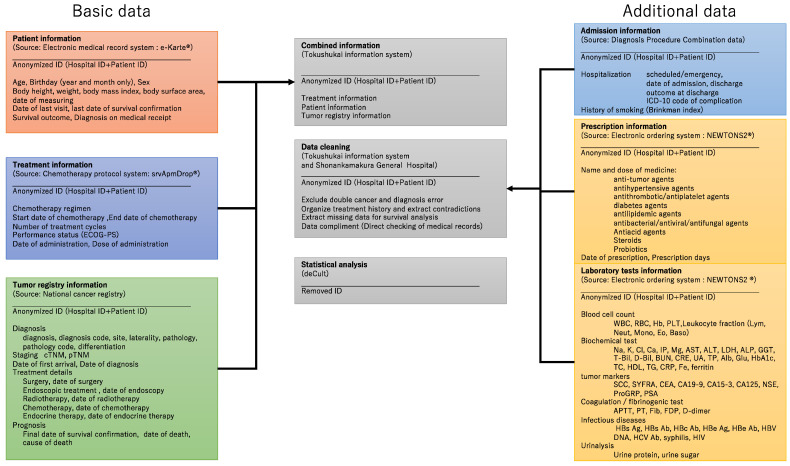
Cohort studies using large-scale databases have become increasingly important in recent years. The Tokushukai Medical Group is a leading medical group in Japan that includes 71 general hospitals nationwide from Hokkaido to Okinawa, with a total of 18,000 beds, and a unified electronic medical record system. This retrospective cohort study aims to evaluate the real-world outcomes of systemic therapy for Japanese patients with cancer using this merit of scale. All adult patients with cancer who received systemic therapy using a centrally registered chemotherapy protocol system at 46 hospitals from April 2010 to March 2020 will be identified (~48,850 patients). Key exclusion criteria include active double cancer and inadequate data extraction. Data will be obtained through electronic medical records, diagnosis procedure combination data, medical prescription data, and the national cancer registration system that includes sociodemographic variables, diagnostic and laboratory tests, concomitant drug prescriptions, cost, and overall survival. Kaplan-Meier estimates will be calculated for time-to-event analyses. Stratified/conventional Cox proportional hazards regression analyses will be conducted to examine the relationships between overall survival and related factors. Our findings provide important insights for future research directions, policy initiatives, medical guidelines, and clinical decision-making.
Keywords: National Cancer Registry; cancer chemotherapy; diagnosis procedure combination data; real-world data.
Conflict of interest statement
Some of the authors have received research funding, honoraria, or scholarship donations from various pharmaceutical companies and other organizations outside of the submitted work, none of which construe actual or potential conflicts of interest. Y.I. received speakers’ bureau fees/honoraria from Bayer, Bristol-Myers Squibb, Daiichi-Sankyo, Pfizer, and Ono Pharm, outside of the submitted work. H.M. has received speakers’ bureau fees/honoraria from Daiichi-Sankyo and Ono Pharm; research funding from Astelas-Amgen Biopharma, Bayer, Bristol Myers Squibb, Chugai, Daiichi-Sankyo, Incite, Novartis, Ono Pharm, Pfizer, and Rakuten-Medical; and scholarship donations from Bayer, Chugai, Daiichi-Sankyo, Eisai, Kyowa-Kirin, Lilly, Ono Pharmaceutical, Pfizer, Taiho Pharma, and Takeda, outside of the submitted work. These organizations had no role in the design, conduct, or reporting of this work.
References
LinkOut - more resources
Full Text Sources
Miscellaneous
