


A Pilot Study of Ketamine Infusion after Suicide Attempt: New Frontiers in Treating Acute Suicidality in a Real-World Medical Setting
- PMID: 36360672
- PMCID: PMC9656070
- DOI: 10.3390/ijerph192113792
A Pilot Study of Ketamine Infusion after Suicide Attempt: New Frontiers in Treating Acute Suicidality in a Real-World Medical Setting
Abstract
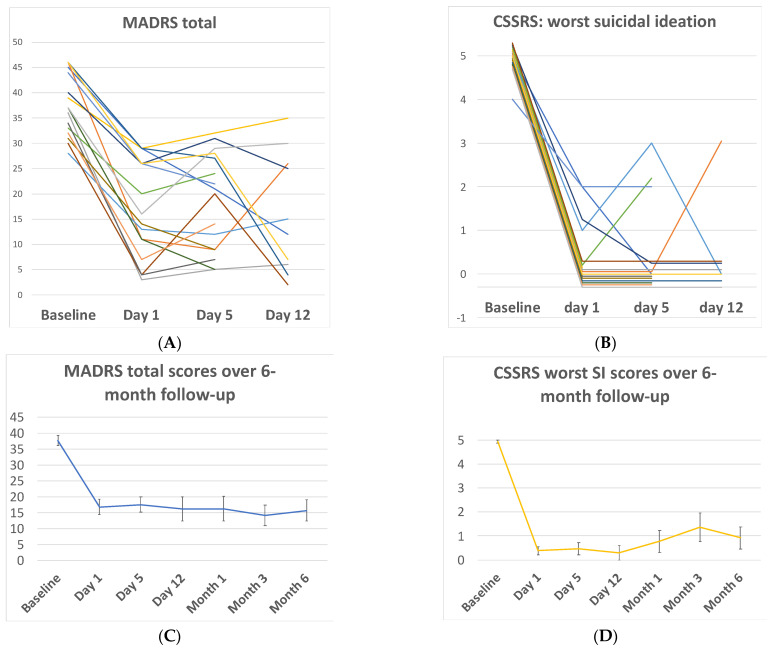
Ketamine, in research settings, rapidly reduces suicidal thoughts 2-24 h after a single infusion in patients with high suicidal ideation. In this study, the authors investigate ketamine's effects on suicidality in a real-world sample of recent suicide attempters on a tertiary-care Consultation-Liaison (CL) psychiatry service. Using an open-label design, 16 transdiagnostic CL patients were recruited, 18-65 years old, to receive a single dose of intravenous ketamine (0.5 mg/kg) in the acute medical setting. All were psychiatrically hospitalized post-infusion. Baseline suicidality and depression measures were compared to ratings taken at 24 h, 5 days, 12 days, and 1, 3 and 6 months post-infusion using paired t-tests. Across all measures, rapid, statistically significant decreases (p's < 0.001) were observed with large to very large effect sizes (Cohen's d's: 1.7-8.8) at acute timepoints (24 h; 5 days). These gains were uniformly maintained to 6 months post-infusion. Open-label ketamine appeared to rapidly and robustly reduced suicidal symptoms in an ultra-high-risk, heterogeneous, real-world sample. Ketamine infusion may therefore be a safe, feasible, viable method to rapidly reduce suicidality among medically hospitalized patients after a suicide attempt, with potentially enduring benefits. The current pilot findings suggest ketamine could be readily integrated into the settings where high-risk CL patients already receive healthcare, with the potential to become an important and novel tool in the treatment of suicidality.
Keywords: consultation-liaison psychiatry; intravenous ketamine; medical toxicology; suicidal ideation; suicide; suicide attempt; tertiary care.
Conflict of interest statement
The authors declare no conflict of interest.
Figures

References
-
- World Health Organization Suicide. Updated 17 June 2021. [(accessed on 3 October 2022)]. Available online: https://www.who.int/news-room/fact-sheets/detail/suicide.
-
- Centers for Disease Control and Prevention Suicide Data and Statistics. Updated 28 June 2022. [(accessed on 3 October 2022)]; Available online: https://www.cdc.gov/suicide/suicide-data-statistics.html.
Publication types
MeSH terms
Substances
LinkOut - more resources
Full Text Sources
Medical
