. 2022 Oct 26;19(21):13902.
doi: 10.3390/ijerph192113902.

Effectiveness of COVID-19 Vaccination on Reduction of Hospitalizations and Deaths in Elderly Patients in Rio Grande do Norte, Brazil

Affiliations

Effectiveness of COVID-19 Vaccination on Reduction of Hospitalizations and Deaths in Elderly Patients in Rio Grande do Norte, Brazil

Ana Isabela L Sales-Moioli et al. Int J Environ Res Public Health. .

Abstract

Since the COVID-19 pandemic emerged, vaccination has been the core strategy to mitigate the spread of SARS-CoV-2 in humans. This paper analyzes the impact of COVID-19 vaccination on hospitalizations and deaths in the state of Rio Grande do Norte, Brazil. We analyzed data from 23,516 hospitalized COVID-19 patients diagnosed between April 2020 and August 2021. We excluded the data from patients hospitalized through direct occupancy, unknown outcomes, and unconfirmed COVID-19 cases, resulting in data from 12,635 patients cross-referenced with the immunization status during hospitalization. Our results indicated that administering at least one dose of the immunizers was sufficient to significantly reduce the occurrence of moderate and severe COVID-19 cases among patients under 59 years. Considering the partially or fully immunized patients, the mean age is similar between the analyzed groups, despite the occurrence of comorbidities and higher than that observed among not immunized patients. Thus, immunized patients present lower Unified Score for Prioritization (USP) levels when diagnosed with COVID-19. Our data suggest that COVID-19 vaccination significantly reduced the hospitalization and death of elderly patients (60+ years) after administration of at least one dose. Comorbidities do not change the mean age of moderate/severe COVID-19 cases and the days required for the hospitalization of these patients.

Keywords: COVID-19; effectiveness; hospitalization; immunization.


Conflict of interest statement

The authors declare no conflict of interest.

Figures
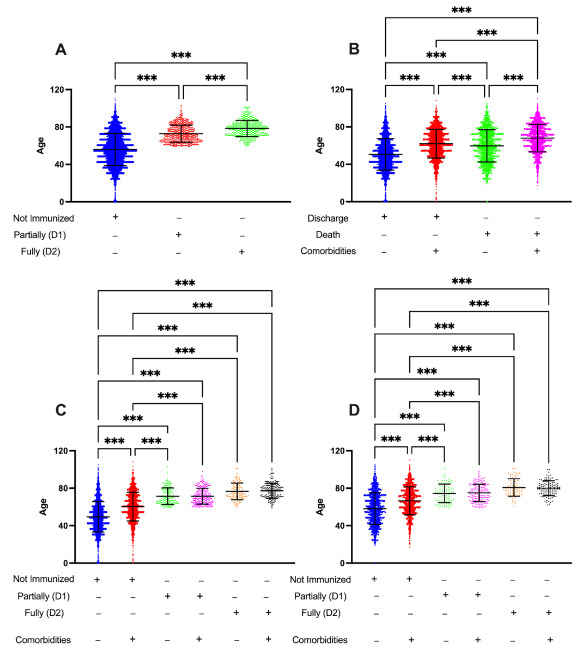
Figure 1
Figure 1
General overview of all analyzed patients according to their age, comorbidities, outcomes, and immunization status. Considering the hospitalizations of moderate and severe COVID-19 cases between April 2020 and August 2021, we analyzed data from 23,516 patients and excluded those hospitalized through direct occupancy, with unknown outcomes, or patients with an unconfirmed COVID-19 case. Based on these criteria, data from 12,635 hospitalized patients were analyzed and cross-referenced with vaccination data. (A) Age of hospitalized patients according to their immunization status; (B) Age distribution of hospitalized patients according to their outcome and comorbidities; (C) Age distribution of discharged patients considering their immunization status and existence of comorbidities; (D) Age distribution of lethal cases considering their immunization status and existence of comorbidities. The statistical analysis was performed using the Kruskal–Wallis test for group comparison and Dunn’s test to perform multiple comparisons. The results are shown as the mean ± standard deviation (*** p < 0.001).
Figure 2
Figure 2
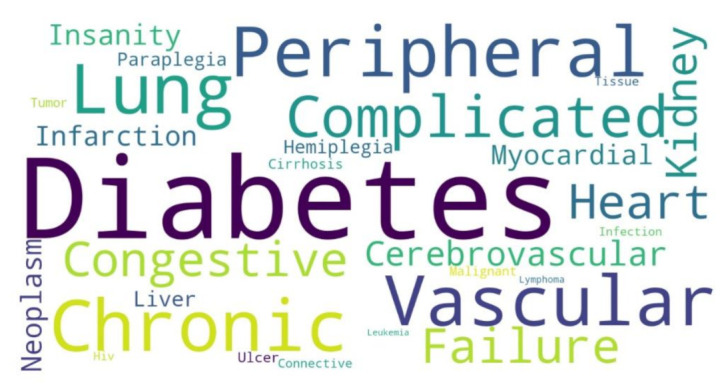
Word cloud of the main comorbidities reported among moderate and severe COVID-19 hospitalizations. Based on RegulaRN data, we identify and analyze the main comorbidities reported on the medical records of each patient. Every comorbidity reported was translated from Portuguese to English and inserted into the word cloud library in Python to generate the word cloud.
Figure 3
Figure 3
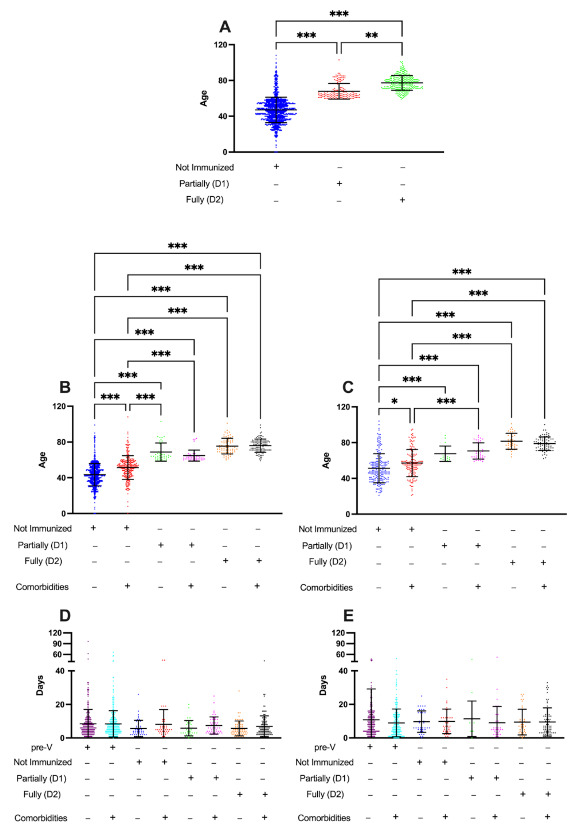
Profile of discharged patients and lethal outcomes related to COVID-19 before and after vaccination. Considering the pre-vaccination (June to August 2020, pre-V) and post-vaccination (June to August 2021, post-v) period, we analyzed the impact of immunization on the profile of hospitalizations and deaths of NI; partially (D1) or fully immunized (D2) patients. (A) Hospitalizations related to COVID-19 during the post-V period; (B) Profile of discharged patients considering their immunization status and existence of comorbidities; (C) Profile of lethal cases considering their immunization status and comorbidities; (D) Days required since admission to hospitalization discharge of moderate/severe COVID-19 patients considering their immunization status and the existence of comorbidities; (E) Days required since admission to lethal outcome of moderate/severe COVID-19 patients considering their immunization status and the existence of comorbidities. The statistical analysis was performed using the Kruskal–Wallis test for group comparison and Dunn’s test to perform multiple comparisons. The results are shown as the mean ± standard deviation (* p < 0.05; ** p < 0.005; *** p < 0.001).
Figure 4
Figure 4
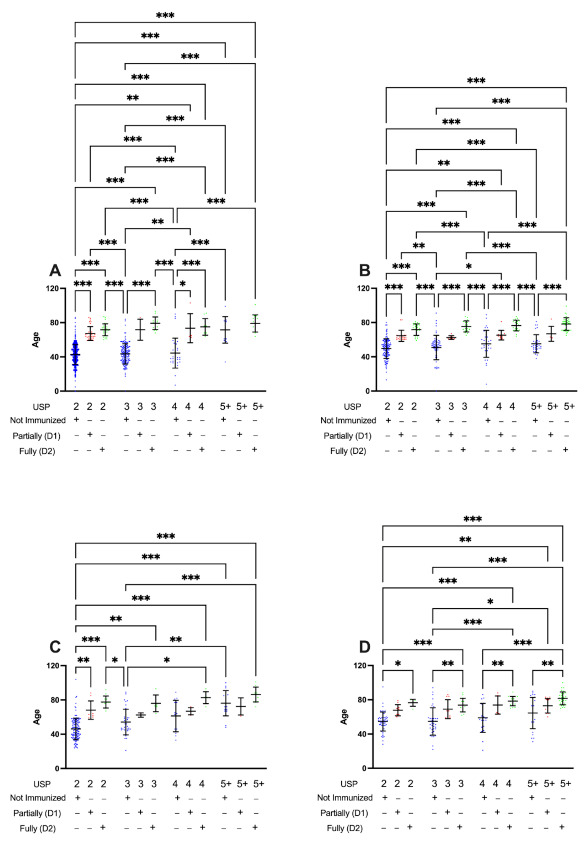
Profile of hospitalization post-vaccination and their influence on the Unified Score for Prioritization (USP). Patients between June and August 2021 were grouped according to their outcome, immunization status, and the existence of comorbidities. (A) Discharged patients without comorbidities; (B) Discharged patients with comorbidities; (C) Lethal cases without comorbidities; (D) Lethal cases with comorbidities. The statistical analysis was performed using the Kruskal–Wallis test for group comparison and Dunn’s test to perform multiple comparisons. The results are shown as the mean ± standard deviation (* p < 0.05; ** p < 0.005; *** p < 0.001).

References

    1. World Health Organization . WHO Director-General’s Opening Remarks at the Media Briefing on COVID-19—11 March 2020. World Health Organization; Geneva, Switzerland: 2020. [(accessed on 22 April 2022)]. Available online: https://www.who.int/director-general/speeches/detail/who-director-genera....
    1. Huang C., Wang Y., Li X., Ren L., Zhao J., Hu Y., Zhang L., Fan G., Xu J., Gu X., et al. Clinical Features of Patients Infected with 2019 Novel Coronavirus in Wuhan, China. Lancet. 2020;395:497–506. doi: 10.1016/S0140-6736(20)30183-5. - DOI - PMC - PubMed
    1. Lai C.-C., Shih T.-P., Ko W.-C., Tang H.-J., Hsueh P.-R. Severe Acute Respiratory Syndrome Coronavirus 2 (SARS-CoV-2) and Coronavirus Disease-2019 (COVID-19): The Epidemic and the Challenges. Int. J. Antimicrob. Agents. 2020;55:105924. doi: 10.1016/j.ijantimicag.2020.105924. - DOI - PMC - PubMed
    1. Chung J.Y., Thone M.N., Kwon Y.J. COVID-19 Vaccines: The Status and Perspectives in Delivery Points of View. Adv. Drug Deliv. Rev. 2021;170:1–25. doi: 10.1016/j.addr.2020.12.011. - DOI - PMC - PubMed
    1. NIH ClinicalTrials.Gov. [(accessed on 22 April 2022)]; Available online: https://clinicaltrials.gov/ct2/results?cond=COVID-19&term=Vaccine&cntry=....

Publication types

Substances