


Serious Injury in Metropolitan and Regional Victoria: Exploring Travel to Treatment and Utilisation of Post-Discharge Health Services by Injury Type
- PMID: 36360940
- PMCID: PMC9657338
- DOI: 10.3390/ijerph192114063
Serious Injury in Metropolitan and Regional Victoria: Exploring Travel to Treatment and Utilisation of Post-Discharge Health Services by Injury Type
Abstract
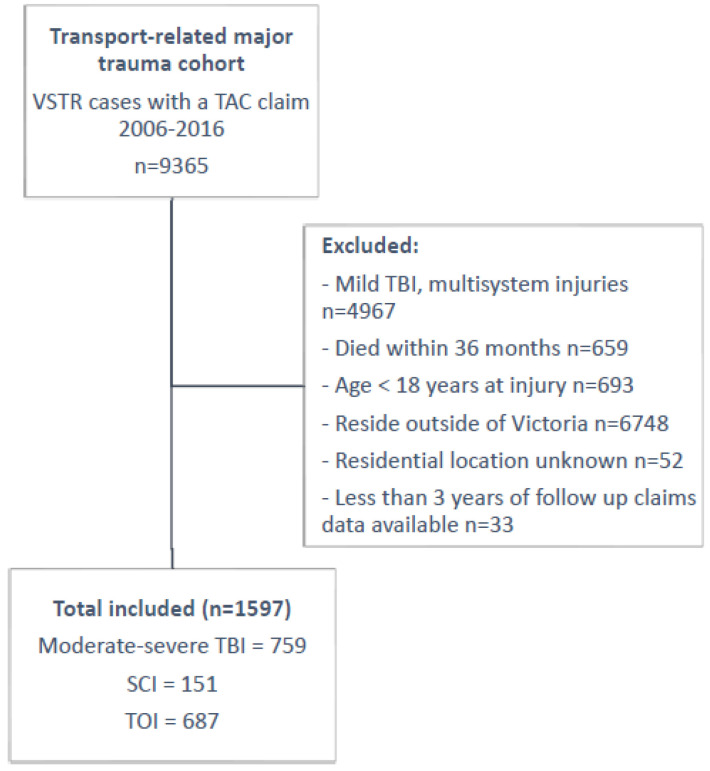
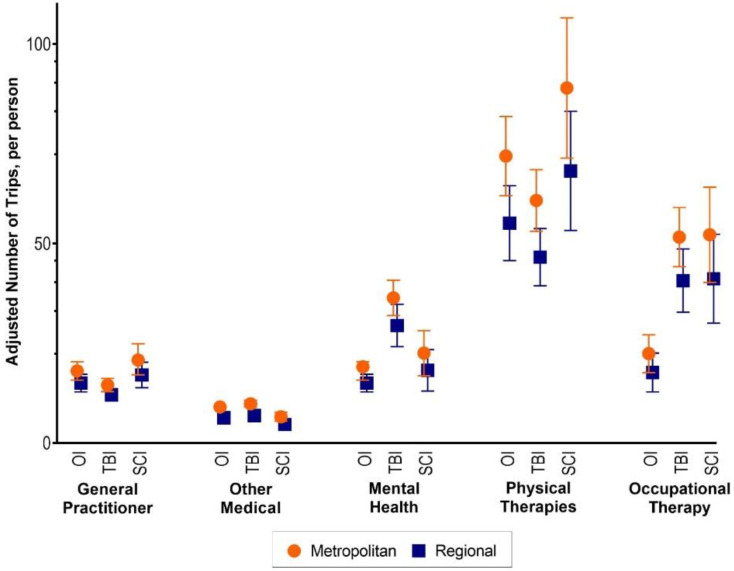
This study aimed to describe regional variations in service use and distance travelled to post-discharge health services in the first three years following hospital discharge for people with transport-related orthopaedic, brain, and spinal cord injuries. Using linked data from the Victorian State Trauma Registry (VSTR) and Transport Accident Commission (TAC), we identified 1597 people who had sustained transport-related orthopaedic, brain, or spinal cord injuries between 2006 and 2016 that met the study inclusion criteria. The adjusted odds of GP service use for regional participants were 76% higher than for metropolitan participants in the orthopaedic and traumatic brain injury (TBI) groups. People with spinal cord injury (SCI) living in regional areas had 72% lower adjusted odds of accessing mental health, 76% lower adjusted odds of accessing OT services, and 82% lower adjusted odds of accessing physical therapies compared with people living in major cities. People with a TBI living in regional areas on average travelled significantly further to access all post-discharge health services compared with people with TBI in major cities. For visits to medical services, the median trip distance for regional participants was 76.61 km (95%CI: 16.01-132.21) for orthopaedic injuries, 104.05 km (95% CI: 51.55-182.78) for TBI, and 68.70 km (95%CI: 8.34-139.84) for SCI. Disparities in service use and distance travelled to health services exist between metropolitan Melbourne and regional Victoria following serious injury.
Keywords: access to healthcare; geography; healthcare utilisation; orthopaedic injury; road trauma; serious injury; spinal cord injury; traumatic brain injury.
Conflict of interest statement
The authors declare no conflict of interest. The funders had no role in the design of the study; in the collection, analyses, or interpretation of data; in the writing of the manuscript; or in the decision to publish the results.
Figures




References
-
- World Health Organization . World Health Organization Global Burden of Disease. World Health Organization; Geneva, Switzerland: 2007.
-
- Gabbe B.J., Simpson P.M., Cameron P.A., Ponsford J., Lyons R.A., Collie A., Harrison J.E., Ameratunga S., Nunn A., Braaf S., et al. Long-term health status and trajectories of seriously injured patients: A population-based longitudinal study. PLoS Med. 2017;14:e1002322. doi: 10.1371/journal.pmed.1002322. - DOI - PMC - PubMed
Publication types
MeSH terms
LinkOut - more resources
Full Text Sources
Medical
Miscellaneous
