


Biomass Smoke Exposure and Atopy among Young Children in the Western Highlands of Guatemala: A Prospective Cohort Study
- PMID: 36360942
- PMCID: PMC9656762
- DOI: 10.3390/ijerph192114064
Biomass Smoke Exposure and Atopy among Young Children in the Western Highlands of Guatemala: A Prospective Cohort Study
Abstract
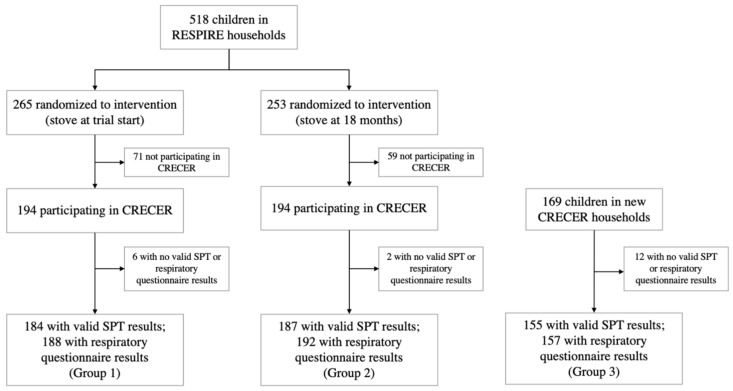
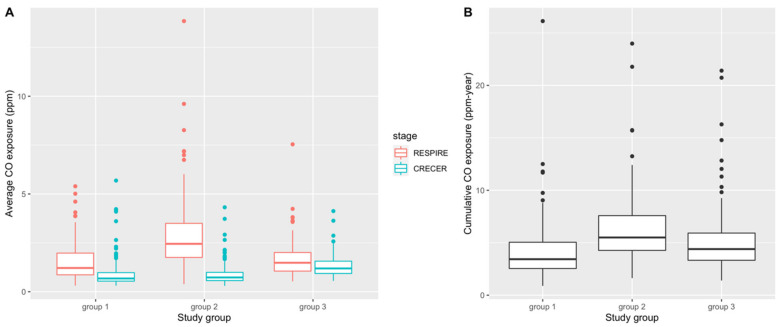
Women and children in rural regions of low-income countries are exposed to high levels of household air pollution (HAP) as they traditionally tend to household chores such as cooking with biomass fuels. Early life exposure to air pollution is associated with aeroallergen sensitization and developing allergic diseases at older ages. This prospective cohort study assigned HAP-reducing chimney stoves to 557 households in rural Guatemala at different ages of the study children. The children's air pollution exposure was measured using personal CO diffusion tubes. Allergic outcomes at 4-5 years old were assessed using skin prick tests and International Study of Asthma and Allergies in Childhood (ISAAC)-based questionnaires. Children assigned to improved stoves before 6 months old had the lowest HAP exposure compared to the other groups. Longer exposure to the unimproved stoves was associated with higher risks of maternal-reported allergic asthma (OR = 2.42, 95% CI: 1.11-5.48) and rhinitis symptoms (OR = 2.01, 95% CI: 1.13-3.58). No significant association was found for sensitization to common allergens such as dust mites and cockroaches based on skin prick tests. Reducing HAP by improving biomass burning conditions might be beneficial in preventing allergic diseases among children in rural low-income populations.
Keywords: CRECER study; allergy; asthma; biomass smoke; child health; eczema; household air pollution; rhinitis.
Conflict of interest statement
The authors declare no conflict of interest. The funders had no role in the design of the study; in the collection, analyses, or interpretation of data; in the writing of the manuscript; or in the decision to publish the results.
Figures
References
-
- World Health Organization (WHO) Household Air Pollution and Health. [(accessed on 28 July 2022)]. Available online: https://www.who.int/news-room/fact-sheets/detail/household-air-pollution....
-
- Lee K.K., Bing R., Kiang J., Bashir S., Spath N., Stelzle D., Mortimer K., Bularga A., Doudesis D., Joshi S.S., et al. Adverse health effects associated with household air pollution: A systematic review, meta-analysis, and burden estimation study. Lancet Glob. Health. 2020;8:e1427–e1434. doi: 10.1016/S2214-109X(20)30343-0. - DOI - PMC - PubMed
-
- Gordon S.B., Bruce N.G., Grigg J., Hibberd P.L., Kurmi O.P., Lam K.B., Mortimer K., Asante K.P., Balakrishnan K., Balmes J., et al. Respiratory risks from household air pollution in low and middle income countries. Lancet Respir. Med. 2014;2:823–860. doi: 10.1016/S2213-2600(14)70168-7. - DOI - PMC - PubMed
