. 2022 Oct 28;23(21):13098.
doi: 10.3390/ijms232113098.

Dual Inhibitors of AChE and BACE-1 for Reducing Aβ in Alzheimer's Disease: From In Silico to In Vivo

Affiliations

Dual Inhibitors of AChE and BACE-1 for Reducing Aβ in Alzheimer's Disease: From In Silico to In Vivo

Noa Stern et al. Int J Mol Sci. .

Abstract

Alzheimer's disease (AD) is a complex and widespread condition, still not fully understood and with no cure yet. Amyloid beta (Aβ) peptide is suspected to be a major cause of AD, and therefore, simultaneously blocking its formation and aggregation by inhibition of the enzymes BACE-1 (β-secretase) and AChE (acetylcholinesterase) by a single inhibitor may be an effective therapeutic approach, as compared to blocking one of these targets or by combining two drugs, one for each of these targets. We used our ISE algorithm to model each of the AChE peripheral site inhibitors and BACE-1 inhibitors, on the basis of published data, and constructed classification models for each. Subsequently, we screened large molecular databases with both models. Top scored molecules were docked into AChE and BACE-1 crystal structures, and 36 Molecules with the best weighted scores (based on ISE indexes and docking results) were sent for inhibition studies on the two enzymes. Two of them inhibited both AChE (IC50 between 4-7 μM) and BACE-1 (IC50 between 50-65 μM). Two additional molecules inhibited only AChE, and another two molecules inhibited only BACE-1. Preliminary testing of inhibition by F681-0222 (molecule 2) on APPswe/PS1dE9 transgenic mice shows a reduction in brain tissue of soluble Aβ42.

Keywords: acetylcholinesterase (AChE); amyloid beta; dual inhibitors; enzyme inhibition; in silico; in vitro; in vivo; multi-targeting; β-secretase (BACE-1).


Conflict of interest statement

All authors declare no conflict of interest.

Figures
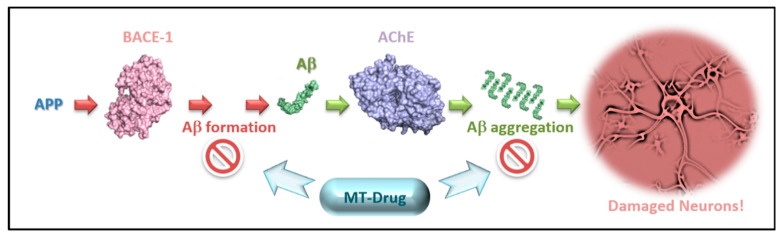
Figure 1
Figure 1
A MT (multi-targeted) drug could bind to both targets, BACE-1 (pink colored) and AChE (violet colored), so the two processes: Aβ peptide (green colored) formation from APP and Aβ aggregation. would be blocked. Additionally, by blocking AChE in the PAS, the level of non-hydrolyzed acetylcholine neurotransmitter would rise, thus, improving cholinergic activity simultaneously with the reduction in aggregation. The protein illustrations were made with Pymol software, Schrödinger and the PDB structure codes: 4M0F (AChE), 4DJW (BACE-1) and 1IYT (Aβ42).
Figure 2
Figure 2
Research workflow: After the creation of ISE models for AChE and for BACE-1, large databases (Section 1.4) were screened by the models’ filters and 682 molecules had top scores in both. These molecules were docked by FlexX and were given weighted scores based on both the docking results and on ISE indexes (Supplementary Excel File, Table S10E). The 177 molecules with the highest weighted scores (Supplementary Excel File, Table S14E) were filtered again by calculated logP and visual inspection to obtain the final 66 molecules (Supplementary Excel File, Table S15E) of which 36 were purchased and sent for testing inhibitions of AChE and of BACE-1 (Supplementary Excel File, Table S16E). Six molecules inhibited either AChE or BACE-1, and two of them inhibited both enzymes (Supplementary Excel File, Table S17E). Details of the in vitro tests are given in Section 2.4 below and the results are presented in Supplementary Excel File, Tables S16E and S17E.
Figure 3
Figure 3
BACE-1 superimposed structures 2G94 (cyan) and 4DJW (pink) in closed and open conformations, respectively. (A) the whole enzyme. (B) An enlargement of the flap region with its residues that have the largest RMSD values (these are the same residues, but with different numbering in PDB structures 70–73 or 131–134). (C) ligands in the binding site: 2G94 peptidomimetic ligand in light blue, 4DJW aminohydantoin ligand in pink. The illustration was made with Maestro 11.0, Schrödinger.
Figure 4
Figure 4
The six hit compounds.
Figure 5
Figure 5
Decrease in Aβ42 level in the brains of mice. In blue—control TG = transgene mice; In orange—tested compound, 2.
Figure 6
Figure 6
(A) The interactions of the dual hit, 3, (F681-0412), with binding site residues in AChE (created with MOE2011). All the important AChE residues are present and in close contacts with the ligand. Non-polar residues are colored green, polar residues are colored light purple, acidic residues are further annotated by a red ring. A hydrogen bond is marked with an arrow, and aromatic hydrocarbon interactions with H atom or a cation are marked as well. In addition to the H-bonds shown by arrows, the other residues interact with the ligand by VdW atom–atom interactions. Most of the residues mentioned in Section 2.2.5 and Supplementary Word File, Section 1.10, are shown in this figure. (B) A corresponding 3D pose of hit 3.
Figure 7
Figure 7
The interactions of hit molecule 2 with binding site residues of BACE-1 Asp93 deprotonated structure. Both of the catalytic aspartates form hydrogen bonds with the hit molecule.

References

    1. [(accessed on 31 January 2022)]; Available online: http://www.nia.nih.gov/alzheimers/topics/symptoms.
    1. Leon R., Garcia A.G., Marco-Contelles J. Recent advances in the multitarget-directed ligands approach for the treatment of Alzheimer’s disease. Med. Res. Res. Rev. 2013;33:139–189. doi: 10.1002/med.20248. - DOI - PubMed
    1. Plascencia-Villa G., Perry G. Status and future directions of clinical trials in Alzheimer’s disease. Int. Rev. Neurobiol. 2020;154:3–50. - PubMed
    1. Savelieff M.G., Nam G., Kang J., Lee H.J., Lee M., Lim M.H. Development of Multifunctional Molecules as Potential Therapeutic Candidates for Alzheimer’s Disease, Parkinson’s Disease, and Amyotrophic Lateral Sclerosis in the Last Decade. Chem. Rev. 2019;119:1221–1322. doi: 10.1021/acs.chemrev.8b00138. - DOI - PubMed
    1. Bortolami M., Rocco D., Messore A., Di Santo R., Costi R., Madia V.N., Scipione L., Pandolfi F. Acetylcholinesterase inhibitors for the treatment of Alzheimer’s disease—A patent review (2016–present) Expert Opin. Ther. Pat. 2021;31:399–420. doi: 10.1080/13543776.2021.1874344. - DOI - PubMed

MeSH terms

Substances
