


Effects of the Probiotic Enterococcus faecium on Muscle Characteristics of Chickens
- PMID: 36362850
- PMCID: PMC9696820
- DOI: 10.3390/life12111695
Effects of the Probiotic Enterococcus faecium on Muscle Characteristics of Chickens
Abstract
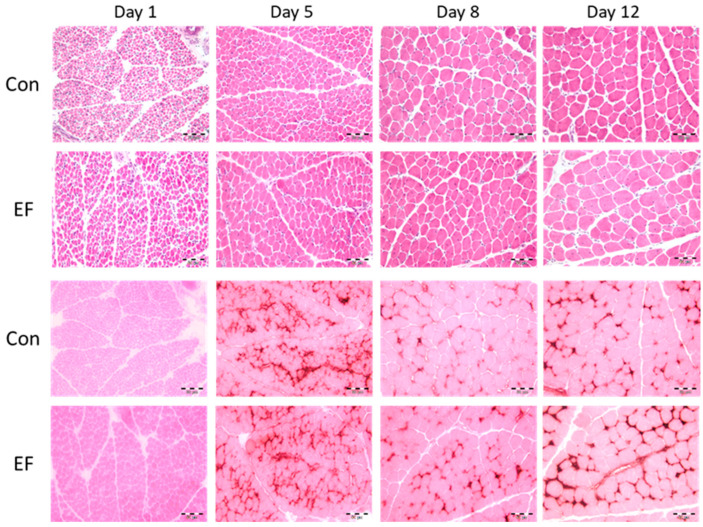
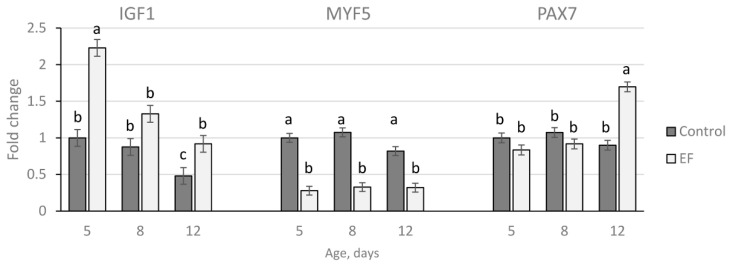
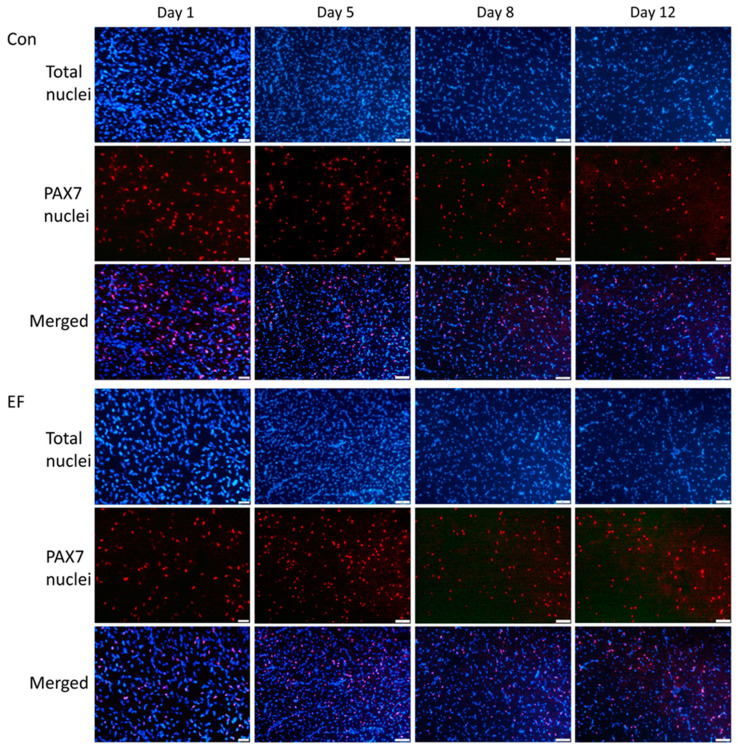
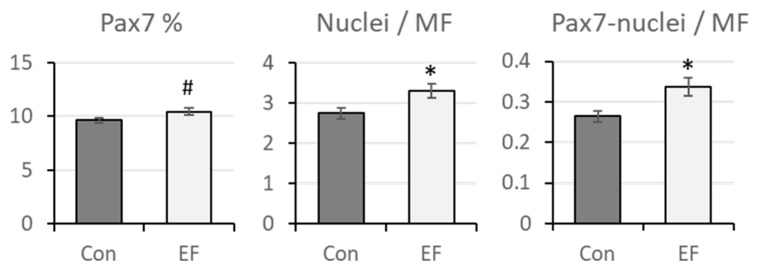
The use of antibiotics in farm animals is one of the main reasons for the development of resistant bacterial strains (e.g., zoonotic pathogens). Therefore, save alternatives are needed. Here, we examined how post-hatch application (day one to seven of life) of the probiotic Enterococcus faecium AL41 (EF) affects the development and tissue properties of the broiler pectoralis major muscle (PM). Expression of regulators, namely IGF-1, PAX7, and MYF5, was also investigated. At day 1 (n = 6), and days 5, 8, and 12 (n = 10), muscle samples were taken from control and EF supplemented chicks. From day 5 on, myonuclei number per fiber was elevated in EF chicks. Improved capillarization (from day 8), larger myofibers, increased body and PM weights (day 12) were found in the EF group. Part of our findings is explainable by higher intramuscular expression of IGF-1 and lower MYF5 expression in EF birds. In both groups IGF-1 expression decreases with age, thereby increasing the cellular myogenic potential. However, a strong increase in PAX7 expression and more PAX7-positive nuclei were found in EF chicks at day 12. We conclude that EF supplementation improves PM growth and health due to positive effects on bioavailability and fusion capacity of SATC progeny and better tissue perfusion.
Keywords: Enterococcus faecium; IGF-1; PAX7; antibiotics replacement; muscle tissue; myogenic regulatory factors; poultry; probiotics.
Conflict of interest statement
The authors declare no conflict of interest.
Figures
References
-
- Crhanova M., Hradecka H., Faldynova M., Matulova M., Havlickova H., Sisak F., Rychlik I. Immune response of chicken gut to natural colonization by gut microflora and to Salmonella enterica serovar Enteritidis infection. Infect. Immun. 2011;79:2755–2763. doi: 10.1128/IAI.01375-10. - DOI - PMC - PubMed
-
- Biloni A., Quintana C.F., Menconi A., Kallapura G., Latorre J., Pixley C., Layton S., Dalmagro M., Hernandez-Velasco X., Wolfenden A., et al. Evaluation of effects of EarlyBird associated with FloraMax-B11 on Salmonella Enteritidis, intestinal morphology, and performance of broiler chickens. Poult. Sci. 2013;92:2337–2346. doi: 10.3382/ps.2013-03279. - DOI - PubMed
Grants and funding
LinkOut - more resources
Full Text Sources
Miscellaneous
