. 2022 Nov 7;12(21):3918.
doi: 10.3390/nano12213918.

Co-Treatment of Caco-2 Cells with Doxorubicin and Gold Nanoparticles Produced from Cyclopia intermedia Extracts or Mangiferin Enhances Drug Effects

Affiliations

Co-Treatment of Caco-2 Cells with Doxorubicin and Gold Nanoparticles Produced from Cyclopia intermedia Extracts or Mangiferin Enhances Drug Effects

Jumoke A Aboyewa et al. Nanomaterials (Basel). .

Abstract

Mangiferin (MGF) is a natural and valuable polyphenol found in significant levels in many plant species, including Cyclopia intermedia (C. intermedia). In a previous study, we synthesized gold nanoparticles (AuNPs) using MGF and a water extract of C. intermedia and reported that these AuNPs have very low cytotoxicity toward a human colon cancer (Caco-2) cell line. Although the study also showed that these biogenic AuNPs in combination with doxorubic (DOX) significantly augmented the cytotoxic effects of DOX in Caco-2 cells, the mechanism of the enhanced effect was not fully understood, and it was also not known if other cell lines would be sensitive to this co-treatment. In the present study, we examined the cytotoxicity of the co-treatment in Caski, HeLa, HT-29, KMST-6 and MDA-321 cell lines. Additionally, we investigated the mechanistic effects of this co-treatment in Caco-2 cells using several assays, including the adenosine triphosphate (ATP), the oxidative stress, the mitochondrial depolarization, the colony formation, the APOPercentage and the DNA fragmentation assays. We also assessed the intracellular uptake of the biogenic AuNPs. The study showed that the biogenic AuNPs were effectively taken up by the cancer cells, which, in turn, may have enhanced the sensitivity of Caco-2 cells to DOX. Moreover, the combination of the biogenic AuNPs and DOX caused a rapid depletion of ATP levels, increased mitochondrial depolarization, induced apoptosis, reduced the production of reactive oxygen species (ROS) and inhibited the long-term survival of Caco-2 cells. Although the study provided some insight into the mechanism of cytotoxicity induced by the co-treatment, further mechanistic and molecular studies are required to fully elucidate the enhanced anticancer effect of the co-treatment.

Keywords: Cyclopia intermedia; DNA fragmentation; Mangiferin; apoptosis; gold nanoparticles; mitochondrial depolarization; nanoparticle uptake.


Conflict of interest statement

The authors declare no conflict of interest.

Figures
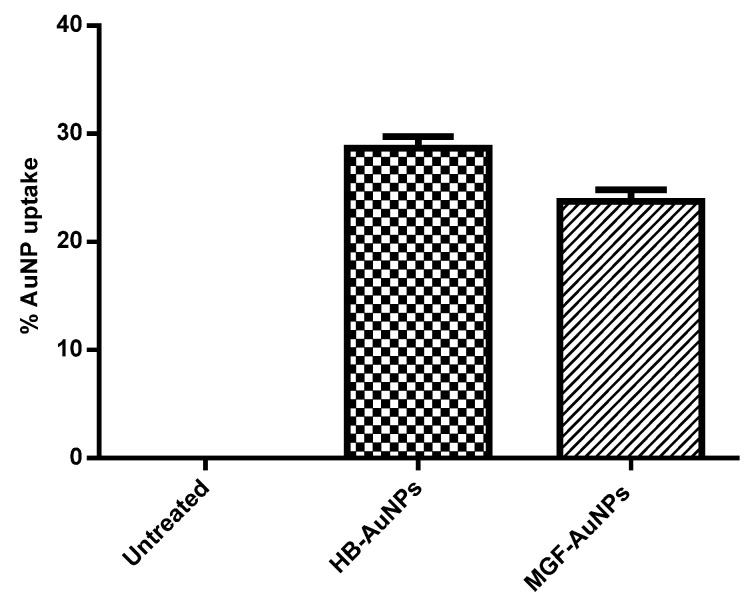
Figure 1
Figure 1
Cellular uptake of AuNPs in Caco-2 cells. Cells were treated for 12 h with HB-AuNPs or MGF-AuNPs, cell lysates were prepared after treatment and Au content within the lysates was determined with ICP-OES. Results are expressed as mean ± standard error of the mean (SEM).
Figure 2
Figure 2
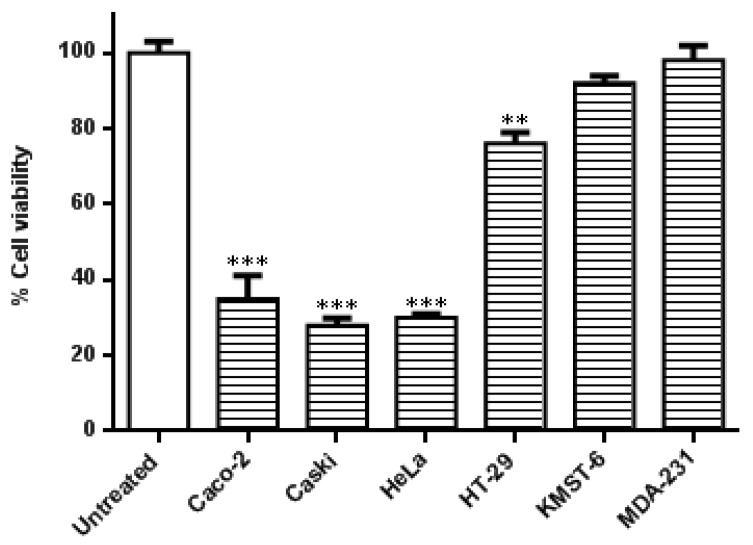
Effects of the co-treatment on the viability of different cell lines. Cells were treated with HB-AuNPs-DOX (1000 µg/mL HB-AuNPs and 1.56 µg/mL DOX) for 24 h, and the viability of the cells was assessed using an MTT assay. Results are expressed as mean ± standard error of the mean (SEM). Data were considered statistically significant if p < 0.05, *** p < 0.001, ** p < 0.01.
Figure 3
Figure 3
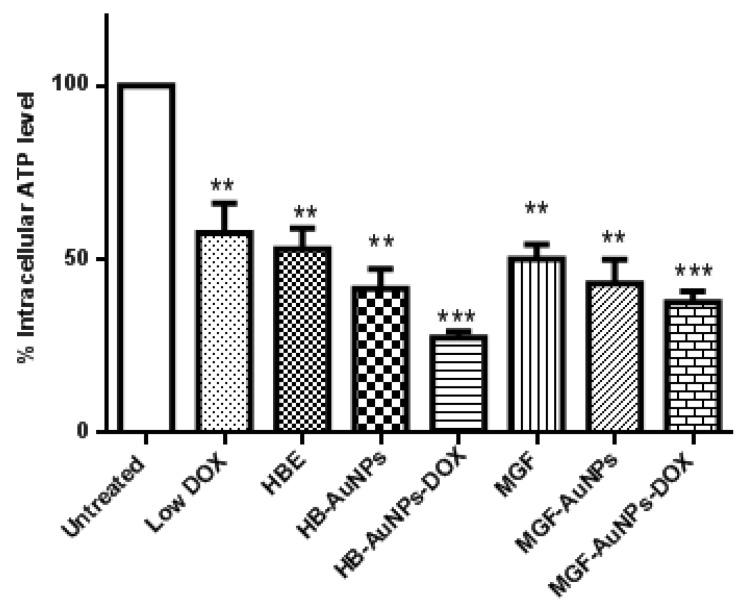
Effect of treatments on intracellular ATP levels in Caco-2 cells. Cells were treated with Low DOX (1.56 µg/mL), MGF (1000 µg/mL), HBE (1000 µg/mL), MGF-AuNPs (1000 µg/mL), HB-AuNPs (1000 µg/mL), MGF-AuNPs-DOX (1000 µg/mL MGF-AuNPs and 1.56 µg/mL DOX) and HB-AuNPs-DOX (1000 µg/mL HB-AuNPs and 1.56 µg/mL DOX). ATP levels were assessed using the Mitochondrial ToxGlo assay. Notes: Results are expressed as mean ± standard error of the mean (SEM). n = 3. Data were considered statistically significant if p < 0.05, *** p < 0.001, ** p < 0.01.
Figure 4
Figure 4
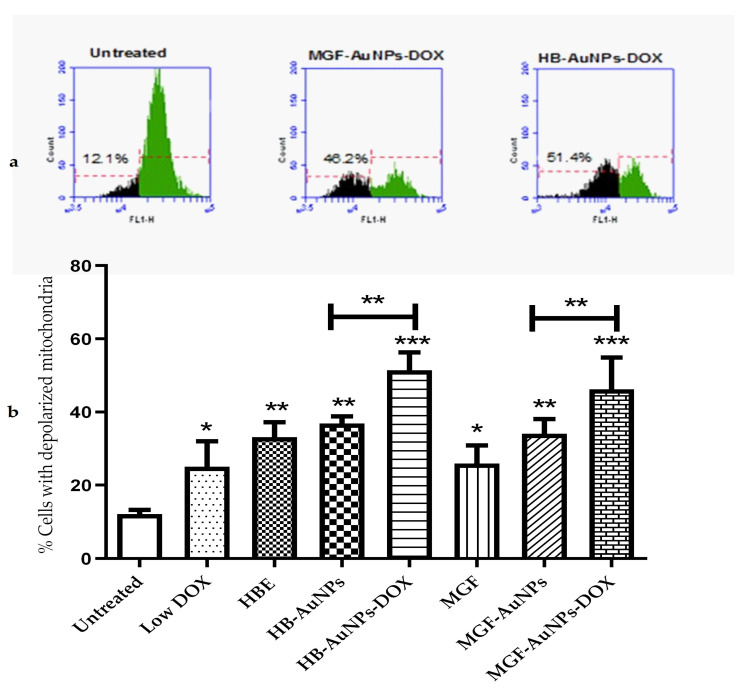
Effect of treatments on mitochondrial function. Caco-2 cells were treated with Low DOX (1.56 µg/mL), MGF (1000 µg/mL), HBE (1000 µg/mL), MGF-AuNPs (1000 µg/mL), HB-AuNPs (1000 µg/mL), MGF-AuNPs-DOX (1000 µg/mL MGF-AuNPs and 1.56 µg/mL DOX) and HB-AuNPs-DOX (1000 µg/mL HB-AuNPs and 1.56 µg/mL DOX). Mitochondrial membrane potential was assessed using a TMRE probe and flow cytometry. (a) shows the histograms of the relative fluorescence of cells left untreated, cells treated with MGF-AuNPs-DOX and HB-AuNPs-DOX; green indicates the cell population with normal mitochondrial membrane potential, and black indicates the cell population with reduced mitochondrial membrane potential; indicated on the histograms are the percentage of cells with depolarized mitochondria. (b) shows a bar graph, which summarizes the results for all the treatments. Results are expressed as mean ± standard error of the mean (SEM). Data were considered statistically significant if p < 0.05, *** p < 0.001, ** p < 0.01, * p < 0.05.
Figure 5
Figure 5
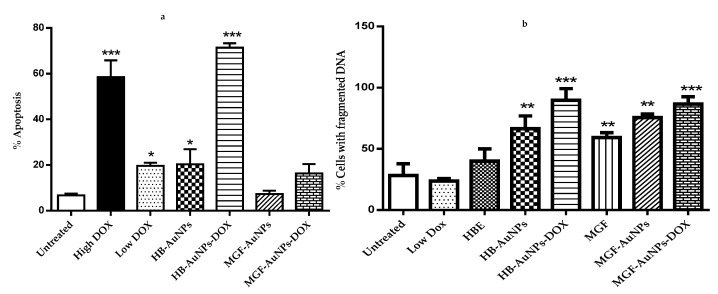
Effect of treatments on apoptosis and DNA fragmentation. Cells were treated with Low DOX (1.56 µg/mL), High DOX (7.8 µg/mL), HBE (1000 µg/mL), MGF (1000 µg/mL), MGF-AuNPs (1000 µg/mL), HB-AuNPs (1000 µg/mL), MGF-AuNPs-DOX (1000 µg/mL MGF-AuNPs and 1.56 µg/mL DOX) and HB-AuNPs-DOX (1000 µg/mL HB-AuNPs and 1.56 µg/mL DOX); (a) shows the results of apoptosis assessed using the APOPercentage assay and flow cytometry; (b) shows the results of the DNA fragmentation assay assessed using the APO-DIRECTTM assay and flow cytometry. Results are expressed as mean ± standard error of the mean (SEM). Data were considered statistically significant if p <0.05, *** p < 0.001, ** p < 0.01, * p < 0.05.
Figure 6
Figure 6
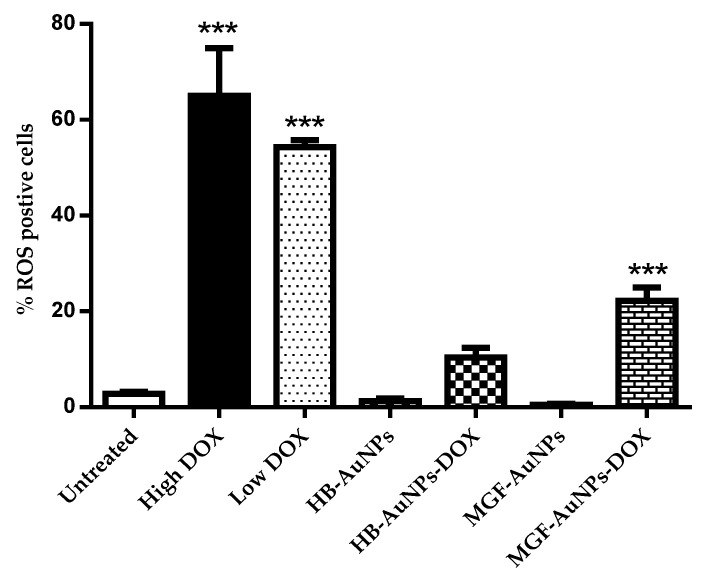
Effect of the treatments on ROS production. Caco-2 cells treated with Low DOX (1.56 µg/mL), High DOX, MGF-AuNPs (1000 µg/mL), HB-AuNPs (1000 µg/mL), MGF-AuNPs-DOX (1000 µg/mL MGF-AuNPs and 1.56 µg/mL DOX) and HB-AuNPs-DOX (1000 µg/mL HB-AuNPs and 1.56 µg/mL DOX) and the level of ROS production was assessed using the CM-H2DCFDA probe and flow cytometry. Results are expressed as mean ± standard error of the mean (SEM). Data were considered statistically significant if p < 0.05, *** p < 0.001.
Figure 7
Figure 7
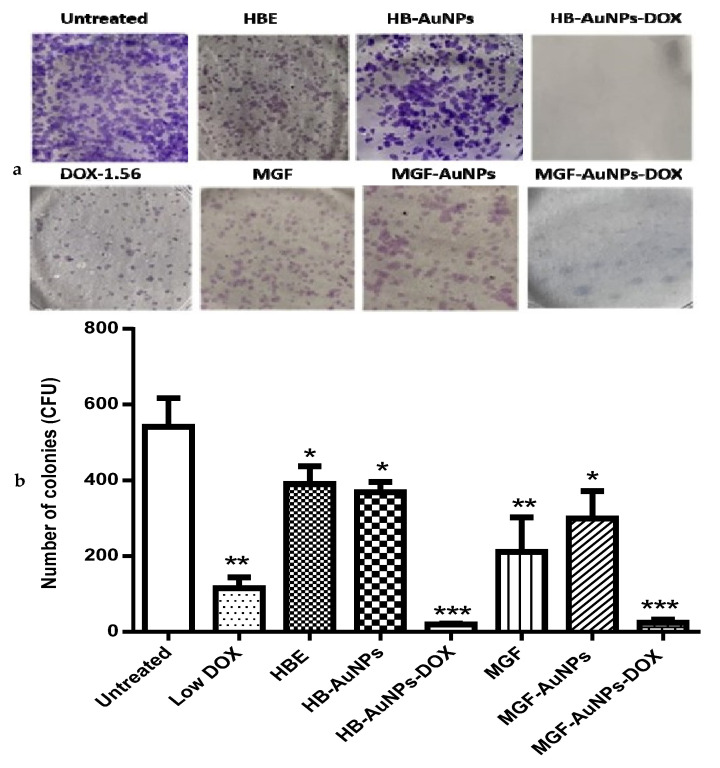
Effects of treatments on the long-term survival of Caco-2 cells. The clonogenic assay was used to assess the effects of Low DOX (1.56 µg/mL), MGF (1000 µg/mL), HBE (1000 µg/mL), MGF-AuNPs (1000 µg/mL), HB-AuNPs (1000 µg/mL), MGF-AuNPs-DOX (1000 µg/mL MGF-AuNPs and 1.56 µg/mL DOX) and HB-AuNPs-DOX (1000 µg/mL HB-AuNPs and 1.56 µg/mL DOX) on the long-term survival of the cells. After a 24 h treatment, cells were cultured in medium without treatments for 14 days. Surviving cells were stained crystal violet; (a) shows images of the colonies (in blue) that were present after 14 days; (b) shows a summary of the colonies counted. Results are expressed as mean ± standard error of the mean (SEM). Data were considered statistically significant if p < 0.05, *** p < 0.001, ** p < 0.01, * p < 0.05.

References

    1. Dehelean C.A., Marcovici I., Soica C., Mioc M., Coricovac D., Iurciuc S., Cretu O.M., Pinzaru I. Plant-Derived Anticancer Compounds as New Perspectives in Drug Discovery and Alternative Therapy. Molecules. 2021;26:1109. doi: 10.3390/molecules26041109. - DOI - PMC - PubMed
    1. Tinoush B., Shirdel I., Wink M. Phytochemicals: Potential Lead Molecules for MDR Reversal. Front. Pharmacol. 2020;11:832. doi: 10.3389/fphar.2020.00832. - DOI - PMC - PubMed
    1. Morozkina S.N., Nhung Vu T.H., Generalova Y.E., Snetkov P.P., Uspenskaya M.V. Mangiferin as New Potential Anti-Cancer Agent and Mangiferin-Integrated Polymer Systems—A Novel Research Direction. Biomolecules. 2021;11:79. doi: 10.3390/biom11010079. - DOI - PMC - PubMed
    1. Khurana R.K., Kaur R., Lohan S., Singh K.K., Singh B. Mangiferin: A Promising Anticancer Bioactive. Pharm. Pat. Anal. 2016;5:169–181. doi: 10.4155/ppa-2016-0003. - DOI - PubMed
    1. Rajendran P., Rengarajan T., Nandakumar N., Divya H., Nishigaki I. Mangiferin in Cancer Chemoprevention and Treatment: Pharmacokinetics and Molecular Targets. J. Recept. Signal Transduct. 2015;35:76–84. doi: 10.3109/10799893.2014.931431. - DOI - PubMed

LinkOut - more resources