


Cellular and Humoral SARS-CoV-2 Vaccination Responses in 192 Adult Recipients of Allogeneic Hematopoietic Cell Transplantation
- PMID: 36366291
- PMCID: PMC9699205
- DOI: 10.3390/vaccines10111782
Cellular and Humoral SARS-CoV-2 Vaccination Responses in 192 Adult Recipients of Allogeneic Hematopoietic Cell Transplantation
Abstract
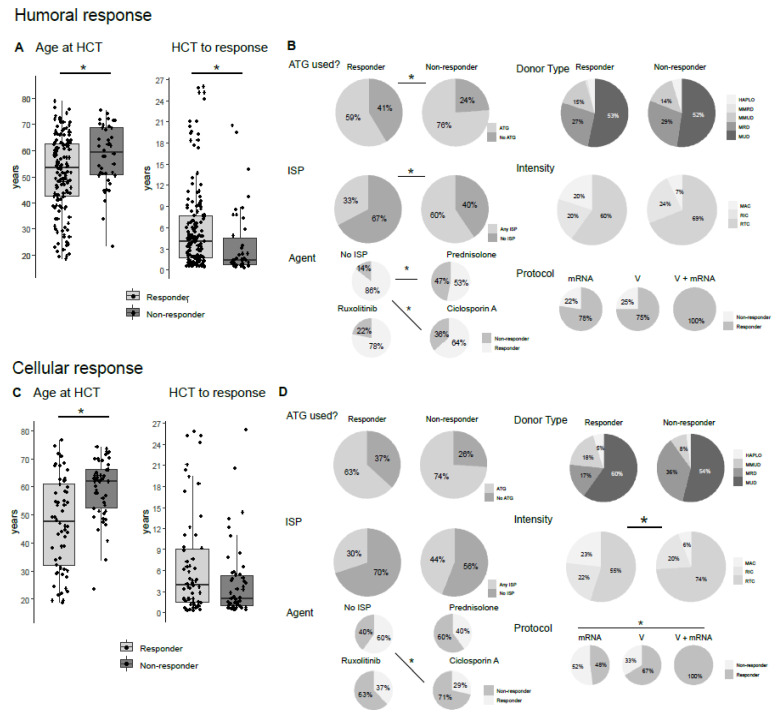
To determine factors influencing the vaccination response against SARS-CoV-2 is of importance in recipients of allogeneic hematopoietic cell transplantation (allo-HCT) as they display an increased mortality after SARS-CoV-2 infection, an increased risk of extended viral persistence and reduced vaccination response. Real-life data on anti-SARS-CoV-2-S1-IgG titers (n = 192) and IFN-γ release (n = 110) of allo-HCT recipients were obtained using commercially available, validated assays after vaccination with either mRNA (Comirnaty™, Pfizer-BioNTech™, NY, US and Mainz, Germany or Spikevax™, Moderna™, Cambridge, Massachusetts, US) or vector-based vaccines (Vaxzevria™,AstraZeneca™, Cambridge, UK or Janssen COVID-19 vaccine™Johnson/Johnson, New Brunswick, New Jersey, US), or after a heterologous protocol (vector/mRNA). Humoral response (78% response rate) was influenced by age, time after transplantation, the usage of antithymocyte globulin (ATG) and ongoing immunosuppression, specifically corticosteroids. High counts of B cells during the vaccination period correlated with a humoral response. Only half (55%) of participants showed a cellular vaccination response. It depended on age, time after transplantation, ongoing immunosuppression with ciclosporin A, chronic graft-versus-host disease (cGvHD) and vaccination type, with vector-based protocols favoring a response. Cellular response failure correlated with a higher CD8+ count and activated/HLA-DR+ T cells one year after transplantation. Our data provide the basis to assess both humoral and cellular responses after SARS-CoV2 vaccination in daily practice, thereby opening up the possibility to identify patients at risk.
Keywords: IFN-γ release assay (IGRA); SARS-CoV-2; allogeneic hematopoietic cell transplantation (allo-HCT); specific antibody titer.
Conflict of interest statement
The authors have nothing to disclose.
Figures
References
-
- Ljungman P., de la Camara R., Mikulska M., Tridello G., Aguado B., Zahrani M.A., Apperley J., Berceanu A., Bofarull R.M., Calbacho M., et al. COVID-19 and Stem Cell Transplantation; Results from an EBMT and GETH Multicenter Prospective Survey. Leukemia. 2021;35:2885–2894. doi: 10.1038/s41375-021-01302-5. - DOI - PMC - PubMed
-
- Sharma A., Bhatt N.S., St Martin A., Abid M.B., Bloomquist J., Chemaly R.F., Dandoy C., Gauthier J., Gowda L., Perales M.-A., et al. Clinical Characteristics and Outcomes of COVID-19 in Haematopoietic Stem-Cell Transplantation Recipients: An Observational Cohort Study. Lancet Haematol. 2021;8:e185–e193. doi: 10.1016/S2352-3026(20)30429-4. - DOI - PMC - PubMed
-
- Schaffrath J., Brummer C., Wolff D., Holtick U., Kröger N., Bornhäuser M., Kraus S., Hilgendorf I., Blau I.-W., Penack O., et al. High Mortality of COVID-19 Early after Allogeneic Stem Cell Transplantation—A Retrospective Multicenter Analysis on Behalf of the German Cooperative Transplant Study Group. Transplant. Cell. Ther. 2022;28:337.e1–337.e10. doi: 10.1016/j.jtct.2022.03.010. - DOI - PMC - PubMed
-
- Fendler A., Au L., Shepherd S.T.C., Byrne F., Cerrone M., Boos L.A., Rzeniewicz K., Gordon W., Shum B., Gerard C.L., et al. Functional Antibody and T Cell Immunity Following SARS-CoV-2 Infection, Including by Variants of Concern, in Patients with Cancer: The CAPTURE Study. Nat. Cancer. 2021;2:1321–1337. doi: 10.1038/s43018-021-00275-9. - DOI - PubMed
LinkOut - more resources
Full Text Sources
Research Materials
Miscellaneous
