


Heterologous Systemic Prime-Intranasal Boosting Using a Spore SARS-CoV-2 Vaccine Confers Mucosal Immunity and Cross-Reactive Antibodies in Mice as well as Protection in Hamsters
- PMID: 36366408
- PMCID: PMC9692796
- DOI: 10.3390/vaccines10111900
Heterologous Systemic Prime-Intranasal Boosting Using a Spore SARS-CoV-2 Vaccine Confers Mucosal Immunity and Cross-Reactive Antibodies in Mice as well as Protection in Hamsters
Abstract
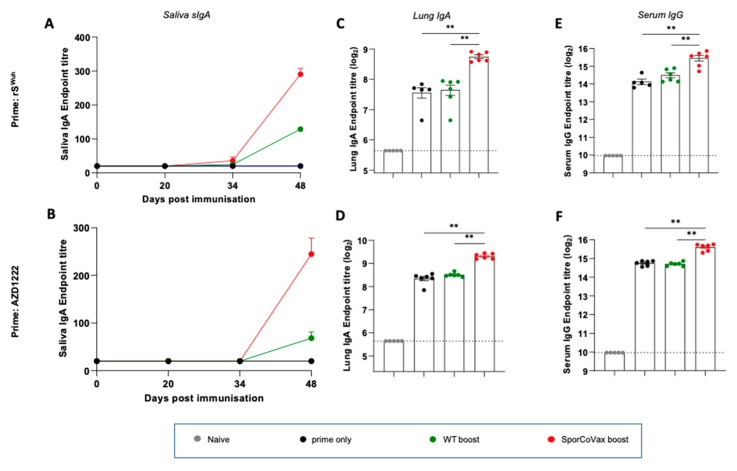
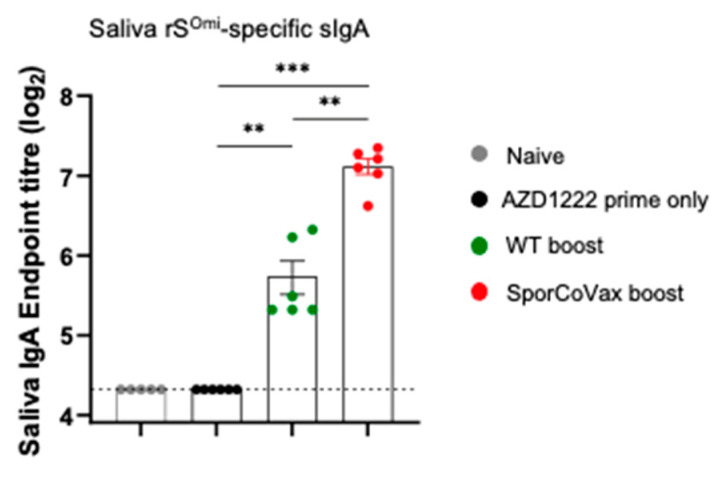
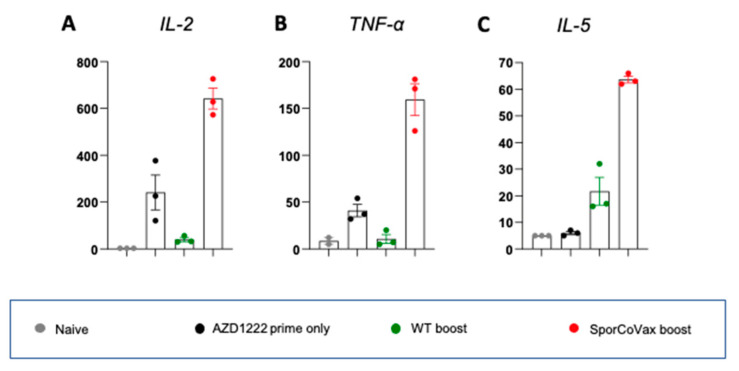
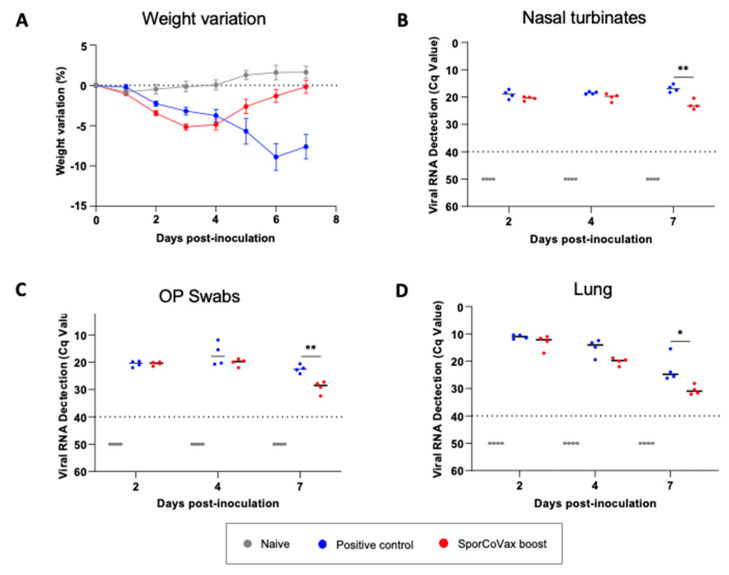
Background: Current severe acute respiratory syndrome coronavirus 2 (SARS-CoV-2) vaccines are administered systemically and typically result in poor immunogenicity at the mucosa. As a result, vaccination is unable to reduce viral shedding and transmission, ultimately failing to prevent infection. One possible solution is that of boosting a systemic vaccine via the nasal route resulting in mucosal immunity. Here, we have evaluated the potential of bacterial spores as an intranasal boost. Method: Spores engineered to express SARS-CoV-2 antigens were administered as an intranasal boost following a prime with either recombinant Spike protein or the Oxford AZD1222 vaccine. Results: In mice, intranasal boosting following a prime of either Spike or vaccine produced antigen-specific sIgA at the mucosa together with the increased production of Th1 and Th2 cytokines. In a hamster model of infection, the clinical and virological outcomes resulting from a SARS-CoV-2 challenge were ameliorated. Wuhan-specific sIgA were shown to cross-react with Omicron antigens, suggesting that this strategy might offer protection against SARS-CoV-2 variants of concern. Conclusions: Despite being a genetically modified organism, the spore vaccine platform is attractive since it offers biological containment, the rapid and cost-efficient production of vaccines together with heat stability. As such, employed in a heterologous systemic prime-mucosal boost regimen, spore vaccines might have utility for current and future emerging diseases.
Keywords: COVID-19; SARS-CoV-2; nasal vaccine; prime boost.
Conflict of interest statement
SMC is CEO of SporeGen Ltd., HAH is a shareholder of SporeGen Ltd.
Figures
References
-
- Brosh-Nissimov T., Orenbuch-Harroch E., Chowers M., Elbaz M., Nesher L., Stein M., Maor Y., Cohen R., Hussein K., Weinberger M., et al. BNT162b2 vaccine breakthrough: Clinical characteristics of 152 fully vaccinated hospitalized COVID-19 patients in Israel. Clin. Microbiol. Infect. 2021;27:1652–1657. doi: 10.1016/j.cmi.2021.06.036. - DOI - PMC - PubMed
-
- Farinholt T., Doddapaneni H., Qin X., Menon V., Meng Q., Metcalf G., Chao H., Gingras M.C., Avadhanula V., Farinholt P., et al. Transmission event of SARS-CoV-2 delta variant reveals multiple vaccine breakthrough infections. BMC Med. 2021;19:255. doi: 10.1186/s12916-021-02103-4. - DOI - PMC - PubMed
-
- Okuya K., Yoshida R., Manzoor R., Saito S., Suzuki T., Sasaki M., Saito T., Kida Y., Mori-Kajihara A., Kondoh T., et al. Potential Role of Nonneutralizing IgA Antibodies in Cross-Protective Immunity against Influenza A Viruses of Multiple Hemagglutinin Subtypes. J. Virol. 2020;94:e00408-20. doi: 10.1128/JVI.00408-20. - DOI - PMC - PubMed
Grants and funding
LinkOut - more resources
Full Text Sources
Research Materials
Miscellaneous
