. 2022 Oct 25;14(11):2348.
doi: 10.3390/v14112348.

In Silico Characterization of African Swine Fever Virus Nucleoprotein p10 Interaction with DNA

Affiliations

In Silico Characterization of African Swine Fever Virus Nucleoprotein p10 Interaction with DNA

Claudia Istrate et al. Viruses. .

Abstract

African swine fever virus (ASFV) is the etiological agent of a highly contagious, hemorrhagic infectious swine disease, with a tremendous sanitary and economic impact on a global scale. Currently, there are no globally available vaccines or treatments. The p10 protein, a structural nucleoprotein encoded by ASFV, has been previously described as capable of binding double-stranded DNA (dsDNA), which may have implications for viral replication. However, the molecular mechanism that governs this interaction is still unknown, mostly due to the lack of a structural model for this protein. In this work, we have generated an ab initio model of the p10 protein and performed extensive structural characterization, using molecular dynamics simulations to identify the motifs and residues regulating DNA recognition. The helix-turn-helix motif identified at the C-terminal region of the protein was shown to be crucial to the dsDNA-binding efficiency. As with other DNA-binding proteins, two distinct serine and lysine-rich regions found in the two helices were identified as key players in the binding to DNA, whose importance was later validated using experimental binding assays. Altogether, these findings may contribute to a better understanding of the p10 function in ASFV replication.

Keywords: African swine fever virus; DNA binding function; K78R; molecular dynamics; p10 protein.


Conflict of interest statement

The authors declare no conflict of interest.

Figures
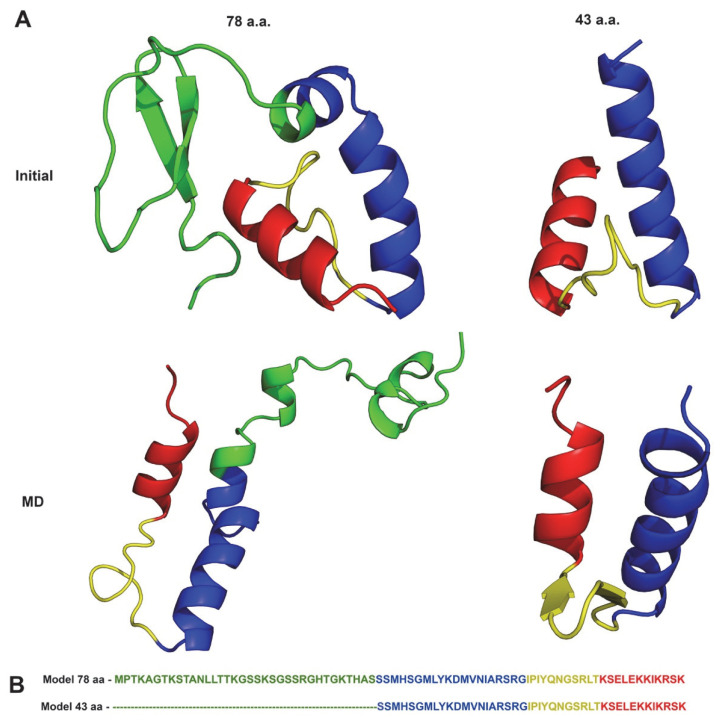
Figure 1
Figure 1
(A) Structural representation of the ab initio models (initial) and of the most representative (central) conformations obtained from MD simulations of wt:p10. (B) a.a. sequences of both models. The full and partial a.a. sequences of both models are colored with the same color scheme used in the structures.
Figure 2
Figure 2
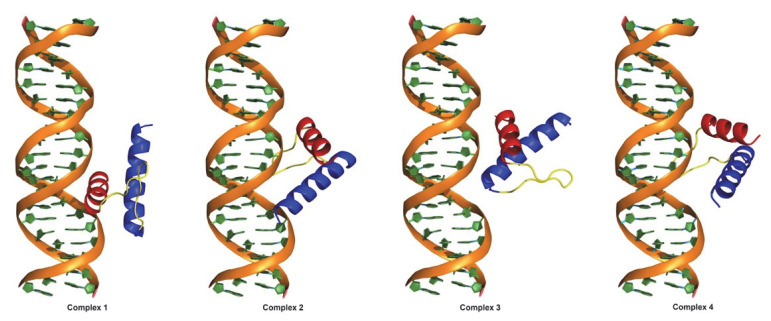
Starting configurations used in the wt:p10 MD simulations in complex with dsDNA.
Figure 3
Figure 3
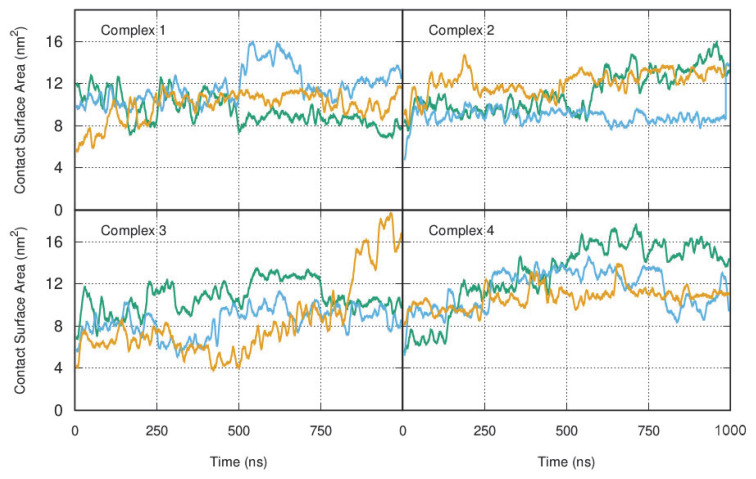
The contact surface area between wt:p10 and the dsDNA calculated for all MD simulations. Replicate 1, 2 and 3 from each simulated system is respectively colored in green, blue, and yellow.
Figure 4
Figure 4
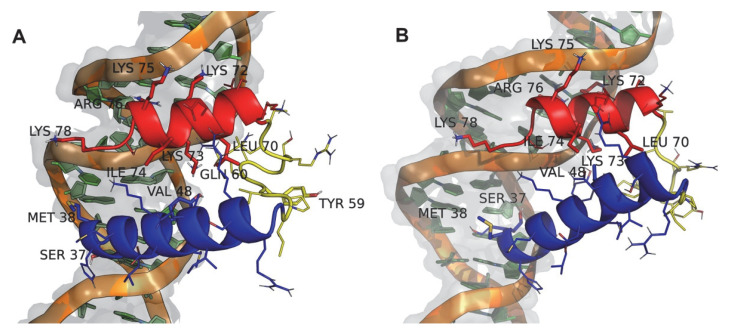
Representative structures of wt:p10/dsDNA from complex 2 (A) and 4 (B) systems. The wt:p10 protein is colored using the previously defined scheme (Figure 1). Residues from wt:p10 showing strong intramolecular and intermolecular interactions with dsDNA are represented as labeled thicker sticks.
Figure 5
Figure 5
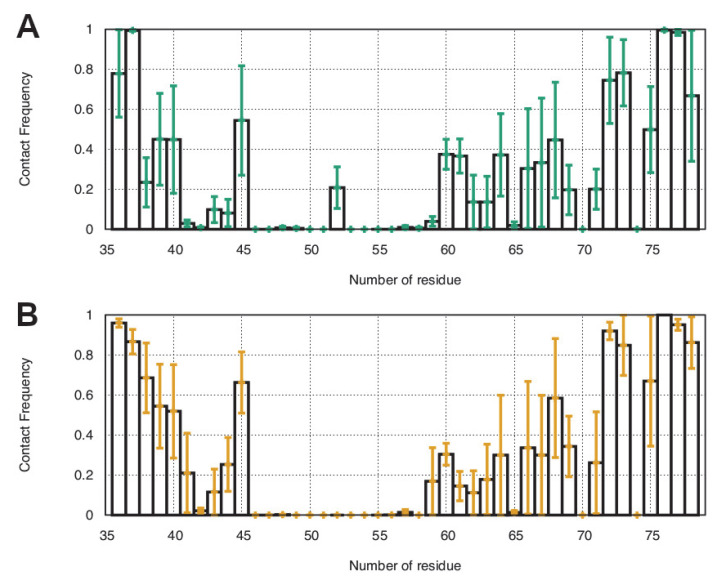
Contact frequency between each wt:p10 residue and the dsDNA in complexes 2 (A) and 4 (B). The standard errors of the mean between replicates were calculated and are highlighted with the green and yellow bars.
Figure 6
Figure 6
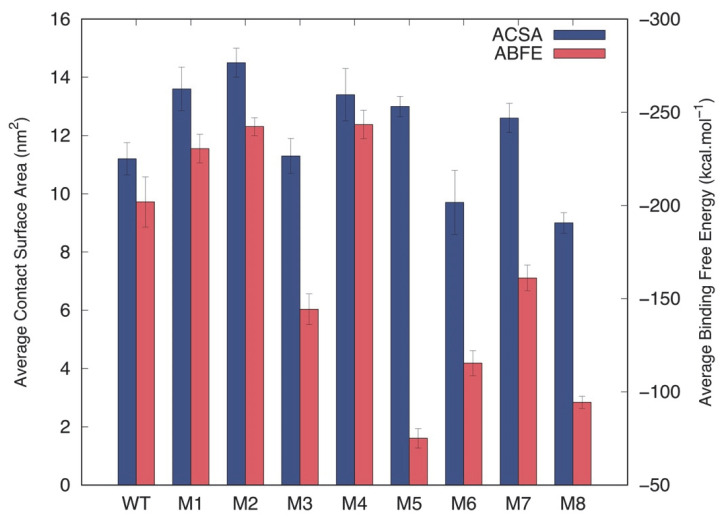
Average contact surface area (blue boxes) and average binding free energy (red boxes) between the wt:p10 and the evaluated mutants with the dsDNA.
Figure 7
Figure 7
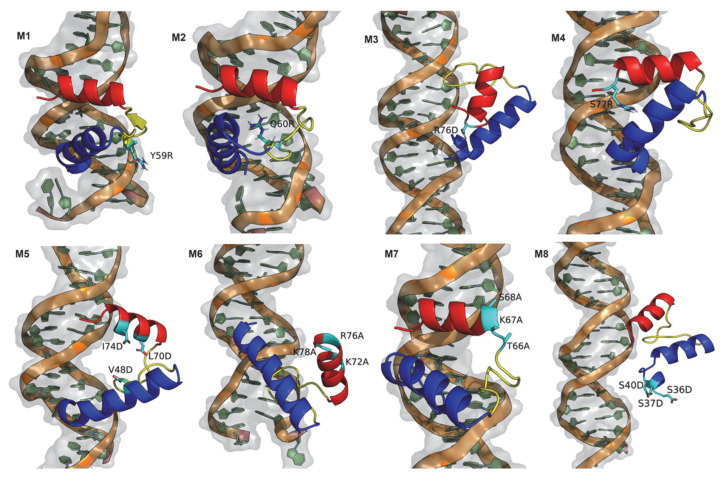
Representative structure from all evaluated mutation systems. p10 protein is colored according to the previously used color code: N-terminal helix in blue, the loop in yellow, and the C-terminal helix in red. The mutated labeled residues are identified as sticks, colored in cyan.
Figure 8
Figure 8
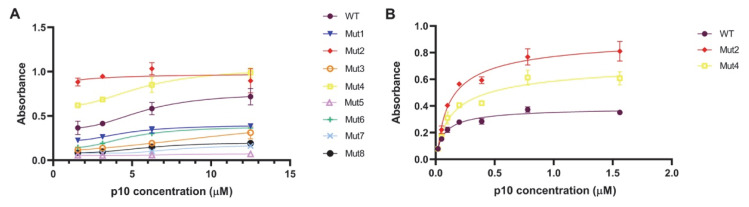
ELISA assay quantifying the dsDNA-binding affinity of M1–8 mutants (A) and at lower concentrations of M2 and M4 (B).

References

    1. Montgomery R.E. On A Form of Swine Fever Occurring in British East Africa (Kenya Colony) J. Comp. Pathol. Ther. 1921;34:159–191. doi: 10.1016/S0368-1742(21)80031-4. - DOI
    1. Penrith M.-L., Vosloo W., Jori F., Bastos A.D.S. African swine fever virus eradication in Africa. Virus Res. 2013;173:228–246. doi: 10.1016/j.virusres.2012.10.011. - DOI - PubMed
    1. Dixon L.K., Sun H., Roberts H. African Swine Fever. Antivir. Res. 2019;165:34–41. doi: 10.1016/j.antiviral.2019.02.018. - DOI - PubMed
    1. Barcos L. International Agencies Provide Support to the Dominican Republic and Haiti to Prevent and Fight African Swine Fever (ASF) [(accessed on 9 April 2022)]. Available online: https://rr-americas.oie.int/en/news/int-ags-support-dominican-haiti-to-asf/
    1. Dixon L.K., Chapman D.A., Netherton C.L., Upton C. African swine fever virus replication and genomics. Virus Res. 2013;173:3–14. doi: 10.1016/j.virusres.2012.10.020. - DOI - PubMed

Publication types

LinkOut - more resources