


Evolutionary Dynamics of Whole-Genome Influenza A/H3N2 Viruses Isolated in Myanmar from 2015 to 2019
- PMID: 36366512
- PMCID: PMC9699102
- DOI: 10.3390/v14112414
Evolutionary Dynamics of Whole-Genome Influenza A/H3N2 Viruses Isolated in Myanmar from 2015 to 2019
Abstract
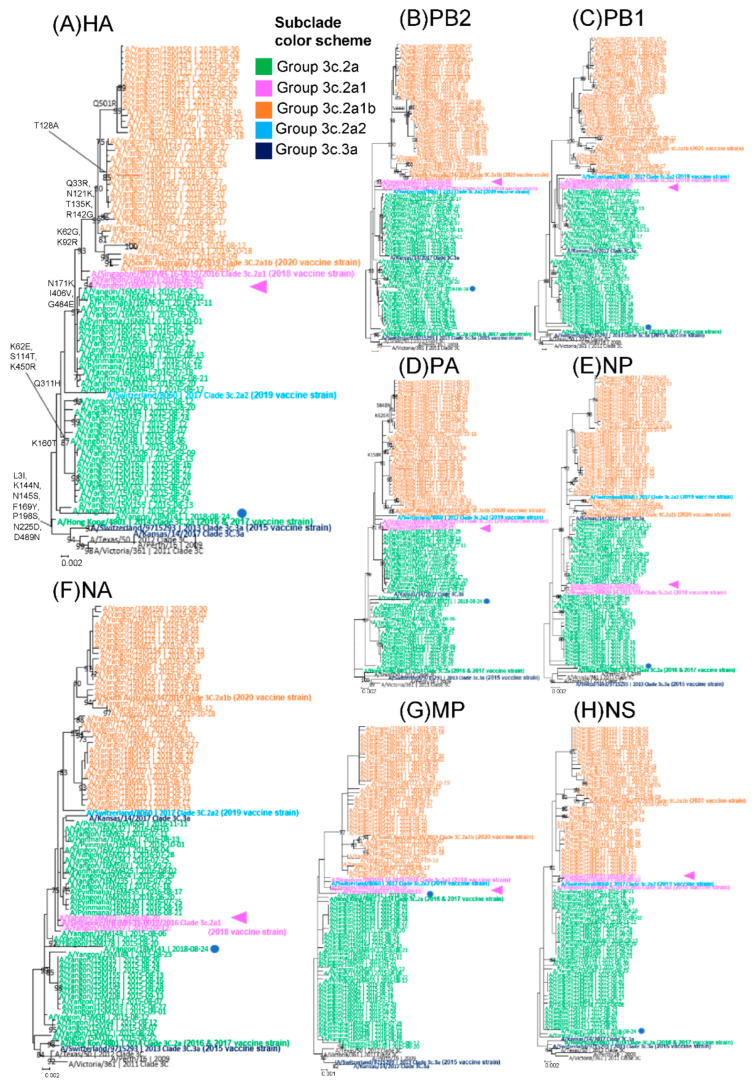
This study aimed to analyze the genetic and evolutionary characteristics of the influenza A/H3N2 viruses circulating in Myanmar from 2015 to 2019. Whole genomes from 79 virus isolates were amplified using real-time polymerase chain reaction and successfully sequenced using the Illumina iSeq100 platforms. Eight individual phylogenetic trees were retrieved for each segment along with those of the World Health Organization (WHO)-recommended Southern Hemisphere vaccine strains for the respective years. Based on the WHO clades classification, the A/H3N2 strains in Myanmar from 2015 to 2019 collectively belonged to clade 3c.2. These strains were further defined based on hemagglutinin substitutions as follows: clade 3C.2a (n = 39), 3C.2a1 (n = 2), and 3C.2a1b (n = 38). Genetic analysis revealed that the Myanmar strains differed from the Southern Hemisphere vaccine strains each year, indicating that the vaccine strains did not match the circulating strains. The highest rates of nucleotide substitution were estimated for hemagglutinin (3.37 × 10⁻³ substitutions/site/year) and neuraminidase (2.89 × 10⁻³ substitutions/site/year). The lowest rate was for non-structural protein segments (4.19 × 10⁻⁵ substitutions/site/year). The substantial genetic diversity that was revealed improved phylogenetic classification. This information will be particularly relevant for improving vaccine strain selection.
Keywords: A/H3N2; evolution; genetic reassortment; mutation; next-generation sequencing; seasonal influenza; variant viruses; whole-genome sequencing.
Conflict of interest statement
The authors declare no conflict of interest. The funders had no role in the design of the study; collection, analyses, or interpretation of data; writing of the manuscript; or decision to publish the results.
Figures
References
-
- Centers for Disease Control and Prevention Key Facts about Influenza (Flu) [(accessed on 10 February 2022)];2022 Available online: https://www.cdc.gov/flu/about/keyfacts.htm.
-
- World Health Organization Influenza (Seasonal) Fact Sheet. [(accessed on 10 February 2022)];2018 Available online: www.who.int/mediacentre/factsheets/fs211/en/
-
- Nair H., Brooks W.A., Katz M., Roca A., Berkley J.A., Madhi S.A., Simmerman J.M., Gordon A., Sato M., Howie S., et al. Global burden of respiratory infections due to seasonal influenza in young children: A systematic review and meta-analysis. Lancet. 2011;378:1917–1930. doi: 10.1016/S0140-6736(11)61051-9. - DOI - PubMed
Publication types
MeSH terms
Substances
LinkOut - more resources
Full Text Sources
Medical
