


Co‑cultivation of anaerobic fungi with Clostridium acetobutylicum bolsters butyrate and butanol production from cellulose and lignocellulose
- PMID: 36367297
- PMCID: PMC9923384
- DOI: 10.1093/jimb/kuac024
Co‑cultivation of anaerobic fungi with Clostridium acetobutylicum bolsters butyrate and butanol production from cellulose and lignocellulose
Abstract
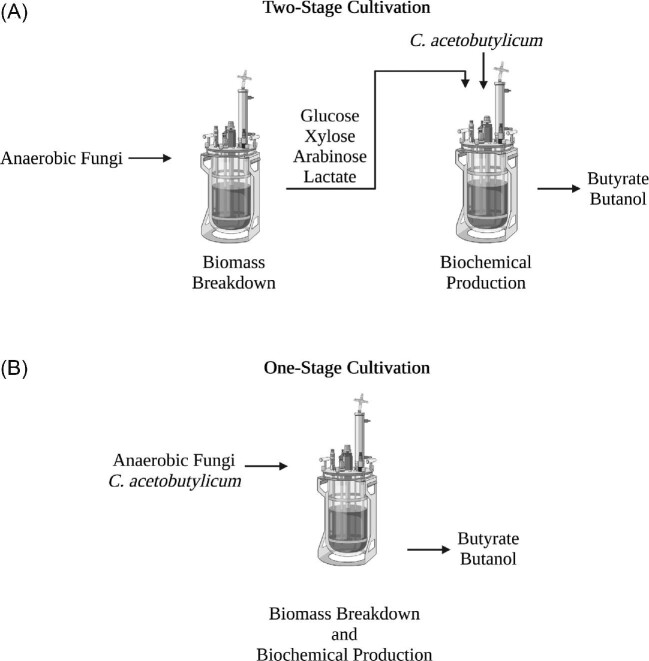
A system for co-cultivation of anaerobic fungi with anaerobic bacteria was established based on lactate cross-feeding to produce butyrate and butanol from plant biomass. Several co-culture formulations were assembled that consisted of anaerobic fungi (Anaeromyces robustus, Neocallimastix californiae, or Caecomyces churrovis) with the bacterium Clostridium acetobutylicum. Co-cultures were grown simultaneously (e.g., 'one pot'), and compared to cultures where bacteria were cultured in fungal hydrolysate sequentially. Fungal hydrolysis of lignocellulose resulted in 7-11 mM amounts of glucose and xylose, as well as acetate, formate, ethanol, and lactate to support clostridial growth. Under these conditions, one-stage simultaneous co-culture of anaerobic fungi with C. acetobutylicum promoted the production of butyrate up to 30 mM. Alternatively, two-stage growth slightly promoted solventogenesis and elevated butanol levels (∼4-9 mM). Transcriptional regulation in the two-stage growth condition indicated that this cultivation method may decrease the time required to reach solventogenesis and induce the expression of cellulose-degrading genes in C. acetobutylicum due to relieved carbon-catabolite repression. Overall, this study demonstrates a proof of concept for biobutanol and bio-butyrate production from lignocellulose using an anaerobic fungal-bacterial co-culture system.
Keywords: Anaerobic fungi; Biofuel; Clostridia; Consortia; RNA-Seq.
© The Author(s) 2022. Published by Oxford University Press on behalf of Society of Industrial Microbiology and Biotechnology.
Conflict of interest statement
The authors declare no conflicts of interest.
Figures



References
-
- Al-Shorgani N. K. N., Tibin E. M., Ali E., Hamid A. A., Yusoff W. M. W., Kalil M. S. (2014). Biohydrogen production from agroindustrial wastes via Clostridium saccharoperbutylacetonicum N1-4 (ATCC 13564). Clean Technologies and Environmental Policy, 16(1), 11–21. 10.1007/s10098-013-0586-6 - DOI
