


Life span, growth, senescence and island syndrome: Accounting for imperfect detection and continuous growth
- PMID: 36367397
- PMCID: PMC10099801
- DOI: 10.1111/1365-2656.13842
Life span, growth, senescence and island syndrome: Accounting for imperfect detection and continuous growth
Abstract
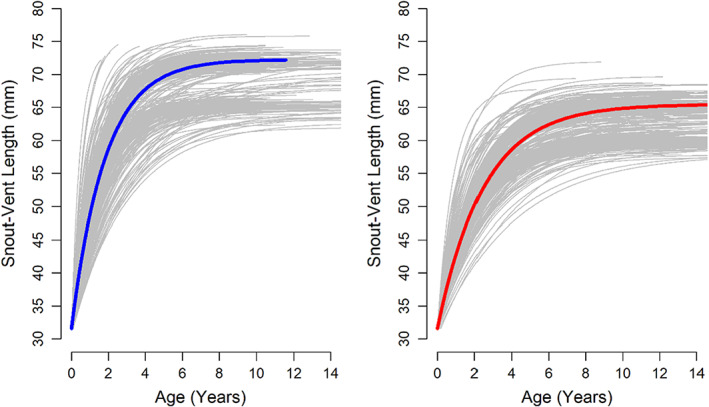
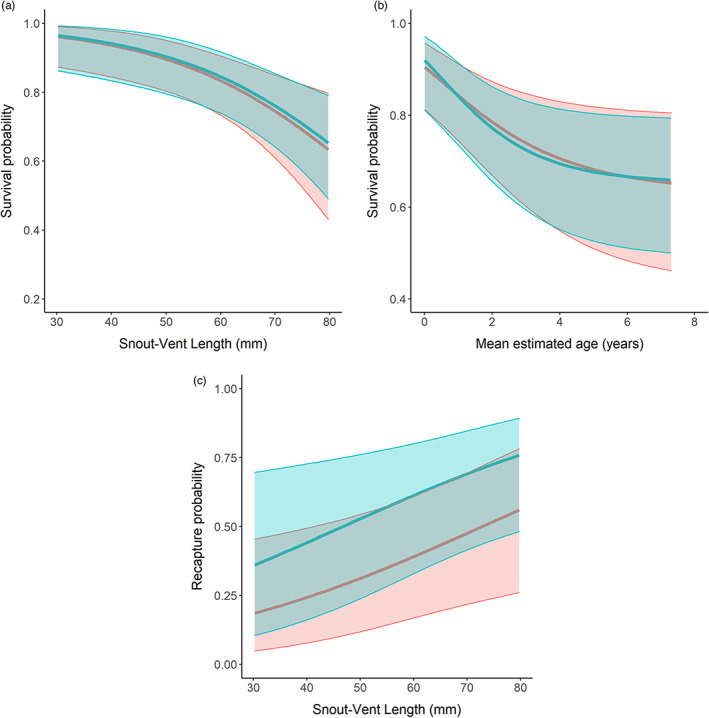
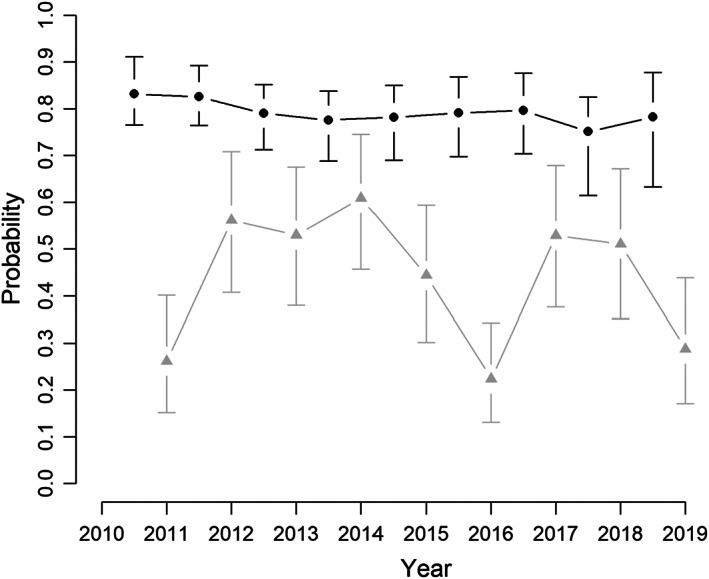
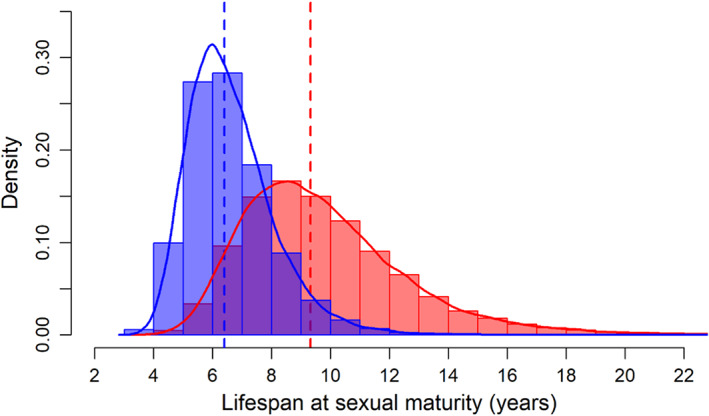
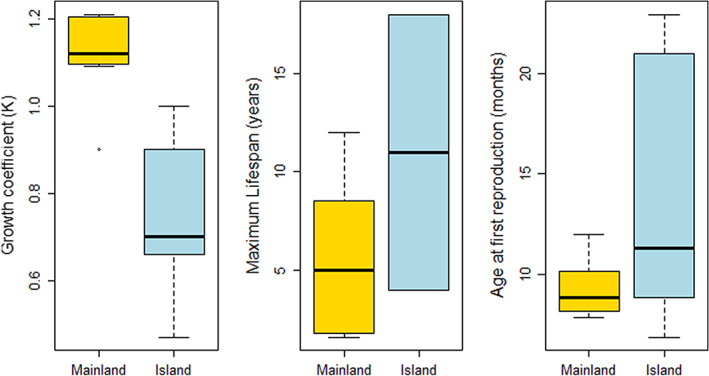
Small vertebrates on islands are expected to attain a larger body size, and a greater survival than their mainland counterparts. Comparative studies have questioned whether lizards exhibit this set of adaptations, referred to as the 'island syndrome'. We collected data on 730 individuals the endemic Lilford's lizard Podarcis lilfordi throughout a 10-year period on a small island of the Balearic archipelago (Spain). We coupled a growth function with a capture-mark-recapture model to simultaneously estimate size- and sex-dependent growth rate and survival. To put our results into a wider context, we conducted a systematic review of growth, life span and age at maturity in different Podarcis species comparing insular and mainland populations. We found a low average growth coefficient (0.56 and 0.41 year-1 for males and females to reach an asymptotic size of 72.3 and 65.6 mm respectively), a high annual survival probability of 0.81 and 0.79 in males and females, and a large variability between individuals in growth parameters. Survival probability decreased with body size in both sexes, indicating a senescence pattern typical of long-lived species or in populations with a low extrinsic mortality. Assuming a constant survival after sexual maturity, at about 2 years old, the average life span was 6.18 years in males and 8.99 in females. The oldest animal was a male last captured at an estimated age of ≥13 years and still alive at the end of the study. Our results agree with the predictions of the 'island syndrome' for survival, life span and growth parameters. A comparative analysis of these values across 29 populations of 16 different species of Podarcis indicated that insular lizards grow slower and live longer than their mainland counterparts. However, our data differed from other island populations of the same species, suggesting that island-specific characteristics play an additional role to isolation. Within this study we developed an analytical approach to study the body size-dependent survival of small reptiles. We discuss its applicability to contrast hypotheses on senescence in different sexes of this species, and provide the code used to integrate the growth and capture-mark-recapture models.
Keywords: Bayesian framework; body size; capture-recapture; indeterminate grower; life-history traits; longitudinal data; mortality.
© 2022 The Authors. Journal of Animal Ecology published by John Wiley & Sons Ltd on behalf of British Ecological Society.
Conflict of interest statement
The authors have no conflict of interest.
Figures
References
-
- Adamopoulou, C. , Valakos, E. , & Price, A. (2000). Small clutch size in a Mediterranean endemic lacertid (Podarcis milensis). Copeia, 2000, 610–614.
-
- Adler, G. H. , & Levins, R. (1994). The Island syndrome in rodent populations. The Quarterly Review of Biology, 69, 473–490. - PubMed
-
- Andrews, R. M. (1976). Growth rate in island and mainland anoline lizards. Copeia, 3, 477–482.
-
- Andrews, R. M. (1982). Patterns of growth in reptiles. Biology of the Reptilia, 13, 273–320.
-
- Andrews, R. M. , & Nichols, J. D. (1990). Temporal and spatial variation in survival rates of the tropical lizard Anolis limifrons . Oikos, 57, 215–221.
Publication types
MeSH terms
LinkOut - more resources
Full Text Sources
