


Signals from the TAFA4-PTEN-PU.1 axis alleviate nasal allergy by modulating the expression of FcεRI in mast cells
- PMID: 36368013
- PMCID: PMC9993457
- DOI: 10.1093/cei/uxac097
Signals from the TAFA4-PTEN-PU.1 axis alleviate nasal allergy by modulating the expression of FcεRI in mast cells
Abstract
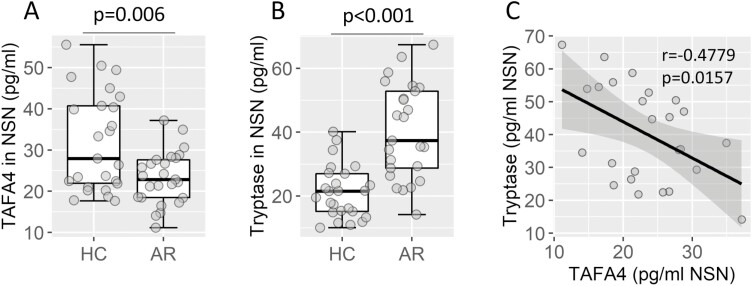
The high-affinity IgE receptor, FcεRI, plays a key role in the antigen-induced mast cell activation. Regulations for FcεRI are not yet well understood. TAFA4 is a molecule derived from neuron tissues, and has immune regulation functions. This study aims to clarify the role of TAFA4 in the regulation of FcεRI expression in mast cells. Nasal secretions were collected from patients with allergic rhinitis (AR) and healthy control (HC) subjects. TAFA4 levels of nasal secretions were evaluated by ELISA. A mouse model AR was developed using ovalbumin as the specific antigen. Negative correlation between TAFA4 and tryptase levels in nasal secretions was observed. TAFA4 could suppress the antigen-related mast cell activation. TAFA4 modulated the transcription of Fcer1g (FcεRI γ gene) in mast cells. Signals from the TAFA4-PTEN-PU.1 axis restricted FcεRI expression in mast cells. Administration of TAFA4 attenuated experimental AR. TAFA4 suppressed the expression of FcεRI in mast cells of airway tissues. TAFA4 can down regulate the expression of FcεRI in mast cells to suppress experimental AR. The data suggest that TAFA4 has translation potential to be developed as an anti-allergy therapy.
Keywords: IgE receptor; immunity; mast cell; nasal allergy; neuropeptide.
© The Author(s) 2022. Published by Oxford University Press on behalf of the British Society for Immunology. All rights reserved. For permissions, please e-mail: journals.permissions@oup.com.
Figures



References
Publication types
MeSH terms
Substances
LinkOut - more resources
Full Text Sources
Molecular Biology Databases
Research Materials
Miscellaneous
