. 2023 Feb;48(3):529-539.
doi: 10.1038/s41386-022-01487-y. Epub 2022 Nov 12.

The basolateral amygdala to lateral septum circuit is critical for regulating social novelty in mice

Affiliations

The basolateral amygdala to lateral septum circuit is critical for regulating social novelty in mice

Lionel A Rodriguez et al. Neuropsychopharmacology. 2023 Feb.

Abstract

The lateral septum (LS) is a basal forebrain GABAergic region that is implicated in social novelty. However, the neural circuits and cell signaling pathways that converge on the LS to mediate social behaviors aren't well understood. Multiple lines of evidence suggest that signaling of brain-derived neurotrophic factor (BDNF) through its receptor TrkB plays important roles in social behavior. BDNF is not locally produced in LS, but we demonstrate that nearly all LS GABAergic neurons express TrkB. Local TrkB knock-down in LS neurons decreased social novelty recognition and reduced recruitment of neural activity in LS neurons in response to social novelty. Since BDNF is not synthesized in LS, we investigated which inputs to LS could serve as potential BDNF sources for controlling social novelty recognition. We demonstrate that selectively ablating inputs to LS from the basolateral amygdala (BLA), but not from ventral CA1 (vCA1), impairs social novelty recognition. Moreover, depleting BDNF selectively in BLA-LS projection neurons phenocopied the decrease in social novelty recognition caused by either local LS TrkB knockdown or ablation of BLA-LS inputs. These data support the hypothesis that BLA-LS projection neurons serve as a critical source of BDNF for activating TrkB signaling in LS neurons to control social novelty recognition.


Conflict of interest statement

KM is the Social Media Editor for Neuropsychopharmacology. No other authors have financial relationships with commercial interests, and the authors declare no competing interests.

Figures

Fig. 1
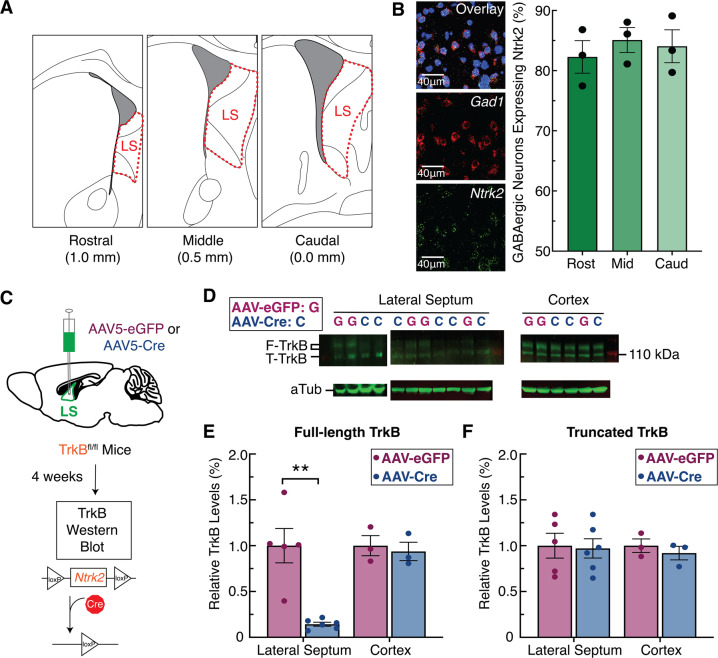
Fig. 1. Tropomyosin receptor kinase B (TrkB) is highly expressed in the lateral septum (LS) and can be effectively depleted with viral manipulations.
A Illustration depicting the anatomical boundaries across the rostral-caudal axis of the LS. B Fluorescent in-situ hybridization in sections of mouse LS (n = 4) demonstrates abundant Ntrk2 expression in Gad1-positive cells throughout the rostral-caudal divisions. C Schematic of the viral strategy using cre-induced TrkB knockdown in the LS of TrkBfl/fl mice. D Western blot quantification of full-length TrkB (F-TrkB), truncated TrkB (T-TrkB), and α-Tubulin (aTub). E Relative expression levels of F-TrkB protein were significantly lower in the LS of the experimental group (AAV-cre in LS of TrkBfl/fl mice, n = 5) compared to controls (AAV-eGFP in LS of TrkBfl/fl mice, n = 6)(t9 = 5.015, p = 0.0014). F Relative expression levels for T-TrkB protein were similar between experimental and control mice.
Fig. 2
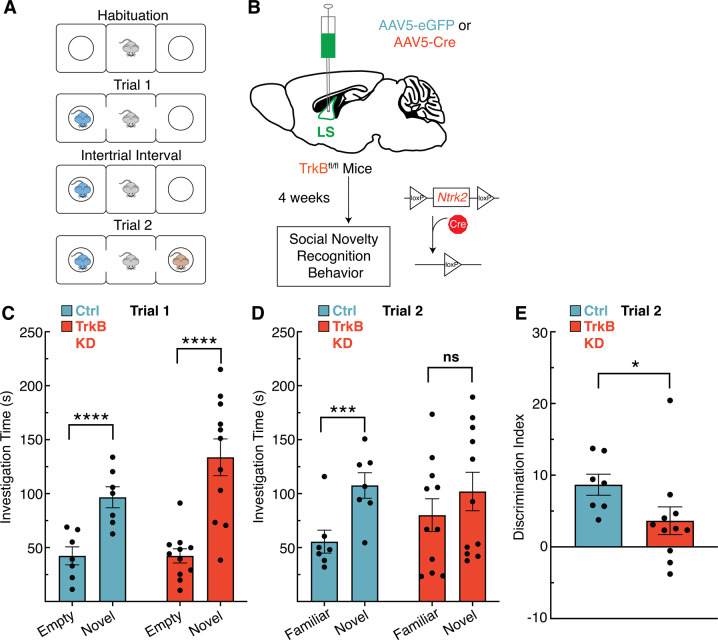
Fig. 2. Tropomyosin receptor kinase B (TrkB) expression in the lateral septum (LS) is required for social novelty recognition behavior in mice.
A Description of three chamber social interaction experiment. B The viral strategy using cre-induced knockdown of TrkB expression in the LS of TrkBfl/fl mice prior to social novelty recognition. C In trial 1, both TrkB intact (Ctrl) and TrkB knockdown (KD) mice spend significantly more time with the novel mouse (2-way RM ANOVA, ns p = 0.0959 interaction of novelty x experimental manipulation, p < 0.0001 main effect of novelty, ns p = 0.2179 main effect of experimental manipulation; Bonferroni post hoc p = 0.0089 for TrkB intact mice, p < 0.0001 for TrkB knockdown mice). D In trial 2, TrkB KD mice do not show a difference between investigation time of the familiar and novel mice (2-way RM ANOVA, ns p = 0.0813 interaction of novelty x experimental manipulation, main effect of novelty p < 0.0003, ns p = 0.6639 main effect of experimental manipulation; Bonferroni post hoc p = 0.0016 for TrkB intact mice, ns p = 0.093 for TrkB KD mice). E Mice with intact LS TrkB (Ctrl) show better social discrimination between the socially novel and familiar mice in Trial 2 when compared toTrkB KD mice (U11,7 = 12, p = 0.0154).
Fig. 3
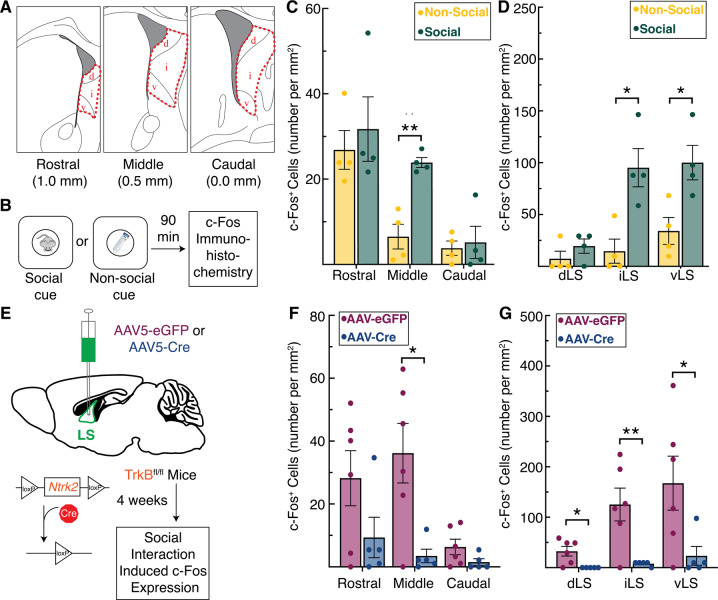
Fig. 3. Tropomyosin receptor kinaseB (TrkB) expression in the lateral septum (LS) is required for social novelty induced c-Fos expression.
A Illustration depicting the anatomical boundaries across the rostral-caudal axis of the LS, denoting the dorsal (d), intermediate (i), and ventral (v) subregions of the LS. B Description of social or non-social cues used to induce c-Fos expression. C Induction of c-Fos is significantly increased by social cues in the middle portion of the LS (t6 = 5.543, p = 0.004), (D) an effect seen specifically in the intermediate (t6 = 3.697, p = 0.030) and ventral subdivisions (t6 = 3.131, p = 0.040) of the middle LS. E The viral strategy using cre-induced TrkB knockdown in the LS of TrkBfl/fl mice prior to examining social interaction induced c-Fos expression. F Knockdown of TrkB in the LS significantly decreases cell recruitment in the middle portion of the LS following social stimuli (t9 = 3.069, p = 0.0396), (G) an effect seen across the dorsal (t9 = 3.049, p = 0.029), intermediate (t9 = 3.254, p = 0.029), and ventral (t9 = 2.342, p = 0.044) subdivisions of the middle LS.
Fig. 4
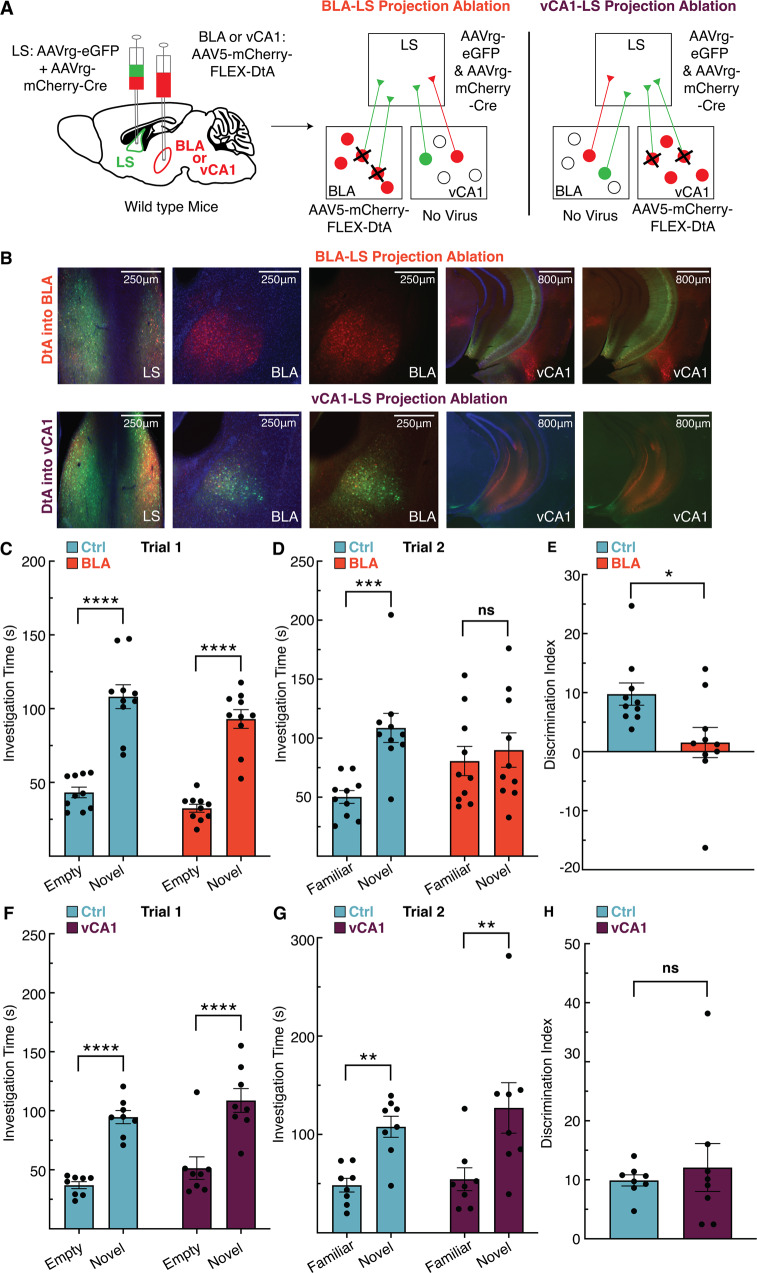
Fig. 4. Ablating inputs to the lateral septum (LS) from basolateral amygdala (BLA), but not ventral CA1 (vCA1), abolishes social novelty recognition behavior in mice.
A Viral strategy to selectively eliminate inputs to the LS from either the BLA or vCA1 utilizing retrograde labeling and cre-mediated expression of diphtheria toxin A (DtA) (left). Schematics depict ablation in the cohort where BLA-LS projections are targeted (middle), and ablation in the cohort where vCA1-LS projections are targeted (right). B Representative images show that in the cohort where DtA is expressed in BLA (top row), BLA-LS projections are ablated, while vCA1-LS projections are intact, while in the cohort where DtA is expressed in vCA1 (bottom row), vCA1-LS projections are ablated while BLA-LS projections remain intact. C In trial 1, both mice with BLA-LS projections intact (Ctrl) and BLA-LS projections ablated (BLA) spend significantly more time with the novel mouse (2-way RM ANOVA, ns p = 0.6498 interaction of novelty x experimental manipulation, p < 0.0001 main effect of novelty, ns p = 0.1261 main effect of experimental manipulation; Bonferroni post hoc p < 0.0001 for BLA-LS intact mice, p < 0.0001 for BLA-LS ablated mice). D In trial 2, there is an interaction between the novelty of the mouse and experimental manipulation. BLA-LS intact mice showed significantly more interaction time with the novel mouse compared to the familiar mouse, while BLA-LS ablated mice did not (2-way RM ANOVA, p = 0.0189 interaction of novelty x experimental manipulation, main effect of novelty p = 0.0023, ns p = 0.6712 main effect of experimental manipulation; Bonferroni post hoc p = 0.0008 for BLA-LS intact mice, ns p = 0.9996 for BLA-LS ablated mice). E Mice with intact BLA-LS projections show better social discrimination between the socially novel and familiar mice in Trial 2 than mice with an ablated BLA-LS circuit (U10,10 = 17, p = 0.0115). F In trial 1, both mice with intact vCA1-LS projections (Ctrl) and ablated vCA1-LS projections (vCA1) spend significantly more time with the novel mouse (2-way RM ANOVA, ns p = 0.9803 interaction of novelty x experimental manipulation, p < 0.0001 main effect of novelty, ns p = 0.1212 main effect of experimental manipulation; Bonferroni post hoc p < 0.0001 for vCA1-LS intact mice, p < 0.0001 for vCA1-LS ablated mice). G In trial 2, both mice with intact vCA1-LS projections and ablated vCA1-LS projections spend significantly more time with the novel mouse (2-way RM ANOVA, ns p = 0.6083 interaction of novelty x experimental manipulation, p = 0.001 main effect of novelty, ns p = 0.4976 main effect of experimental manipulation; Bonferroni post hoc p = 0.0093 for vCA1-LS intact mice, p = 0.0022 for vCA1-LS ablated mice). H Mice with intact vCA1-LS projections and mice with ablated vCA1-LS projections show no difference in social discrimination (U9,9 = 30, p = 0.8527).
Fig. 5
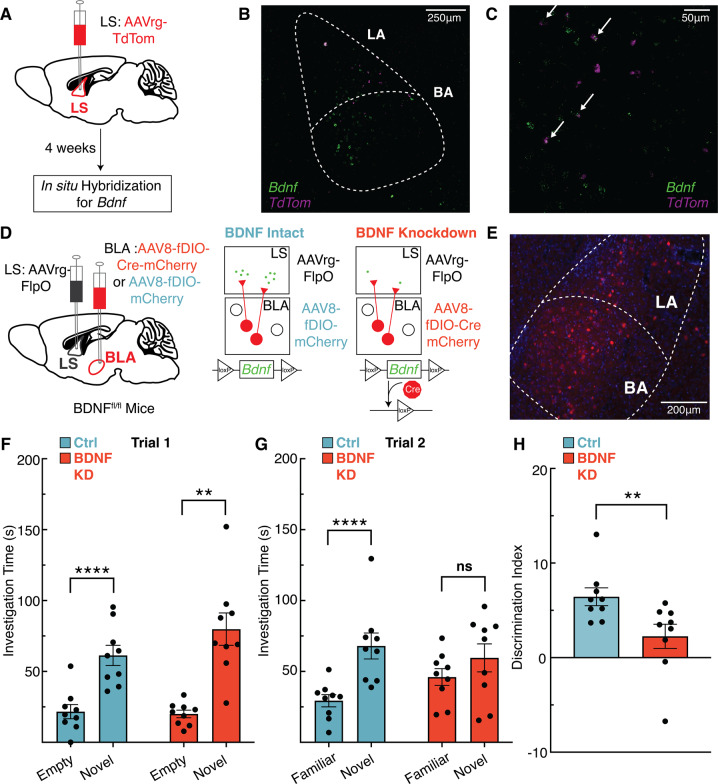
Fig. 5. Knockdown of brain-derived neurotrophic factor (BDNF) in basolateral amygdala (BLA) inputs to the lateral septum (LS) abolishes social novelty recognition behavior in mice.
A Schematic of strategy to label BLA-LS projections and demonstrate Bdnf expression in BLA-LS neurons. B Representative ×20 image of the topographic location of Bdnf and TdTom transcripts within the BLA. (C) ×40 image of Bdnf + and TdTom + cells, arrows point to co-expressing cells. D Schematic of viral strategy to deplete BDNF expression in BLA-LS projections in BDNFfl/fl mice. E Representative images of viral expression of mCherry within the BLA. F In trial 1, both mice with intact BDNF in BLA-LS projections (Ctrl) and BDNF knockdown in BLA-LS projections (BDNF KD) spend significantly more time interacting with the novel mouse (2-way RM ANOVA, ns p = 0.1397 interaction of novelty x experimental manipulation, p < 0.0001 main effect of novelty, ns p = 0.3072 main effect of experimental manipulation; Bonferroni post hoc p = 0.0010 for BDNF intact mice, p < 0.0001 for BDNF knockdown mice). G In trial 2, there is an interaction between the novelty of the mouse and experimental manipulation. Mice with intact BDNF in BLA-LS projections spent significantly more interacting with the novel mouse compared to the familiar mouse, while mice with BDNF KD in BLA-LS projections mice did not (2-way RM ANOVA, p = 0.0179 interaction of novelty x experimental manipulations, main effect of novelty p < 0.0001, ns p = 0.6761 main effect of experimental manipulation; Bonferroni post hoc p < 0.0001 for mice with intact BDNF in BLA-LS projections, ns p = 0.1237 for mice with BDNF KD in BLA-LS projections). H Mice with intact BDNF expression in BLA-LS projections display better social discrimination between the socially novel and familiar mice in trial 2 than mice with BDNF KD in BLA-LS projections (U9,9 = 9, p = 0.004).

References

    1. Chevallier C, Kohls G, Troiani V, Brodkin ES, Schultz RT. The social motivation theory of autism. Trends Cogn Sci (Regul Ed) 2012;16:231–9. doi: 10.1016/j.tics.2012.02.007. - DOI - PMC - PubMed
    1. Happé F, Ronald A. The “fractionable autism triad”: a review of evidence from behavioural, genetic, cognitive and neural research. Neuropsychol Rev. 2008;18:287–304. doi: 10.1007/s11065-008-9076-8. - DOI - PubMed
    1. Marwick K, Hall J. Social cognition in schizophrenia: a review of face processing. Br Med Bull. 2008;88:43–58. doi: 10.1093/bmb/ldn035. - DOI - PubMed
    1. Mier D, Kirsch P. Social-cognitive deficits in schizophrenia. Curr Top Behav Neurosci. 2017;30:397–409. doi: 10.1007/7854_2015_427. - DOI - PubMed
    1. Weigelt S, Koldewyn K, Kanwisher N. Face identity recognition in autism spectrum disorders: a review of behavioral studies. Neurosci Biobehav Rev. 2012;36:1060–84. doi: 10.1016/j.neubiorev.2011.12.008. - DOI - PubMed

Publication types

Substances

LinkOut - more resources