. 2022 Nov 11;12(1):19351.
doi: 10.1038/s41598-022-21270-9.

Amoxicillin impact on pathophysiology induced by short term high salt diet in mice

Affiliations

Amoxicillin impact on pathophysiology induced by short term high salt diet in mice

Suresh Kumar et al. Sci Rep. .

Abstract

Current evidence emerging from both human and animal models confirms that high-salt diet consumption over a period modulates the gut ecology and subsequently accelerates the development of the pathophysiology of many metabolic diseases. The knowledge of short-term intake of a high-salt diet (HSD) on gut microbiota and their role in the progression of metabolic pathogenesis and the consequence of a typical course of common antibiotics in this condition has yet not been investigated. The present study elicited this knowledge gap by studying how the gut microbiota profile changes in mice receiving HSD for a short period followed by Amoxicillin treatment on these mice in the last week to mimic a typical treatment course of antibiotics. In this study, we provided a standard chow diet (CD) and HSD for 3 weeks, and a subset of these mice on both diets received antibiotic therapy with Amoxicillin in the 3rd week. We measured the body weight of mice for 3 weeks. After 21 days, all animals were euthanised and subjected to a thorough examination for haemato-biochemical, histopathological, and 16S rRNA sequencing, followed by bioinformatics analysis to determine any changes in gut microbiota ecology. HSD exposure in mice for short duration even leads to a significant difference in the gut ecology with enrichment of specific gut microbiota crucially linked to developing the pathophysiological features of metabolic disease-related inflammation. In addition, HSD treatment showed a negative impact on haemato-biochemical parameters. However, Amoxicillin treatment in HSD-fed mice restored the blood-biochemical markers near to control values and reshaped gut microbiota known for improving the pathophysiological attributes of metabolic disease related inflammation. This study also observed minimal and insignificant pathological changes in the heart, liver, and kidney in HSD-fed mice.


Conflict of interest statement

The authors declare no competing interests.

Figures
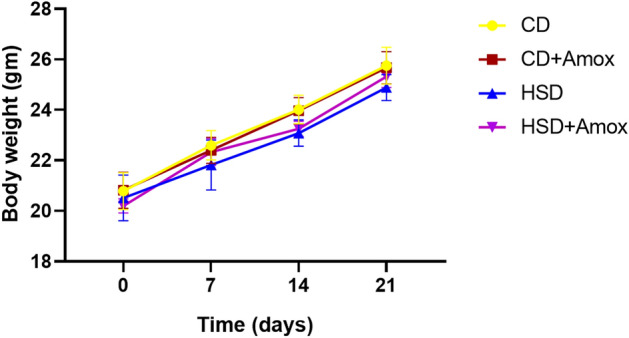
Figure 1
Figure 1
Effect of high-salt diet (4% in chow) and Amoxicillin treatment on body weight of mice. As shown by the data, no significant difference in body weight of mice was observed among different groups. Data represent mean ± SD; N = 6 mice/group, One Way ANOVA (*p < 0.05, **p < 0.01, ***p < 0.001. CD: Standard—chow diet for 3 weeks; CD + Amox: Standard—chow diet for 3 weeks and subjected to Amoxicillin treatment in 3rd week; HSD: High-salt diet for 3 weeks; HSD + Amox: High-salt diet for 3 weeks and subjected to Amoxicillin treatment in 3rd week.
Figure 2
Figure 2
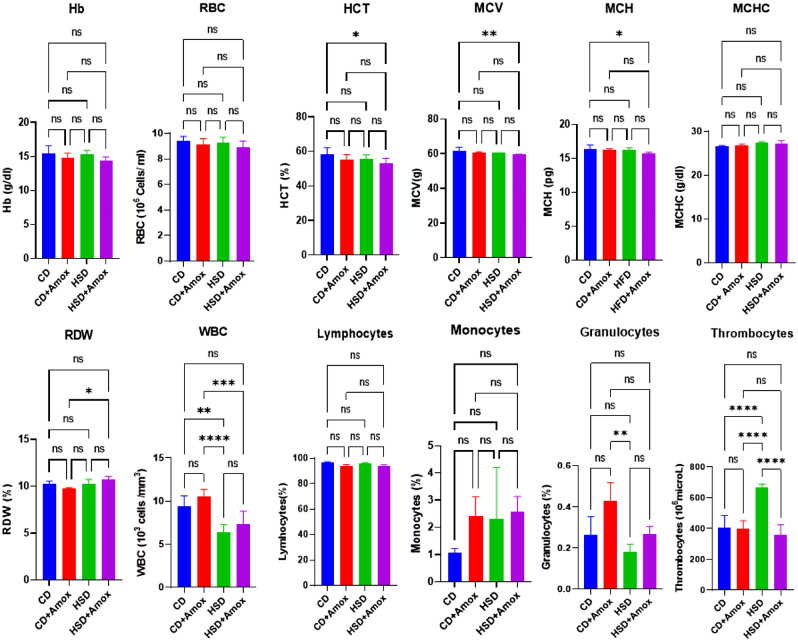
Short-term effect of high-salt diet (4% in chow) followed by Amoxicillin treatment on haematological parameters in mice. HSD treatment for 3 weeks in mice increases the thrombocytes concentration. Amoxicillin treatment in the 3rd week in HSD fed mice brought the elevated level of the thrombocytes near to control value. Values are means ± SD for 6 samples in each group. Statistically significance of differences was evaluated by one way ANOVA followed by Bonferroni test (*p < 0.05, **p < 0.01, ****p < 0.0001). CD: Standard—chow diet for 3 weeks; CD + Amox: Standard—chow diet for 3 weeks and subjected to Amoxicillin treatment in 3rd week; HSD: High-salt diet for 3 weeks; HSD + Amox: High-salt diet for 3 weeks and subjected to Amoxicillin treatment in 3rd week.
Figure 3
Figure 3
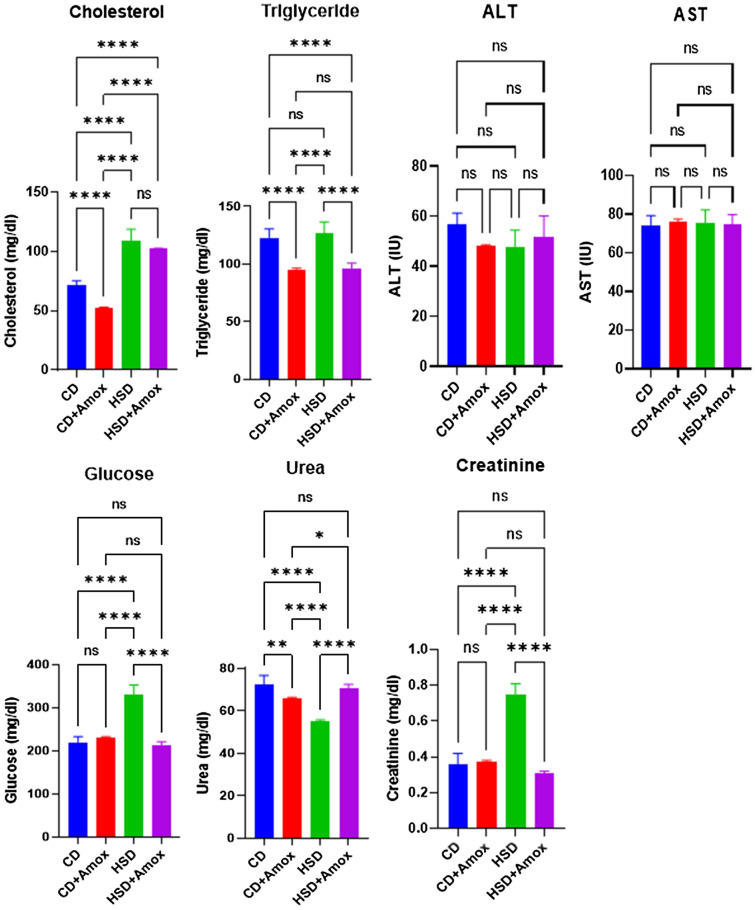
Short-term effect of high-salt diet (4% in chow) followed by Amoxicillin treatment on biochemical parameters in mice. HSD treatment for 3 weeks in mice showed a significant increase in total cholesterol, glucose, creatinine and a significant decrease in blood urea level. Amoxicillin treatment in the last one week in HSD fed mice caused restoration of the glucose, triglycerides, creatinine and blood urea levels towards the control value. Values are means ± SD for 6 samples in each group. Statistical significance of differences was evaluated by one way ANOVA followed by Bonferroni test (*p < 0.05, **p < 0.01, ***p < 0.001, ****p < 0.0001). CD: Standard—chow diet for 3 weeks; CD + Amox: Standard—chow diet for 3 weeks and subjected to Amoxicillin treatment in 3rd week; HSD: High-salt diet for 3 weeks; HSD + Amox: High-salt diet for 3 weeks and subjected to Amoxicillin treatment in 3rd week.
Figure 4
Figure 4
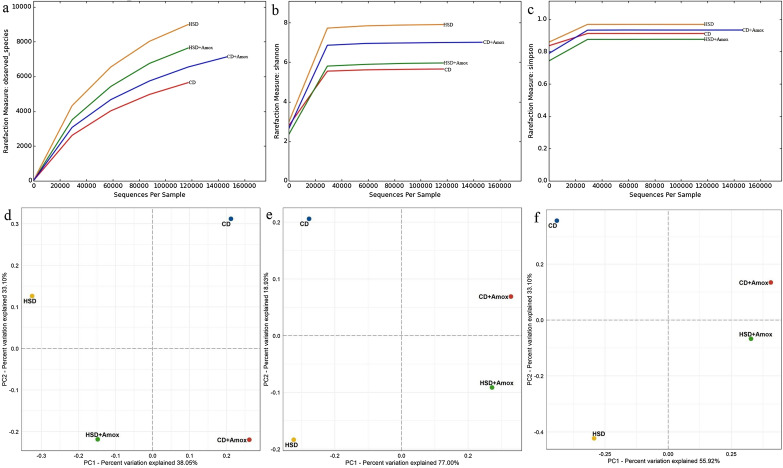
Short-term effect of high-salt diet (4% in chow) followed by Amoxicillin treatment on gut bacteria diversity in mice. Rarefaction curves (a) and Shannon–Wiener curves (b) achieved a plateau, suggesting that the number of OTUs was sufficient to capture the authentic bacterial communities in each sample. Comparisons for alpha-diversity such as observed species index (a), Shannon (b) and Simpson (c) index and beta-diversity (with unweighted (d), weighted (e) Unifrac distance matrix and Bray–Curtis dissimilarity matrix (e) showed marked differences in the bacterial communities among the groups. The percent variation explained by each group is indicated on the axis. CD: Standard—chow diet for 3 weeks; CD + Amox: Standard—chow diet for 3 weeks and subjected to Amoxicillin treatment in 3rd week; HSD: High-salt diet for 3 weeks; HSD + Amox: High-salt diet for 3 weeks and subjected to Amoxicillin treatment in 3rd week.
Figure 5
Figure 5
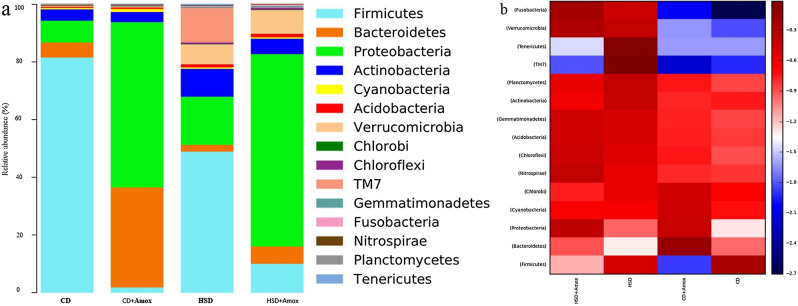
Bar chart (a) and heat map (b) showed the short-term effect of a high-salt diet (4% in chow) followed by Amoxicillin treatment on the relative abundance of the most represented phylum for each group. HSD treatment for 3 weeks in mice caused a significant increase of Firmicutes to Bacteroidetes (F/B) ratio and Proteobacteria. During the last week, Amoxicillin treatment in HSD fed mice mice caused a significant decrease in the Firmicutes to Bacteroidetes (F/B) ratio and as well as increased of Proteobacteria. Color heat map (4b) analysis illustrating the top 15 mean abundances of the bacterial community taxa assigned to phyla. The color intensity in each sample is normalized to represent its relative ratio in the four groups. The color scale of higher (dark red) and lower (dark blue) shows the relative abundances of bacterial communities. CD: Standard—chow diet for 3 weeks; CD + Amox: Standard—chow diet for 3 weeks and subjected to Amoxicillin treatment in 3rd week; HSD: High-salt diet for 3 weeks; HSD + Amox: High-salt diet for 3 weeks and subjected to Amoxicillin treatment in 3rd week.
Figure 6
Figure 6
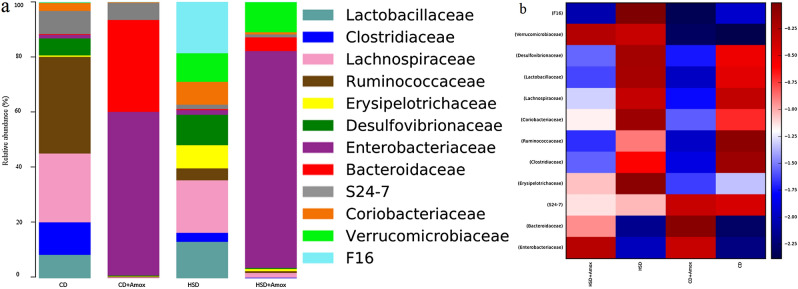
Bar chart (a) and heat map (b) showed the short-term effect of a high-salt diet (4% in chow) followed by Amoxicillin treatment on the relative abundance of the most represented family for each group. Amoxicillin-treatment in HSD-fed mice found a significant decrease in Erysipelotrichaceae, Desulfovibrionaceae, Coriobacteriaceae, F16 and a significant increase in Bacteroidaceae, Enterobacteriaceae and Verrucomicrobiaceae. Color heat map (b) analysis illustrating the top 12 mean abundances of the bacterial community taxa assigned to family. The color intensity in each sample is normalized to represent its relative ratio in the four groups. The color scale of higher (dark red) and lower (dark blue) shows the relative abundances of bacterial communities. CD: Standard—chow diet for 3 weeks; CD + Amox: Standard—chow diet for 3 weeks and subjected to Amoxicillin treatment in 3rd week; HSD: High-salt diet for 3 weeks; HFD + Amox: High-salt diet for 3 weeks and subjected to Amoxicillin treatment in 3rd week.
Figure 7
Figure 7
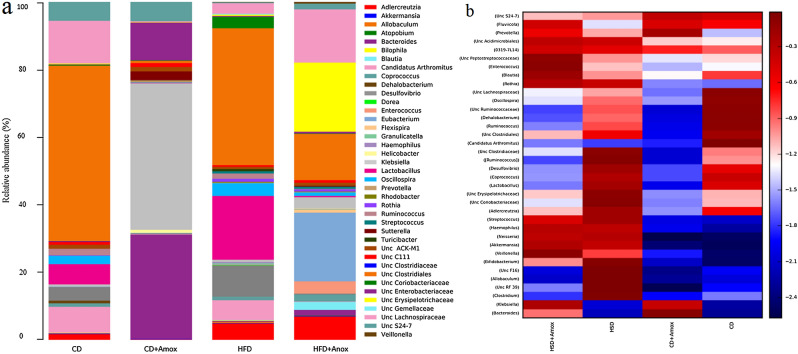
Bar chart (a) and heat map (b) showed the short-term effect of a high-salt diet (4% in chow) on the relative abundance of the most represented bacterial taxa at the genus level for each sample. Amoxicillin-treatment in HSD-fed mice found a significant decrease in Lactobacillus, Streptococcus, Unc Clostridiaceae, Clostridium, [Ruminococcus], Unc Erysipelotrichaceae, Allobaculum, Desulfovibrio, Unc Coriobacteriaceae, Unc F16 and a significant increase in Bacteroides and Akkermansia. The color intensity in each sample is normalized to represent its relative ratio in the four groups. The color scale of higher (dark red) and lower (dark blue) shows the relative abundances of top 36 mean abundance of bacterial communities. CD: Standard—chow diet for 3 weeks; CD + Amox: Standard—chow diet for 3 weeks and subjected to Amoxicillin treatment in 3rd week; HSD: High-salt diet for 3 weeks; HFD + Amox: High-salt diet for 3 weeks and subjected to Amoxicillin treatment in 3rd week.
Figure 8
Figure 8
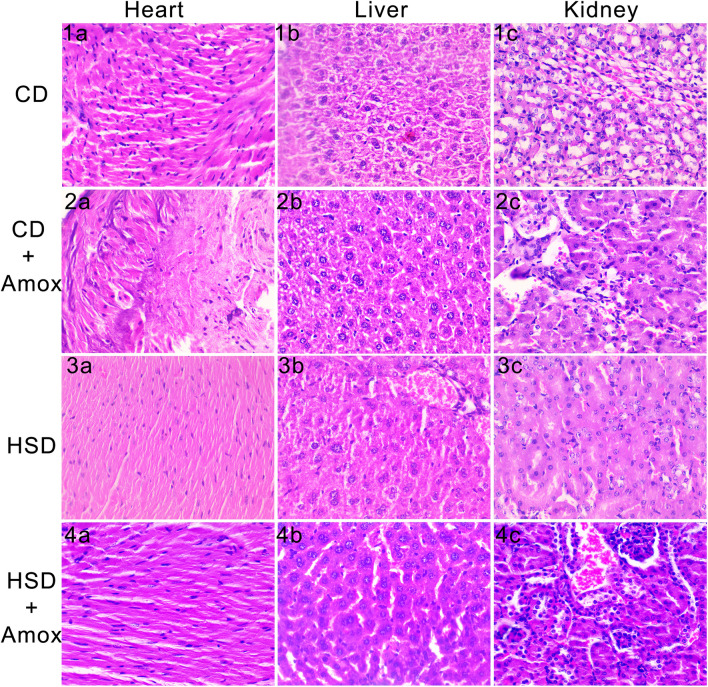
Short-term effect of high-salt diet (4%) followed by Amoxicillin treatment on the heart, liver, and kidney of mice. The figure represents histopathogical examination of heart, liver and kidney sections by hematoxylin and eosin staining. The photomicrograph of the heart tissue of HSD-fed mice showed mild cardiomyocyte hypertrophy and associated degenerative changes (3a). Liver histopathology also indicated the changes in HSD-fed mice, including oddly shaped cells and decreased cell proliferation (3b). No significant changes were observed in the kidney issue of HSD-fed mice (3c). However, these histopathological changes were insufficient to conclude as the significant observations. No significant changes were observed in the heart, liver and kidney of Amoxicillin treated HSD-fed mice (4a, 4b and 4c).

References

    1. Ha SK. Dietary salt intake and hypertension. Electrolyte Blood Press. 2014;12:7–18. - PMC - PubMed
    1. Li Q, et al. Enjoyment of spicy flavor enhances central salty-taste perception and reduces salt intake and blood pressure. Hypertension (Dallas, Texas, 1979). 2017;70:1291–1299. - PubMed
    1. Li Y, Lyu Y, Huang J, Huang K, Yu J. Transcriptome sequencing reveals high-salt diet-induced abnormal liver metabolic pathways in mice. BMC Gastroenterol. 2021;21:1–10. - PMC - PubMed
    1. Kau AL, Ahern PP, Griffin NW, Goodman AL, Gordon JI. Human nutrition, the gut microbiome and the immune system. Nature. 2011;474:327–336. - PMC - PubMed
    1. Vernocchi P, Del Chierico F, Putignani L. Gut microbiota profiling: Metabolomics based approach to unravel compounds affecting human health. Front. Microbiol. 2016;7:1144. - PMC - PubMed

Publication types