Review
. 2023 Jan 2;35(1):162-186.
doi: 10.1093/plcell/koac321.

Breeding crops for drought-affected environments and improved climate resilience

Affiliations
Review

Breeding crops for drought-affected environments and improved climate resilience

Mark Cooper et al. Plant Cell. .

Abstract

Breeding climate-resilient crops with improved levels of abiotic and biotic stress resistance as a response to climate change presents both opportunities and challenges. Applying the framework of the "breeder's equation," which is used to predict the response to selection for a breeding program cycle, we review methodologies and strategies that have been used to successfully breed crops with improved levels of drought resistance, where the target population of environments (TPEs) is a spatially and temporally heterogeneous mixture of drought-affected and favorable (water-sufficient) environments. Long-term improvement of temperate maize for the US corn belt is used as a case study and compared with progress for other crops and geographies. Integration of trait information across scales, from genomes to ecosystems, is needed to accurately predict yield outcomes for genotypes within the current and future TPEs. This will require transdisciplinary teams to explore, identify, and exploit novel opportunities to accelerate breeding program outcomes; both improved germplasm resources and improved products (cultivars, hybrids, clones, and populations) that outperform and replace the products in use by farmers, in combination with modified agronomic management strategies suited to their local environments.


Figures

Figure 1
Figure 1
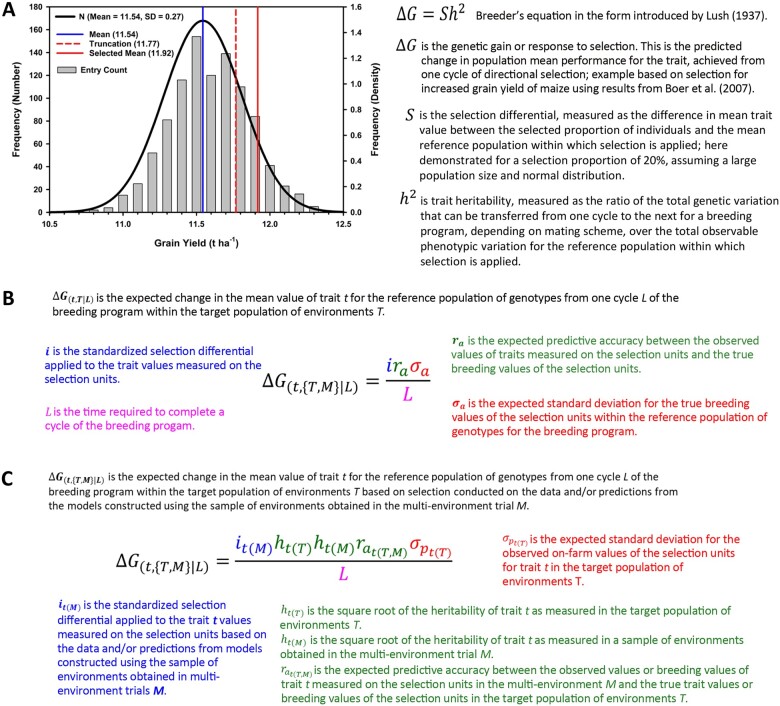
Three formulations of the breeder’s equation. A, The formulation first introduced by Lush (1937), together with a graphical representation based on the grain yield results reported by Boer et al. (2007) for a maize multi-environment trial (MET) conducted to evaluate a sample of progeny from a large biparental mapping study within the US corn belt. B, The second form is structured to emphasize the connection between the genetic variation for breeding values among individuals in the reference population of genotypes and the predictive accuracy for transmission, from one breeding cycle to the next, of the favorable alleles of the genes controlling the breeding value for a trait. The predictive accuracy component (ra) of this form of the equation is a research target for improvement through the design of improved G2P models for the application of genomic prediction in plant breeding. C, The third form is structured to emphasize the genetic correlation between the genetic variation for a target trait that can be exposed in METs conducted at stages of a breeding program (e.g. Figures 2 and 4) and the expected trait genetic variation within the TPEs.
Figure 2
Figure 2
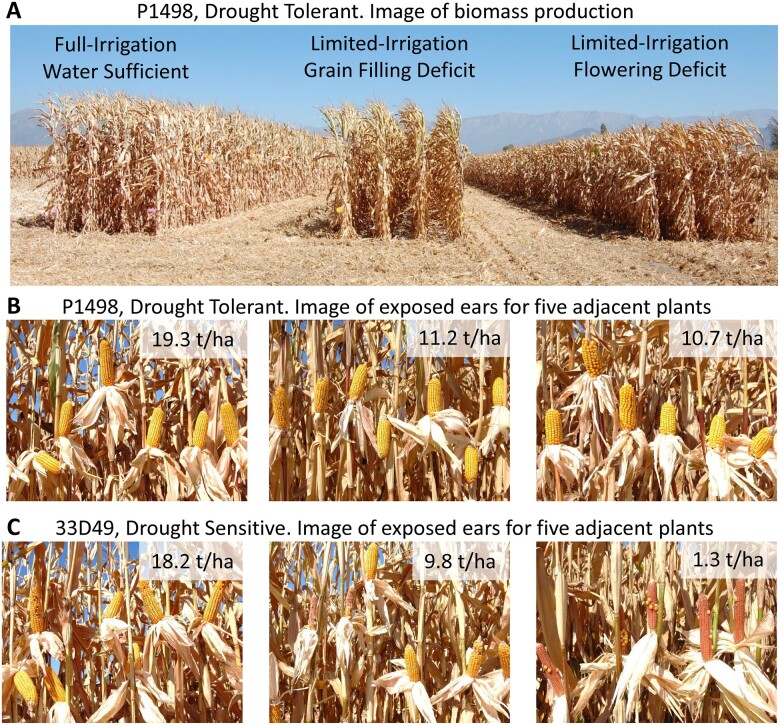
Experimental demonstration of contrasting grain yield reaction-norms for two maize hybrids for a sequence of three environments contrasting in water availability. Images are from the evaluation of two commercial maize hybrids, P1498 (tolerant) and 33D49 (sensitive), with similar yield potential in environments with sufficient water and with contrasting yield responses to water limitations imposed to coincide with the flowering period and post-flowering during the grain-filling period. The experiment was conducted under conditions with no rainfall during the growing season and water was supplied by drip-tape irrigation. A, Above-ground biomass production at the time of harvest for hybrid P1498 in side-by-side plots imposing three levels of irrigation treatment. B, Ears of hybrid P1498 for five adjacent plants within a plot row for each of the three irrigation treatments. C, Ears of hybrid 33D49 for five adjacent plants within a plot row for each of the three irrigation treatments. Yield levels for each hybrid treatment combination were obtained from combined harvest of the whole experimental plot used for the ear images.
Figure 3
Figure 3
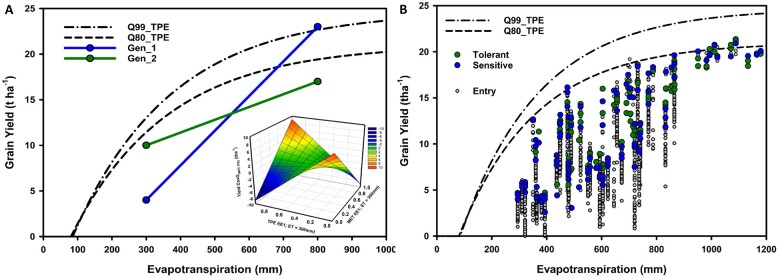
Schematic representations of GxE interactions and contrasting reaction-norms for grain yield of maize hybrids (genotypes) with contrasting levels of drought resistance and yield potential and environments contrasting for water availability, represented by a continuum of crop evapotranspiration. A, Theoretical representation of extreme crossover genotype-by-environment interactions for two genotypes based on contrasting yield-evapotranspiration reaction-norms (Gen_1, high yield potential and drought-sensitive; Gen_2, low yield potential and drought resistant) in response to environmental contrasts in water availability as quantified in terms of season total crop evapotranspiration (Env_1, environment-type characterized by low water availability; Env_2, environment-type characterized by high water availability). The two hybrid grain yield reaction-norms are superimposed on two yield-evapotranspiration fronts estimated by applying quantile regression (Q99%, 99% quantile regression; Q80%, 80% quantile regression) to a large sample of simulated GxExM combinations designed to represent the TPEs of the US corn belt (Cooper et al., 2020). The insert plots the theoretical genetic covariance between the yield variation observed in a breeding MET and the TPEs as the frequency of the two environment types (Env_1, ET = 300 mm and Env_2 = 800 mm) sampled in the MET changes for 0 to 1, relative to their frequency in the TPE, ranging from 0 to 1. The genetic covariance for grain yield between the MET and the TPE is used in combination with the genetic variance within the MET and the TPE to estimate the genetic correlation between the MET and the TPE as represented in form three of the breeder’s equation in Figure 1. B, Empirical grain yield results for a set of maize hybrids evaluated across a range of environments with different levels of water availability as determined by crop evapotranspiration. The empirical results are also superimposed on the Q99% and Q80% yield-evapotranspiration fronts (Cooper et al., 2020). A group of hybrids characterized as drought tolerant, and a group of hybrids characterized as drought sensitive, as depicted in Figure 2, are identified from the full set of hybrid entries in the MET.
Figure 4
Figure 4
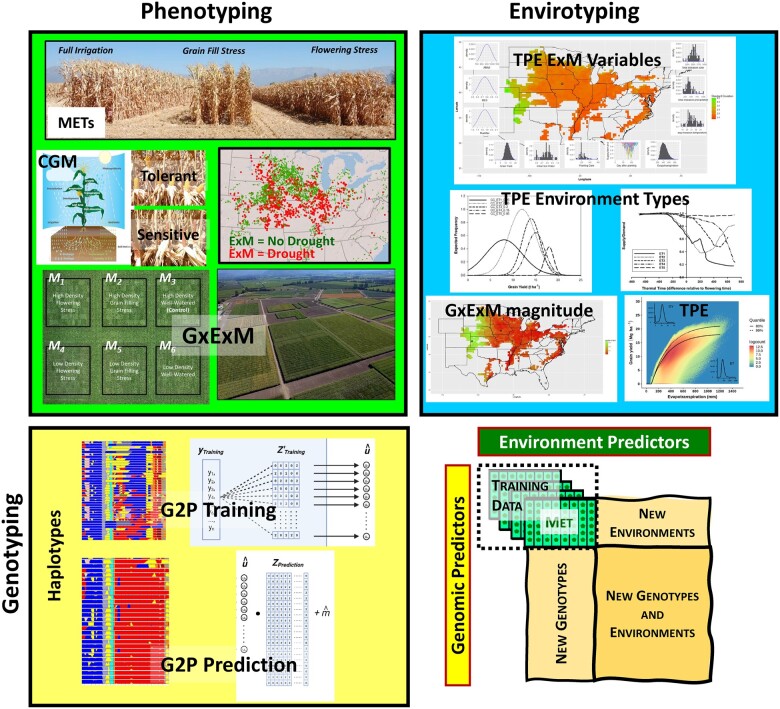
Integration of phenotyping, genotyping, and envirotyping to create training data sets for breeding prediction applications. Different views of key components and methodologies contributing to phenotyping, envirotyping, and genotyping activities involved in the conduct of breeding METs for stages of a plant breeding program. The accumulation of MET data sets over multiple breeding program cycles can be used to design appropriate training data sets to develop models for genomic prediction applications in breeding. The genotyping of individual entries is used to construct genotypic predictors based on individual markers (e.g. single-nucleotide polymorphisms; SNPs) or combinations of contiguous markers used to form haplotypes. The envirotyping activities are undertaken to construct enviromic predictors used to distinguish the different characteristics of the environments (e.g. crop evapotranspiration to integrate many environmental and crop variables that determine the availability of water to the crop and distinguish between water-limited and water-sufficient environments).
Figure 5
Figure 5
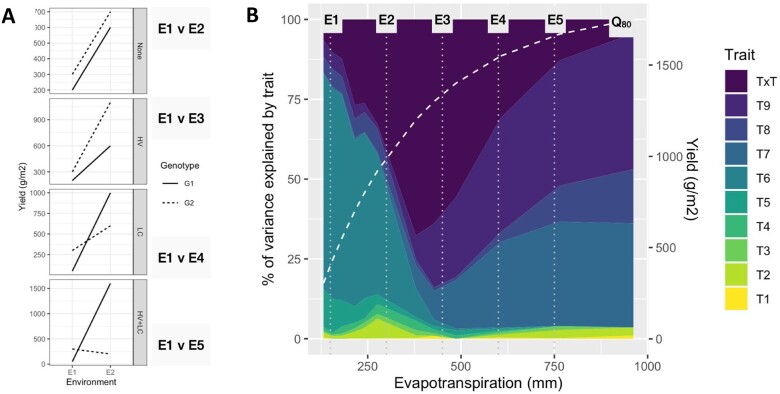
Schematic representations of GxE interactions. A, The emergence of GxE interactions for grain yield and two contrasting genotype reaction-norms (G1, G2) for grain yield along a continuum of environments (E1–E5) varying for crop water availability, as determined by crop evapotranspiration (Messina et al., 2022a, 2022b). B, The grain yield variation reaction-norms along the water availability continuum are an outcome of changes in the contributions of different physiological processes and traits (T1–T9) and trait networks (indicated by the different trait contributions and the TxT interactions) during the crop lifecycle that determine the grain yield outcomes as the environmental conditions change. Yield is modeled as a function of GxExM conditions along the water availability continuum. The continuum of water availability can be quantified by applying appropriate environmental descriptors as demonstrated in Figure 3 and described in Figure 4. The 80% quantile yield-evapotranspiration front (Q80) from Figure 3 is superimposed to indicate how different trait combinations are expected to contribute to the grain yield performance of the maize hybrids along the environmental continuum of water availability. The combination of different trait contributions and genetic variation for the traits within the reference population of genotypes under improvement by the breeding program contributes to the emergence of the genetic variation for grain yield, GxE interactions between environment types that were identified by envirotyping (indicated for comparisons between environment type E1 and environment types E2–E5 along the water availability continuum), and the contrasting grain yield reaction-norms indicated for the two hybrids. For reference, Figure 2 provides an empirical demonstration of examples of contrasting maize hybrid grain yield reaction-norms for a stratified sample of contrasting environment types.
Figure 6
Figure 6
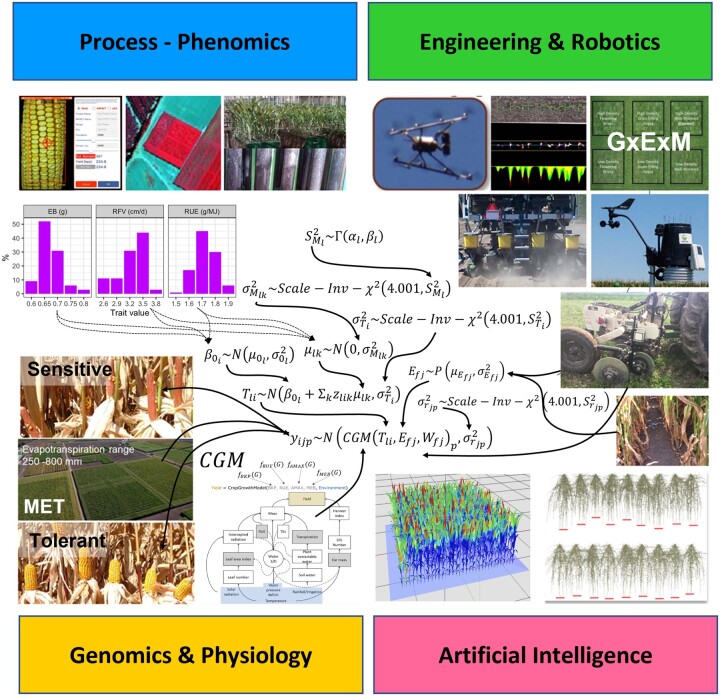
An example of the inputs from different phenotyping, envirotyping, and genotyping methods, depicted in Figure 4, used in combination with a hierarchical genotype-to-phenotype model for prediction of grain yield of maize hybrids using an appropriate crop growth model (CGM). The example is based on the application a maize CGM in combination with whole-genome prediction (WGP) for a network of traits included in the CGM (CGM-WGP) for yield prediction of maize hybrids for a range of environments that differed in water availability and is based on the studies reported by Messina et al. (2018) and Diepenbrock et al. (2022).

References

    1. Adee E, Roozeboom K, Balboa GR, Schlegel A, Ciampitti IA (2016) Drought-tolerant corn hybrids yield more in drought-stressed environments with no penalty in non-stressed environments. Front Plant Sci 7: 1534. - PMC - PubMed
    1. Allard RW, Bradshaw AD (1964) Implications of genotype–environmental interactions in applied plant breeding. Crop Sci 4: 503–508
    1. Araus JL, Cairns JE (2014) Field high-throughput phenotyping, the new frontier in crop breeding. Trends Plant Sci 19: 52–61 - PubMed
    1. Araus JL, Kefauver SC, Zaman-Allah M, Olsen MS, Cairns JE (2018) Translating high-throughput phenotyping into genetic gain. Trends Plant Sci 23: 451–466 - PMC - PubMed
    1. Atlin GN, Cairns JE, Biswanath D (2017) Rapid breeding and varietal replacement are critical to adaptation of cropping systems in the developing world to climate change. Glob Food Sec 12: 31–37 - PMC - PubMed

Publication types