


Diagnostic performance of different specimens in detecting enterovirus A71 in children with hand, foot and mouth disease
- PMID: 36371008
- PMCID: PMC10176262
- DOI: 10.1016/j.virs.2022.11.004
Diagnostic performance of different specimens in detecting enterovirus A71 in children with hand, foot and mouth disease
Abstract
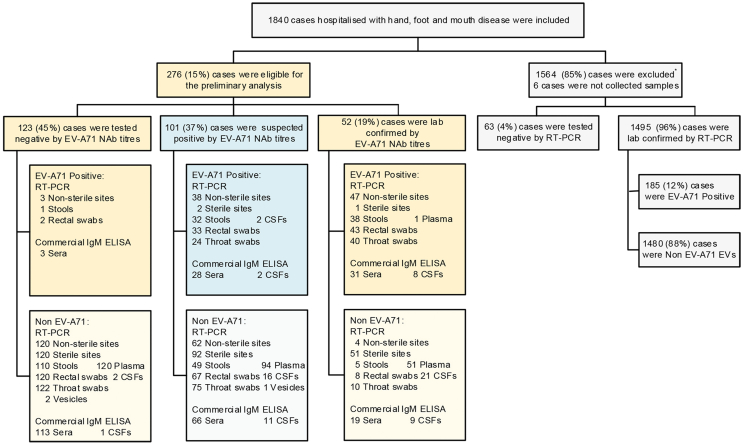
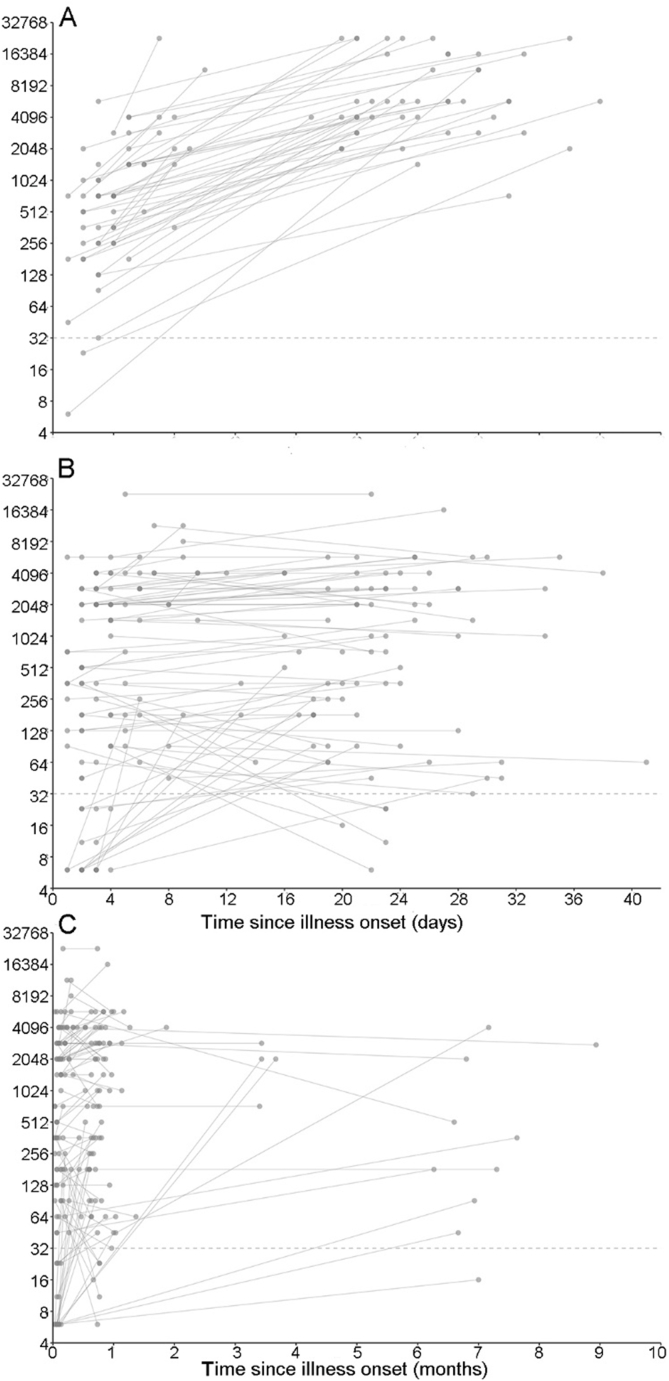
Hand, foot and mouth disease (HFMD) is a major public health problem among children in the Asia-Pacific region. The optimal specimen for HFMD virological diagnosis remains unclear. Enterovirus A71 (EV-A71) neutralizing antibody titres detected in paired sera were considered the reference standard for calculating the sensitivity, specificity, positive and negative predictive value of throat swabs, rectal swabs, stool, blood samples and cerebrospinal fluid (CSF) by RT-PCR or ELISA assay. In this study, clinical samples from 276 HFMD patients were collected for analysing the sensitivity of different kind of specimens. Our results showed that stool had the highest sensitivity (88%, 95% CI: 74%-96%) and agreement with the reference standard (91%). The order of diagnostic yield for EV-A71 infection was stool sample ≥ rectal swab > throat swab > blood sample > CSF sample, and using a combination of clinical samples improved sensitivity for enterovirus detection. The sensitivity of ELISA for IgM antibody detection in sterile-site specimens was significantly higher than that of RT-PCR (serum/plasma: 62% vs. 2%, CSF: 47% vs. 0%) (P < 0.002). In conclusion, our results suggest that stool has the highest diagnostic yield for EV-A71-infected HFMD. If stool is unavailable, rectal swabs can be collected to achieve a similar diagnostic yield. Otherwise, throat swabs may be useful in detecting positive samples. Although IgM in blood or CSF is diagnostically accurate, it lacks sensitivity, missing 40%-50% of cases. The higher proportion of severe cases and shorter interval between onset and sampling contributed to the increase in congruency between clinical testing and the serological reference standard.
Keywords: Enterovirus A71 (EV-A71); Evaluation of diagnostic methods; Hand, foot and mouth disease (HFMD); Sensitivity; Specificity.
Copyright © 2022 The Authors. Publishing services by Elsevier B.V. All rights reserved.
Conflict of interest statement
Conflict of interest Hongjie Yu received investigator-initiated research funding from Sanofi Pasteur, GlaxoSmithKline, and Yichang HEC Changjiang Pharmaceutical Company and Shanghai Roche Pharmaceutical Company, none of which is related to HFMD and enteroviruses. All other authors report no competing interests.
Figures




References
-
- Aw-Yong K.L., Tan C.W., Koh M.T., Sam I.C., Chan Y.F. Diagnosis of human enterovirus A71 infection in Malaysia using a commercial IgM-capture enzyme-linked immunosorbent assay and an IgM-colloidal gold immunochromatographic assay. Trop. Biomed. 2016;33:238–245. - PubMed
-
- Bharucha T., Sengvilaipaseuth O., Seephonelee M., Vongsouvath M., Vongsouvath M., Rattanavong S., Piorkowski G., Lecuit M., Gorman C., Pommier J.D., Garson J.A., Newton P.N., De Lamballerie X., Dubot-Pérès A. Viral RNA degradation makes urine a challenging specimen for detection of Japanese encephalitis virus in patients with suspected CNS infection. Open Forum Infect. Dis. 2019;6:ofz048. - PMC - PubMed
-
- Centers for Disease, C.,Prevention Notes from the field: severe hand, foot, and mouth disease associated with coxsackievirus A6 - Alabama, Connecticut, California, and Nevada, November 2011-February 2012. Morb. Mortal. Wkly. Rep. 2012;61:213–214. - PubMed
-
- Cordey S., Schibler M., L'huillier A.G., Wagner N., Goncalves A.R., Ambrosioni J., Asner S., Turin L., Posfay-Barbe K.M., Kaiser L. Comparative analysis of viral shedding in pediatric and adult subjects with central nervous system-associated enterovirus infections from 2013 to 2015 in Switzerland. J. Clin. Virol. 2017;89:22–29. - PubMed
MeSH terms
Grants and funding
LinkOut - more resources
Full Text Sources
