High-Fidelity Cytosine Base Editing in a GC-Rich Corynebacterium glutamicum with Reduced DNA Off-Target Editing Effects
- PMID: 36374037
- PMCID: PMC9769817
- DOI: 10.1128/spectrum.03760-22
High-Fidelity Cytosine Base Editing in a GC-Rich Corynebacterium glutamicum with Reduced DNA Off-Target Editing Effects
Abstract
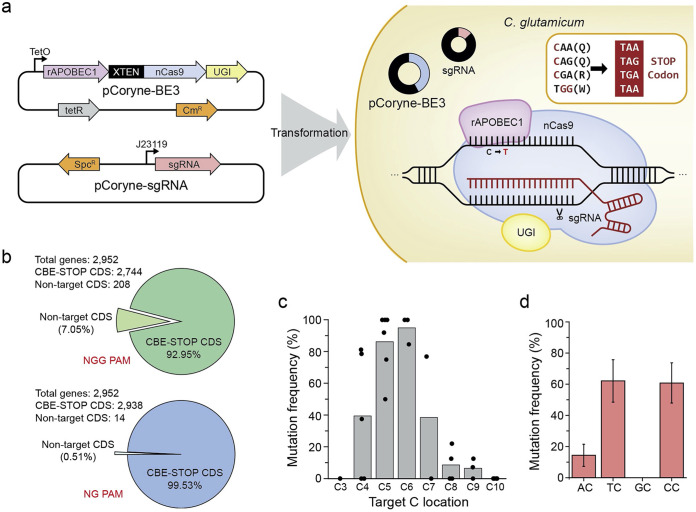
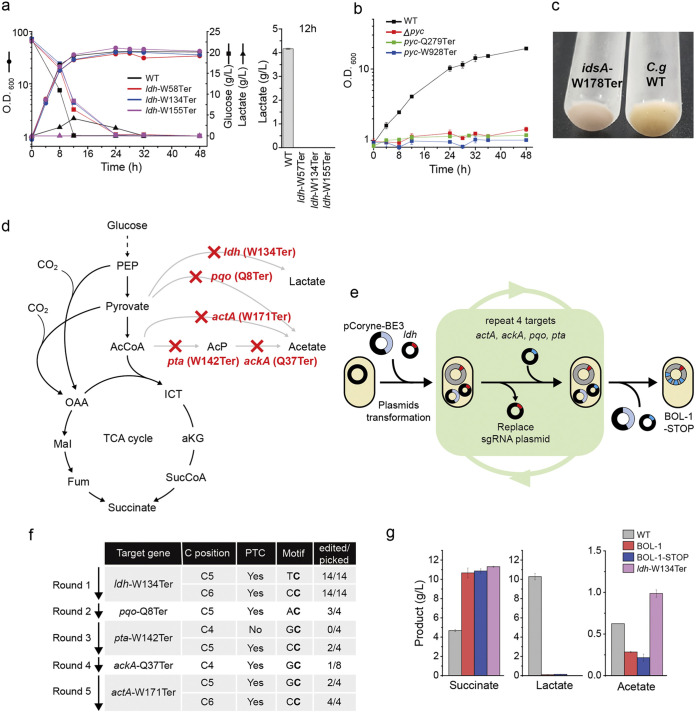
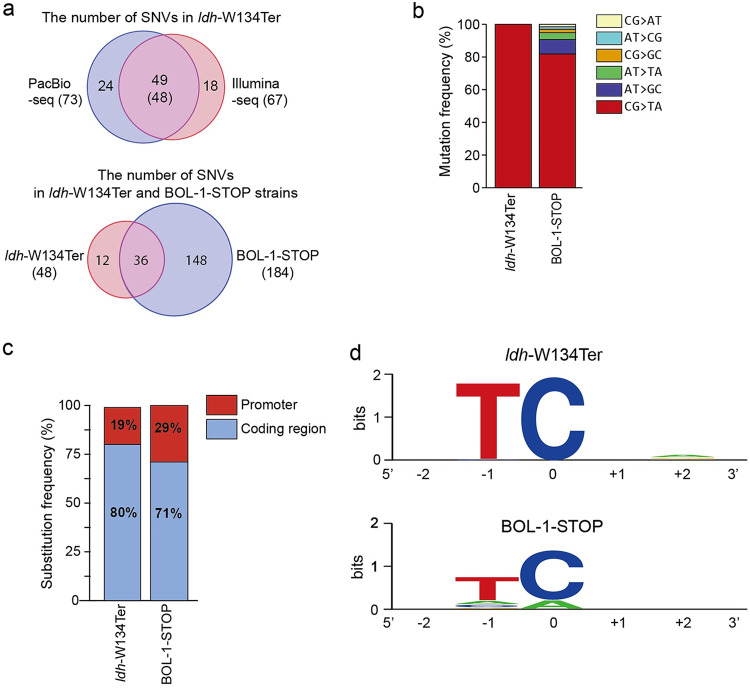
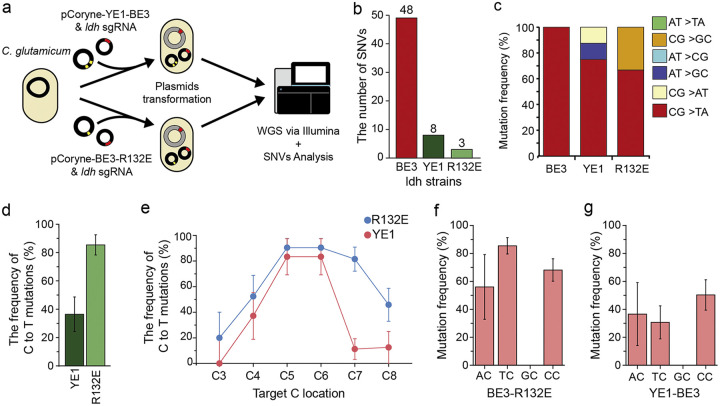
Genome editing technology is a powerful tool for programming microbial cell factories. However, rat APOBEC1-derived cytosine base editor (CBE) that converts C•G to T•A at target genes induced DNA off-targets, regardless of single-guide RNA (sgRNA) sequences. Although the high efficiencies of the bacterial CBEs have been developed, a risk of unidentified off-targets impeded genome editing for microbial cell factories. To address the issues, we demonstrate the genome engineering of Corynebacterium glutamicum as a GC-rich model industrial bacterium by generating premature termination codons (PTCs) in desired genes using high-fidelity cytosine base editors (CBEs). Through this CBE-STOP approach of introducing specific cytosine conversions, we constructed several single-gene-inactivated strains for three genes (ldh, idsA, and pyc) with high base editing efficiencies of average 95.6% (n = 45, C6 position) and the highest success rate of up to 100% for PTCs and ultimately developed a strain with five genes (ldh, actA, ackA, pqo, and pta) that were inactivated sequentially for enhancing succinate production. Although these mutant strains showed the desired phenotypes, whole-genome sequencing (WGS) data revealed that genome-wide point mutations occurred in each strain and further accumulated according to the duration of CBE plasmids. To lower the undesirable mutations, high-fidelity CBEs (pCoryne-YE1-BE3 and pCoryne-BE3-R132E) was employed for single or multiplexed genome editing in C. glutamicum, resulting in drastically reduced sgRNA-independent off-targets. Thus, we provide a CRISPR-assisted bacterial genome engineering tool with an average high efficiency of 90.5% (n = 76, C5 or C6 position) at the desired targets. IMPORTANCE Rat APOBEC1-derived cytosine base editor (CBE) that converts C•G to T•A at target genes induced DNA off-targets, regardless of single-guide RNA (sgRNA) sequences. Although the high efficiencies of bacterial CBEs have been developed, a risk of unidentified off-targets impeded genome editing for microbial cell factories. To address the issues, we identified the DNA off-targets for single and multiple genome engineering of the industrial bacterium Corynebacterium glutamicum using whole-genome sequencing. Further, we developed the high-fidelity (HF)-CBE with significantly reduced off-targets with comparable efficiency and precision. We believe that our DNA off-target analysis and the HF-CBE can promote CRISPR-assisted genome engineering over conventional gene manipulation tools by providing a markerless genetic tool without need for a foreign DNA donor.
Keywords: CRISPR; Corynebacterium glutamicum; cytosine base editor; gene editing; genome editing; industrial bacteria; nonsense mutation; off-target.
Conflict of interest statement
The authors declare no conflict of interest.
Figures
References
-
- Luo X, Reiter MA, d’Espaux L, Wong J, Denby CM, Lechner A, Zhang Y, Grzybowski AT, Harth S, Lin W, Lee H, Yu C, Shin J, Deng K, Benites VT, Wang G, Baidoo EEK, Chen Y, Dev I, Petzold CJ, Keasling JD. 2019. Complete biosynthesis of cannabinoids and their unnatural analogues in yeast. Nature 567:123–126. doi: 10.1038/s41586-019-0978-9. - DOI - PubMed
-
- Schafer A, Tauch A, Jager W, Kalinowski J, Thierbach G, Puhler A. 1994. Small mobilizable multi-purpose cloning vectors derived from the Escherichia coli plasmids pK18 and pK19: selection of defined deletions in the chromosome of Corynebacterium glutamicum. Gene 145:69–73. doi: 10.1016/0378-1119(94)90324-7. - DOI - PubMed
Publication types
MeSH terms
Substances
LinkOut - more resources
Full Text Sources
Molecular Biology Databases
Research Materials
Miscellaneous