Review
. 2022 Nov 28;51(23):9831-9852.
doi: 10.1039/d2cs00727d.

Porous organic polymers for CO2 capture, separation and conversion

Affiliations
Review

Porous organic polymers for CO2 capture, separation and conversion

Kyung Seob Song et al. Chem Soc Rev. .

Abstract

Porous organic polymers (POPs) have long been considered as prime candidates for carbon dioxide (CO2) capture, separation, and conversion. Especially their permanent porosity, structural tunability, stability and relatively low cost are key factors in such considerations. Whereas heteratom-rich microporous networks as well as their amine impregnation/functionalization have been actively exploited to boost the CO2 affinity of POPs, recently, the focus has shifted to engineering the pore environment, resulting in a new generation of highly microporous POPs rich in heteroatoms and featuring abundant catalytic sites for the capture and conversion of CO2 into value-added products. In this review, we aim to provide key insights into structure-property relationships governing the separation, capture and conversion of CO2 using POPs and highlight recent advances in the field.


Conflict of interest statement

There are no conflicts to declare.

Figures
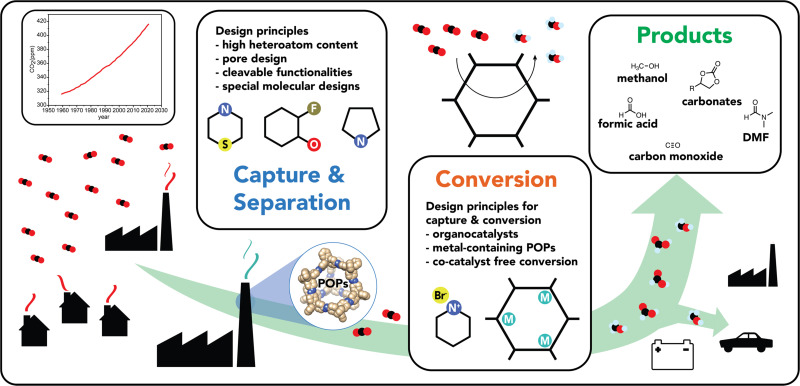
Fig. 1
Fig. 1. Schematic representation of various CO2 emission sources and a plot of atmospheric CO2 concentration over the years. An overview of as to how POPs can contribute to the CO2 circular economy by the capture/separation and the subsequent conversion of CO2 into value-added products.
Fig. 2
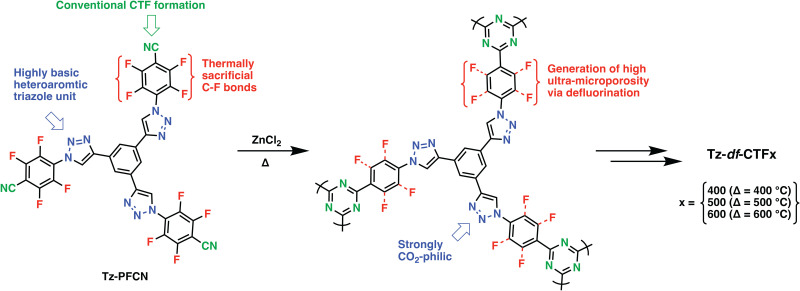
Fig. 2. Schematic illustration of the formation of Tz-df-CTFs via a Dual Strategic Approach. Reproduced from ref. with permission of the publisher.
Fig. 3
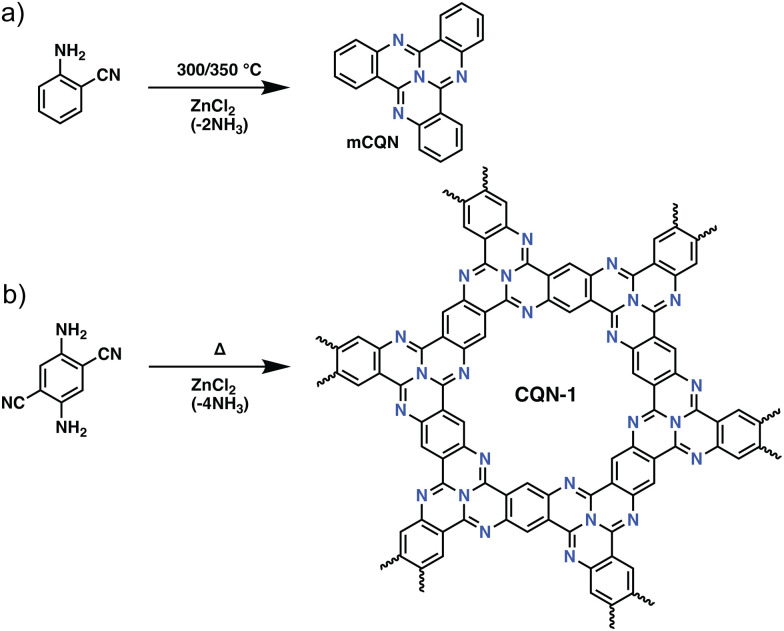
Fig. 3. The synthetic route for covalent quinazoline networks (CQNs). (a) Preparation of model compound, tricycloquinazoline (mCQN). (b) The synthesis of CQN-1. Reproduced from ref. with permission of the publisher.
Fig. 4
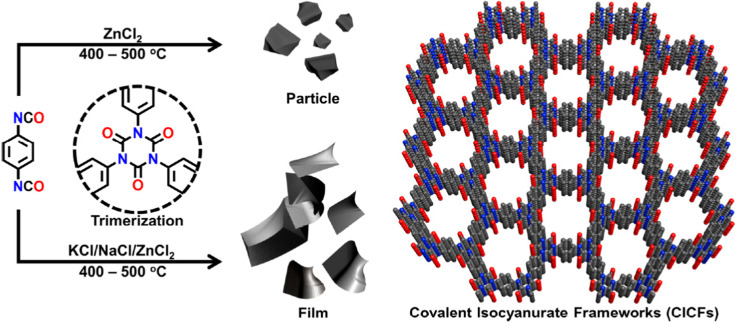
Fig. 4. The synthetic route for the preparation of covalent isocyanurate frameworks (CICFs). High heteroatom content improves CO2 uptake capacity and binding affinity. Reproduced from ref. with permission of the publisher.
Fig. 5
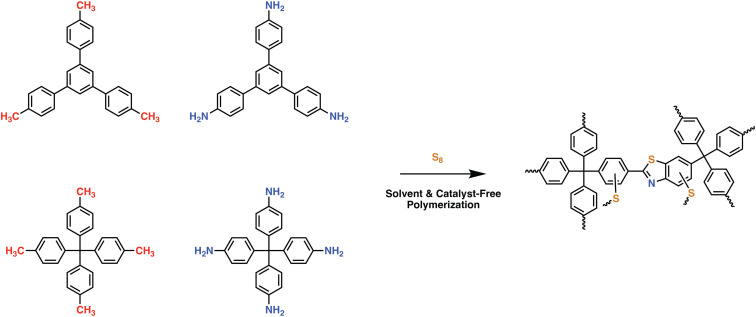
Fig. 5. Synthetic scheme for the preparation of ultramicroporous benzothiazole polymers (BTAPs) through environmentally benign conditions without using any solvent or catalyst. BTAPs were synthesized by simply reacting aromatic methyl- (M1 or M2) and amine-substituted monomers (A1 or A2) and elemental sulfur, S8, at 275 °C in quantitative yields, followed by a heating step at 400 °C for pore activation and sulfur impregnation. Reproduced from ref. with permission of the publisher.
Fig. 6
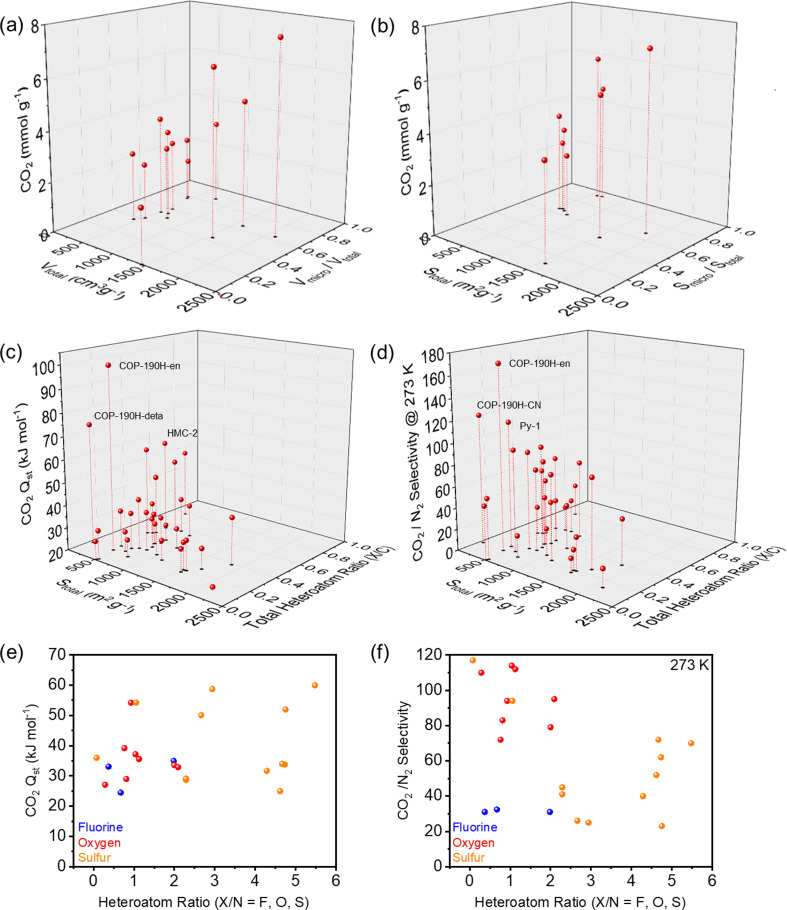
Fig. 6. CO2 capture performance of POPs containing heteroatoms with various parameters. (a) CO2 adsorption at 273 K versus total pore volume (Vtotal) and micropore volume ratio (Vmicro/Vtotal). (b) CO2 adsorption at 273 K versus total surface area (Stotal) and micropore surface area ratio (Smicro/Stotal). (c) Heat of adsorption (CO2Qst) and total surface area (Stotal) versus total heteroatom ratio (X/C, X = all heteroatom species in the same POPs) (d) CO2/N2 selectivity at 273 K and total surface area (Stotal) versus total heteroatom ratio (X/C, X = all heteroatom species in the same POPs) (e) heat of adsorption (CO2Qst) versus heteroatom ratio (X/N, X = F, O, S). (f) CO2/N2 selectivity versus heteroatom ratio (X/N, X = F, O, S). All the data is summarized in the Table 1.
Fig. 7
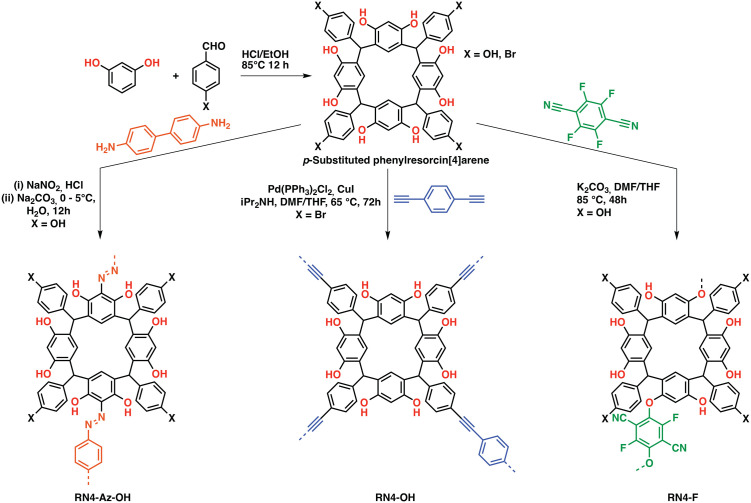
Fig. 7. Phenylresorcin-based POPs. (a) Synthetic schemes of C-phenylresorcin[4]arene-based porous organic polymers (POPs). RN4-Az-OH: diazo coupling between p-hydroxyphenylresorcin[4]arene and benzidine, RN4-OH: Sonogashira polycondensation between p-bromophenylresorcin[4]arene and 1,4-diethynylbenzene, and RN4-F: aromatic nucleophilic substitution reaction between p-hydroxyphenylresorcin[4]arene and tetrafluoroterephthalonitrile (12 phenolic OH groups are likely to be equally reactive) digital photographs of the respective POPs in the form of powder Reproduced from ref. with permission of the publisher.
Fig. 8
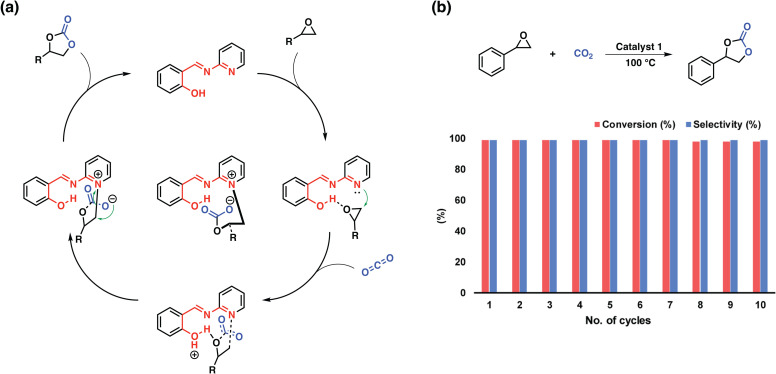
Fig. 8. Probable mechanism and recyclability studies. (a) A proposed mechanism for the coupling reaction of an epoxide with CO2 by catalyst 1. (b) Recycling of the catalyst in the coupling reaction of styrene oxide and CO2 under optimized reaction conditions. Reproduced from ref. with permission of the publisher.
Fig. 9
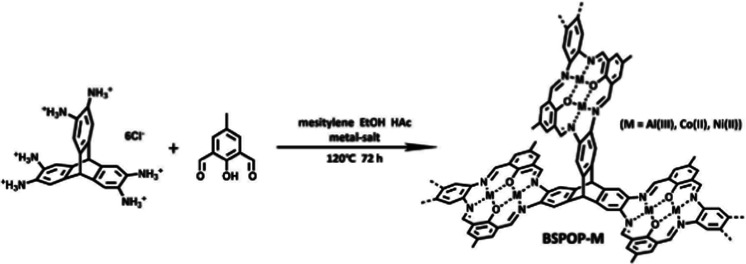
Fig. 9. Precise positioning of metal ions in bimetallic POPs. Synthetic scheme of BSPOP-M. Reproduced from ref. with permission of the publisher.
Fig. 10
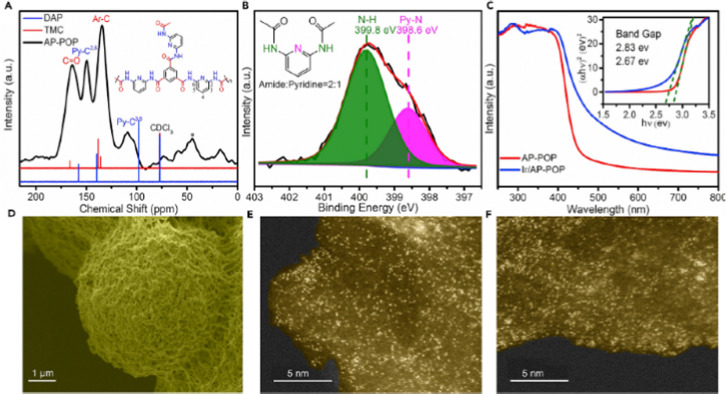
Fig. 10. Structure analysis of Ir/AP-POPs. Atomically dispersed and stable Ir metal atoms are analyzed. (A) The solid-state 13C/CP-MAS NMR spectrum of the AP-POP suggests the presence of CO, C–N, and C–Ar groups. (B) The N 1s core level XPS spectrum of the AP-POP distinguishes N in the pyridinic and amide groups in the framework. (C) The UV-vis absorbance spectra of samples with and without Ir indicate the p–p* electron transition of the conjugated polymer and show the supported Ir single atoms result in a red-shift of absorption. (D) An SEM image shows the spherical particles morphology of the AP-POP. (E and F) HAADF-STEM images of fresh (E and F) used 1.25% Ir/AP-POP indicate only the atomically dispersed Ir species on the support, even after the CO2 hydrogenation reaction. Reproduced from ref. with permission of the publisher.
Fig. 11
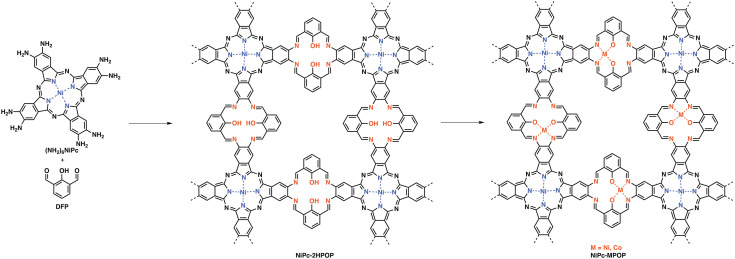
Fig. 11. Synthesis example of incorporating two different single metal atom species in porous organic polymers. Stepwise synthesis of Ni-Pc-MPOP by condensing of (NH2)8NiPc and DFP. Reproduced from ref. with permission of the publisher.
None
Kyung Seob Song
None
Patrick W. Fritz
None
Ali Coskun

References

    1. E. S. R. L. G. M. Laboratory, Trends in Atmospheric Carbon Dioxide, https://gml.noaa.gov/ccgg/trends/mlo.html, (accessed 28.03.2022, 2022)
    1. Marchetti C. Clim. Change. 1977;1:59–68. doi: 10.1007/BF00162777. - DOI
    1. Basile A., Gugliuzza A., Iulianelli A. and Morrone P., Advanced Membrane Science and Technology for Sustainable Energy and Environmental Applications, Woodhead Publishing, 2011, pp. 113–159
    1. Riboldi L. Bolland O. Energy Procedia. 2017;114:2390–2400. doi: 10.1016/j.egypro.2017.03.1385. - DOI
    1. Yang C. Xiong Y. Chen J. Jin J. Mi J. Chem. Eng. J. 2021;420:129555. doi: 10.1016/j.cej.2021.129555. - DOI