. 2022 Nov 14;17(11):e0277620.
doi: 10.1371/journal.pone.0277620. eCollection 2022.

Enhanced recombinant protein production in CHO cell continuous cultures under growth-inhibiting conditions is associated with an arrested cell cycle in G1/G0 phase

Affiliations

Enhanced recombinant protein production in CHO cell continuous cultures under growth-inhibiting conditions is associated with an arrested cell cycle in G1/G0 phase

Verónica Avello et al. PLoS One. .

Abstract

Low temperature and sodium butyrate (NaBu) are two of the most used productivity-enhancing strategies in CHO cell cultures during biopharmaceutical manufacturing. While these two approaches alter the balance in the reciprocal relationship between cell growth and productivity, we do not fully understand their mechanisms of action beyond a gross cell growth inhibition. Here, we used continuous culture to evaluate the differential effect of low temperature and NaBu supplementation on CHO cell performance and gene expression profile. We found that an increase in cell-productivity under growth-inhibiting conditions was associated with the arrest of cells in the G1/G0 phase. A transcriptome analysis revealed that the molecular mechanisms by which low temperature and NaBu arrested cell cycle in G1/G0 differed from each other through the deregulation of different cell cycle checkpoints and regulators. The individual transcriptome changes in pattern observed in response to low temperature and NaBu were retained when these two strategies were combined, leading to an additive effect in arresting the cell cycle in G1/G0 phase. The findings presented here offer novel molecular insights about the cell cycle regulation during the CHO cell bioprocessing and its implications for increased recombinant protein production. This data provides a background for engineering productivity-enhanced CHO cell lines for continuous manufacturing.


Conflict of interest statement

The authors have declared that no competing interests exist.

Figures

Fig 1
Fig 1. Schematic representation of the culture conditions performed in continuous cultures.
BM and NB correspond to basal medium with and without sodium butyrate, respectively. HD-37C-BM represents the control culture condition.
Fig 2
Fig 2. Culture parameters of CHO cell continuous cultures.
(white) without NaBu and (black) with NaBu. A) Viable cell density. B) Specific growth rate. C) hr-tPA titre. D) Cell-specific productivity. E) Glucose consumption rate. F) Lactate production rate. Statistical analysis of culture parameters is detailed in Table 1. Experimental values represent the mean of two biological replicates ± SEM. HD, High dilution rate; LD, low dilution rate; GLC, glucose; LAC, lactate; NaBu, sodium butyrate, hr-tPA, human recombinant tissue plasminogen activator. Profiles of CHO cell cultures at steady state are found in S2 Fig in the S2 File.
Fig 3
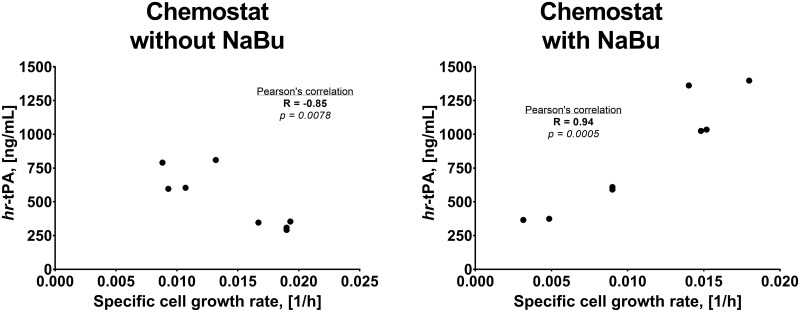
Fig 3. Relationship between specific cell growth rate and hr-tPA production in CHO cell cultures.
(right) Chemostat cultures without sodium butyrate; (left) Chemostat cultures with sodium butyrate. Each dot corresponds to one biological replicate. Pearson’s correlation was calculated.
Fig 4
Fig 4. Cell cycle analysis of CHO cells in continuous culture.
A) Percentage of cells in G1/G0 phase. B) Percentage of cells in S phase. C) Percentage of cells in G2/M phase. Experimental values represent the mean of two biological replicates ± SEM.
Fig 5
Fig 5. Relationship between cell cycle distribution and hr-tPA production in CHO cells.
A) Population in G1/G0 phase vs hr-tPA titre. B) Population in G1/G0 phase vs. qP. C) Population in S phase vs hr-tPA titre. D) Population in S phase vs. qP. E) Population in G2/M phase vs hr-tPA titre. F) Population in G2/M phase vs. qP. Each dot corresponds to a biological replicate of a specific culture condition. Pearson’s correlations were calculated considering each gene target and their relative titre/qP corresponding to the control culture conditions (HD-37C-BM).
Fig 6
Fig 6. Heat map of differentially expressed genes.
The mRNA expression levels are shown in Log2FC. Green and red boxes represent down- and upregulated genes, respectively. Genes were grouped into specific biological pathways. Transcriptome analysis is found in S1 File.

References

    1. Torres M, Dickson AJ. Combined gene and environmental engineering offers a synergetic strategy to enhance r-protein production in Chinese hamster ovary cells. Biotechnol Bioeng. 2021; 550–565. doi: 10.1002/bit.28000 - DOI - PubMed
    1. Huang YM, Hu WW, Rustandi E, Chang K, Yusuf-Makagiansar H, Ryll T. Maximizing productivity of CHO cell-based fed-batch culture using chemically defined media conditions and typical manufacturing equipment. Biotechnol Prog. 2010;26: 1400–1410. doi: 10.1002/btpr.436 - DOI - PubMed
    1. Hussain H, Fisher DI, Abbott WM, Roth RG, Dickson AJ. Use of a protein engineering strategy to overcome limitations in the production of “Difficult to Express” recombinant proteins. Biotechnol Bioeng. 2017;114: 2348–2359. doi: 10.1002/bit.26358 - DOI - PubMed
    1. Orlova NA, Kovnir S V., Gabibov AG, Vorobiev II. Stable high-level expression of factor VIII in Chinese hamster ovary cells in improved elongation factor-1 alpha-based system. BMC Biotechnol. BMC Biotechnology; 2017;17: 1–15. doi: 10.1186/s12896-017-0353-6 - DOI - PMC - PubMed
    1. Altamirano C, Paredes C, Illanes A, Cairó JJ, Gòdia F. Strategies for fed-batch cultivation of t-PA producing CHO cells: Substitution of glucose and glutamine and rational design of culture medium. J Biotechnol. 2004;110: 171–179. doi: 10.1016/j.jbiotec.2004.02.004 - DOI - PubMed

Publication types

Substances