


Declarative referential gesturing in a wild chimpanzee (Pan troglodytes)
- PMID: 36375066
- PMCID: PMC9704713
- DOI: 10.1073/pnas.2206486119
Declarative referential gesturing in a wild chimpanzee (Pan troglodytes)
Abstract
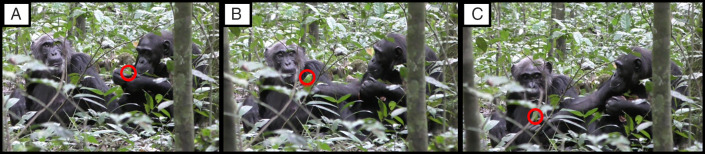
Humans are argued to be unique in their ability and motivation to share attention with others about external entities-sharing attention for sharing's sake. Indeed, in humans, using referential gestures declaratively to direct the attention of others toward external objects and events emerges in the first year of life. In contrast, wild great apes seldom use referential gestures, and when they do, it seems to be exclusively for imperative purposes. This apparent species difference has fueled the argument that the motivation and ability to share attention with others is a human-specific trait with important downstream consequences for the evolution of our complex cognition [M. Tomasello, Becoming Human (2019)]. Here, we report evidence of a wild ape showing a conspecific an item of interest. We provide video evidence of an adult female chimpanzee, Fiona, showing a leaf to her mother, Sutherland, in the context of leaf grooming in Kibale Forest, Uganda. We use a dataset of 84 similar leaf-grooming events to explore alternative explanations for the behavior, including food sharing and initiating dyadic grooming or playing. Our observations suggest that in highly specific social conditions, wild chimpanzees, like humans, may use referential showing gestures to direct others' attention to objects simply for the sake of sharing. The difference between humans and our closest living relatives in this regard may be quantitative rather than qualitative, with ramifications for our understanding of the evolution of human social cognition.
Keywords: chimpanzee; declarative gesture; referential communication; shared attention; showing.
Conflict of interest statement
The authors declare no competing interest.
Figures
References
-
- Camaioni L., The emergence of intentional communication in ontogeny, phylogeny, and pathology. Eur. Psychol. 2, 216–225 (1997).
-
- Bates E., Camaioni L., Volterra V., The acquisition of performatives prior to speech. Merrill-Palmer Q. Behav. Dev. 21, 205–226 (1975).
-
- Cameron‐Faulkner T., Theakston A., Lieven E., Tomasello M., The relationship between infant holdout and gives, and pointing. Infancy 20, 576–586 (2015).
-
- Boundy L., Cameron-Faulkner T., Theakston A., Intention or attention before pointing: Do infants’ early holdout gestures reflect evidence of a declarative motive? Infancy 24, 228–248 (2019). - PubMed
-
- Hobaiter C., Leavens D. A., Byrne R. W., Deictic gesturing in wild chimpanzees (Pan troglodytes)? Some possible cases. J. Comp. Psychol. 128, 82–87 (2014). - PubMed
Publication types
MeSH terms
LinkOut - more resources
Full Text Sources
Research Materials
Miscellaneous
