


Monoclonal Antibodies for Treatment of SARS-CoV-2 Infection During Pregnancy : A Cohort Study
- PMID: 36375150
- PMCID: PMC9747093
- DOI: 10.7326/M22-1329
Monoclonal Antibodies for Treatment of SARS-CoV-2 Infection During Pregnancy : A Cohort Study
Abstract
Background: Monoclonal antibody (mAb) treatment decreases hospitalization and death in high-risk outpatients with mild to moderate COVID-19. However, no studies have evaluated adverse events and effectiveness of mAbs in pregnant persons compared with no mAb treatment.
Objective: To determine the frequency of drug-related adverse events and obstetric-associated safety outcomes after treatment with mAb compared with no mAb treatment of pregnant persons, and the association between mAb treatment and a composite of 28-day COVID-19-related hospital admission or emergency department (ED) visit, COVID-19-associated delivery, or mortality.
Design: Retrospective, propensity score-matched, cohort study.
Setting: UPMC Health System from 30 April 2021 to 21 January 2022.
Participants: Persons aged 12 years or older with a pregnancy episode and any documented positive SARS-CoV-2 test (polymerase chain reaction or antigen test).
Intervention: Bamlanivimab and etesevimab, casirivimab and imdevimab, or sotrovimab treatment compared with no mAb treatment.
Measurements: Drug-related adverse events, obstetric-associated safety outcomes among persons who delivered, and a risk-adjusted composite of 28-day COVID-19-related hospital admission or ED visit, COVID-19-associated delivery, or mortality.
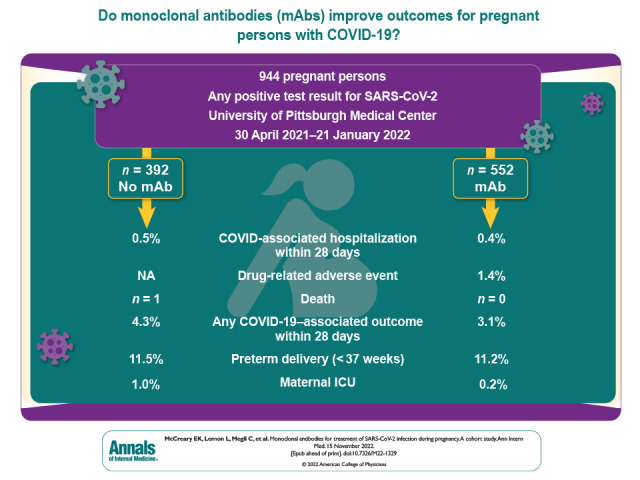
Results: Among 944 pregnant persons (median age [interquartile range (IQR)], 30 years [26 to 33 years]; White (79.5%; n = 750); median Charlson Comorbidity Index score [IQR], 0 [0 to 0]), 552 received mAb treatment (58%). Median gestational age at COVID-19 diagnosis or treatment was 179 days (IQR, 123 to 227), and most persons received sotrovimab (69%; n = 382). Of those with known vaccination status, 392 (62%) were fully vaccinated. Drug-related adverse events were uncommon (n = 8; 1.4%), and there were no differences in any obstetric-associated outcome among 778 persons who delivered. In the total population, the risk ratio for mAb treatment of the composite 28-day COVID-19-associated outcome was 0.71 (95% CI, 0.37 to 1.4). The propensity score-matched risk ratio was 0.61 (95% CI, 0.34 to 1.1). There were no deaths among mAb-treated patients compared with 1 death in the nontreated control patients. There were more non-COVID-19-related hospital admissions in the mAb-treated persons in the unmatched cohort (14 [2.5%] vs. 2 [0.5%]; risk ratio, 5.0; 95% CI, 1.1 to 21.7); however, there was no difference in the propensity score-matched rates, which were 2.5% mAb-treated vs. 2% untreated (risk ratio, 1.3; 95% CI, 0.58% to 2.8%).
Limitations: Drug-related adverse events were patient and provider reported and potentially underrepresented. Symptom severity at the time of SARS-CoV-2 testing was not available for nontreated patients.
Conclusion: In pregnant persons with mild to moderate COVID-19, adverse events after mAb treatment were mild and rare. There was no difference in obstetric-associated safety outcomes between mAb treatment and no treatment among persons who delivered. There was no difference in 28-day COVID-19-associated outcomes and non-COVID-19-related hospital admissions for mAb treatment compared with no mAb treatment in a propensity score-matched cohort.
Primary funding source: No funding was received for this study.
Conflict of interest statement
Figures
References
-
- Bariola JR, McCreary EK, Wadas RJ, et al. Impact of bamlanivimab monoclonal antibody treatment on hospitalization and mortality among nonhospitalized adults with severe acute respiratory syndrome coronavirus 2 infection. Open Forum Infect Dis. 2021;8:ofab254. [PMID: ] doi: 10.1093/ofid/ofab254 - DOI - PMC - PubMed
-
- Regeneron Pharmaceuticals. Fact Sheet For Health Care Providers Emergency Use Authorization (Eua) Of Regen-Cov®. Accessed at www.regeneron.com/downloads/treatment-covid19-eua-fact-sheet-for-hcp.pdf... on 18 August 2022.
Publication types
MeSH terms
Substances
Grants and funding
LinkOut - more resources
Full Text Sources
Medical
Miscellaneous
