Individualized antidepressant therapy in patients with major depressive disorder: Novel evidence-informed decision support tool
- PMID: 36376052
- PMCID: PMC9833178
- DOI: 10.46747/cfp.6811807
Individualized antidepressant therapy in patients with major depressive disorder: Novel evidence-informed decision support tool
Abstract
Objective: To introduce a visual clinical decision support tool to assist with individualizing first-line antidepressant pharmacotherapy for adults with major depressive disorder (MDD) in a Canadian context.
Sources of information: A literature review was conducted with Google Scholar, PubMed, the Cochrane Database of Systematic Reviews, and Trip Pro using the MeSH headings depression, antidepressive agents, primary care, practice patterns, medication adherence, and decision making, shared.
Main message: Major depressive disorder affects about 4.7% of Canadians annually and is a prevalent condition encountered and diagnosed in primary care. Untreated depression is associated with decreased quality of life, increased risk of suicide, and worsening physical health outcomes when depression co-occurs with other chronic medical conditions. In a network meta-analysis, antidepressant medications (such as selective serotonin reuptake inhibitors, serotonin-norepinephrine reuptake inhibitors, bupropion, and vortioxetine) reduced depressive symptoms by 50% or more when compared with placebo in acute treatment of adults with moderate to severe MDD. Poor treatment adherence and high discontinuation rates limit MDD treatment success. Factors such as strong therapeutic alliances between patients and prescribers, collaborative care, patient education, and supportive self-management have been shown to enhance treatment adherence. The most recent Canadian Network for Mood and Anxiety Treatments depression treatment guidelines (published in 2016) suggest 15 different first-line antidepressant medication options for the treatment of MDD. There is a need for evidence-informed decision support aids to individualize antidepressant therapy to treat patients diagnosed with MDD.
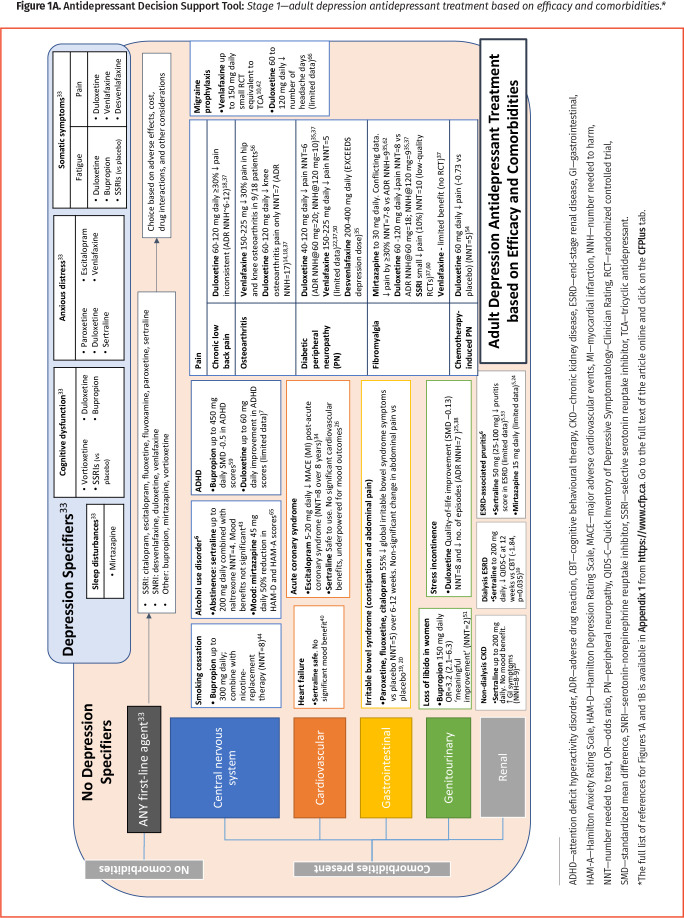
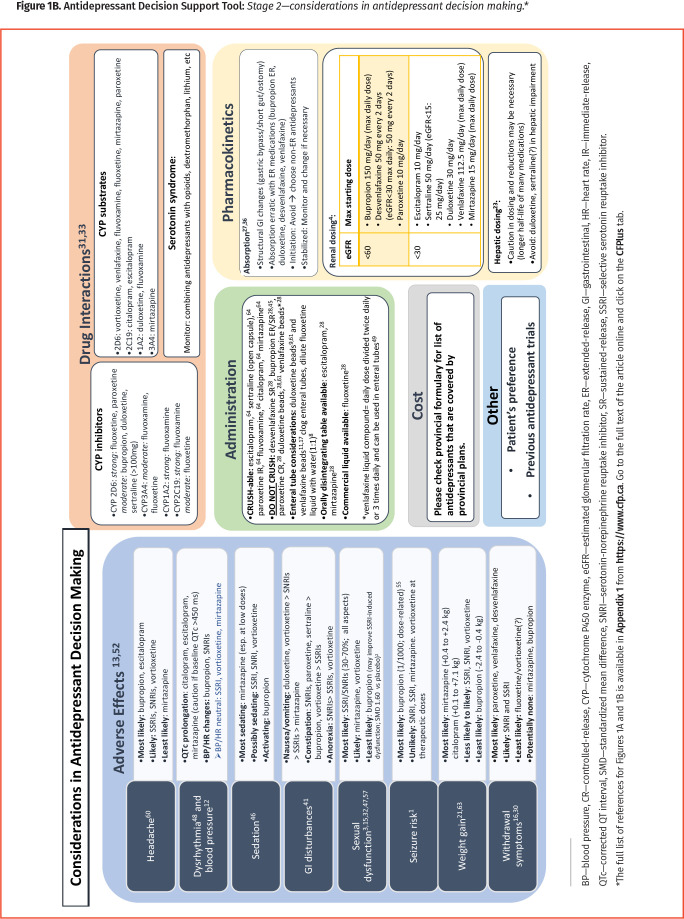
Conclusion: Recent studies on antidepressants have indicated no single antidepressant is superior to others in treating patients with MDD. This suggests there may be opportunities to enhance treatment adherence and success by tailoring antidepressant therapy to align with each patient's preferences. The Antidepressant Decision Support Tool was developed to help prescribers and adult patients engage in shared decision making to select an individualized and optimal first-line antidepressant for the treatment of acute MDD.
Copyright © 2022 the College of Family Physicians of Canada.
Figures
References
-
- Lam RW, McIntosh D, Wang J, Enns MW, Kolivakis T, Michalak EE, et al. . Canadian Network for Mood and Anxiety Treatments (CANMAT) 2016 clinical guidelines for the management of adults with major depressive disorder: section 1. Disease burden and principles of care. Can J Psychiatry 2016;61(9):510-23. Epub 2016 Aug 2. - PMC - PubMed
-
- Vos T, Lim SS, Abbafati C, Abbas KM, Abbasi M, Abbasifard M, et al. . Global burden of 369 diseases and injuries in 204 countries and territories, 1990–2019: a systematic analysis for the Global Burden of Disease Study 2019. Lancet 2020;396(10258):1204-22. Erratum in: Lancet 2020;396(10262):1562. Epub 2020 Oct 23. - PMC - PubMed
-
- Daly EJ, Trivedi MH, Wisniewski SR, Nierenberg AA, Gaynes BN, Warden D, et al. . Health-related quality of life in depression: a STAR*D report. Ann Clin Psychiatry 2010;22(1):43-55. - PubMed
-
- Rihmer Z, Gonda X.. Prevention of depression-related suicides in primary care. Psychiatr Hung 2012;27(2):72-81. - PubMed
-
- Moussavi S, Chatterji S, Verdes E, Tandon A, Patel V, Ustun B.. Depression, chronic diseases, and decrements in health: results from the World Health Surveys. Lancet 2007;370(9590):851-8. - PubMed
Publication types
MeSH terms
Substances
LinkOut - more resources
Full Text Sources
Research Materials