. 2022 Nov 14;12(1):19475.
doi: 10.1038/s41598-022-21878-x.

Racial disparities and prevalence of cardiovascular disease risk factors, cardiometabolic risk factors, and cardiovascular health metrics among US adults: NHANES 2011-2018

Affiliations

Racial disparities and prevalence of cardiovascular disease risk factors, cardiometabolic risk factors, and cardiovascular health metrics among US adults: NHANES 2011-2018

Stephanie M Lopez-Neyman et al. Sci Rep. .

Abstract

This study estimated the prevalence of cardiovascular disease (CVD) risk factors, cardiometabolic (CM) risk factors, and cardiovascular health metrics (CVHMs) among US adults and across race/ethnicity groups. The study comprised 8370 US adults aged ≥ 20 years from the National Health and Nutrition Examination Survey (NHANES) 2011-2018, free of coronary heart disease/heart failure, angina/angina pectoris, heart attack, and stroke, who provided complete data for the outcome variables of interest. Age-adjusted prevalence of CVD and CM risk factors, and CVHMs were computed for all adults and across race/ethnicity groups. All analyses accounted for the complex, multi-stage survey sampling design of the NHANES. Hypertension (45.0%), obesity (40.0%), fasting plasma glucose ≥ 100 mg/dL or hypoglycemic medication (51.0%), ideal physical activity (59.2%) and ideal smoking status (56.9%) were most prevalent for the whole sample. Mexican Americans and non-Hispanic Blacks had elevated risk for some, but not all, CVD and CM risk factors compared to non-Hispanic Whites and non-Hispanic Asians. Reducing further health disparities and persisting differences among racial and ethnic groups is vital to achieving the American Heart Association vision of all people having ideal cardiovascular health, living healthier and longer.


Conflict of interest statement

The authors declare no competing interests.

Figures

Figure 1
Figure 1
Flow chart of participant selection. NHANES National Health and Nutrition Examination Survey, CVD cardiovascular disease, CHF coronary heart failure, CHD coronary heart disease, ANG angina/angina pectoris, HAT heart attack, CVHM cardiovascular health metric, PA physical activity, SS smoke status, BMI body mass index, BP blood pressure, CHOL total cholesterol, FPG fasting plasma glucose. aCVD events includes CHF, CHD, ANG, HAT, Stroke. bCVHM includes PA, SS, BMI, BP, CHOL, FPG.
Figure 2
Figure 2
Age-standardized prevalence of cardiovascular disease risk factor for adults ≥ 20 years by race/ethnicity. SBP systolic blood pressure, DBP diastolic blood pressure, BMI body mass index, FPG fasting plasma glucose, HbAlc hemoglobin Alc. Risk factors defined as, hypertension (SBP ≥ 130 mmHg, DBP ≥ 80, or taking anti-hypertensive medication), hypercholesterolemia (cholesterol ≥ 240 mg/dL, or lipid-lowering medication), obesity (BMI ≥ 30 kg/m2), diabetes mellitus (FPG ≥ 126 mg/dL, HbAlc ≥ 6.5%, or taking hypoglycemic medication, smoking (smoked at least 100 cigarettes in life and currently smoking cigarettes). Statistics are displayed as percent (95% confidential interval). aAll values (except n) are weighted percentages, and age standardized to Census 2010 US population.
Figure 3
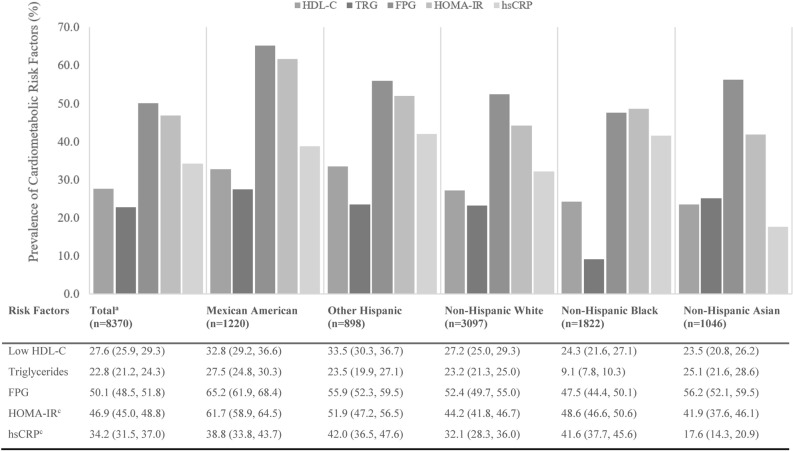
Figure 3
Age-standardized prevalence of cardiometabolic risk factor for adults ≥ 20 years by race/ethnicity. FPG fasting plasma glucose, HDL-C high density lipoprotein-cholesterol, HOMA-IR homeostatic model assessment of insulin resistance, hsCRP high-sensitivity C-reactive protein. Risk factors defined as, low HDL-C (< 40 mg/dL in men and < 50 mg/dL, in women), triglycerides (≥ 150 mg/dL), FPG (≥ 100 mg/dL and/or taking antidiabetic medication), HOMA-IR (≥ 2.5 [fasting glucose (mg/dL) × fasting insulin (mU/L)/405]), hsCRP (≥ 3 mg/L). Statistics are displayed as percent (95% confidential interval). aAll values (except n) are weighted percentages, and age standardized to Census 2010 US population

References

    1. Angell SY, et al. The American Heart Association 2030 impact goal: A presidential advisory from the American Heart Association. Circulation. 2020;141(9):e120–E138. doi: 10.1161/CIR.0000000000000758. - DOI - PMC - PubMed
    1. Virani SS, et al. Heart disease and stroke statistics-2021 update: A report from the American Heart Association. Circulation. 2021;143(8):e254–e743. doi: 10.1161/CIR.0000000000000950. - DOI - PubMed
    1. Roger VL, et al. Recommendations for cardiovascular health and disease surveillance for 2030 and beyond: A policy statement from the American Heart Association. Circulation. 2020;141(9):e104–e119. doi: 10.1161/CIR.0000000000000756. - DOI - PubMed
    1. He J, et al. Trends in cardiovascular risk factors in US adults by race and ethnicity and socioeconomic status, 1999–2018. JAMA. 2021;326(13):1286–1298. doi: 10.1001/jama.2021.15187. - DOI - PMC - PubMed
    1. Mitchell UA, Alishire JA, Kim JK, Crimmins EM. Black-white differences in 20-year trends in cardiovascular risk in the United States, 1990–2010. Ethn. Dis. 2019;29(4):587–598. doi: 10.18865/ed.29.4.587. - DOI - PMC - PubMed