


Adjacent segment disease after minimally invasive transforaminal lumbar interbody fusion for degenerative lumbar diseases: incidence and risk factors
- PMID: 36376871
- PMCID: PMC9661740
- DOI: 10.1186/s12891-022-05905-6
Adjacent segment disease after minimally invasive transforaminal lumbar interbody fusion for degenerative lumbar diseases: incidence and risk factors
Abstract
Study design: Retrospective study.
Objectives: To explore the incidence and risk factors for symptomatic adjacent segment disease (ASD) in patients enveloped in degenerative lumbar diseases after minimally invasive transforaminal lumbar interbody fusion (MIS-TLIF).
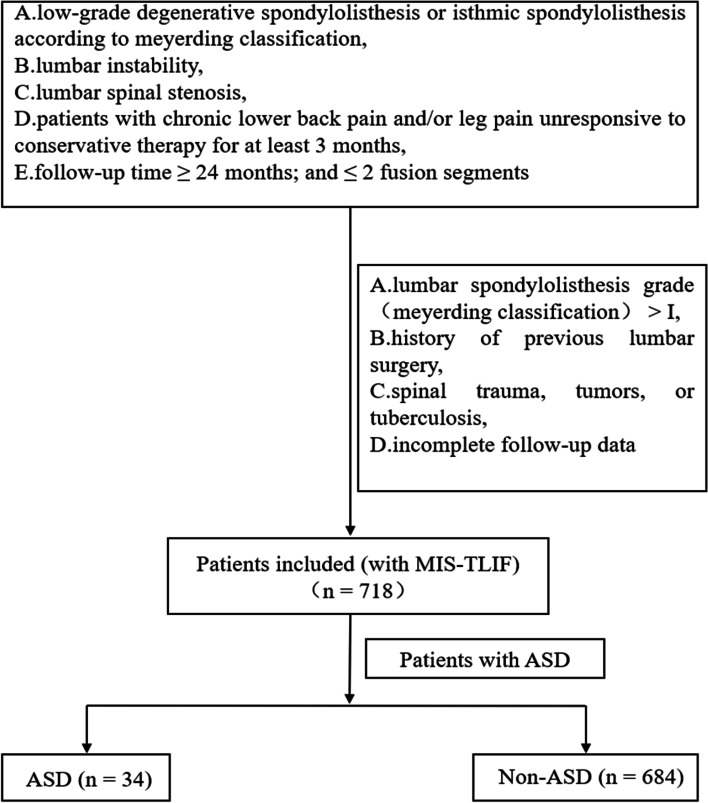
Methods: Data were retrospectively analyzed on 744 patients who underwent MIS-TLIF for degenerative lumbar diseases in our hospital from October 2012 to December 2018. The patients were divided into the ASD group and non-ASD (N-ASD) group on the basis of developing ASD at follow-up, and then the incidence of ASD was calculated. Clinical and radiological risk factors were assessed over time to determine their association with ASD by excluding less important factors.
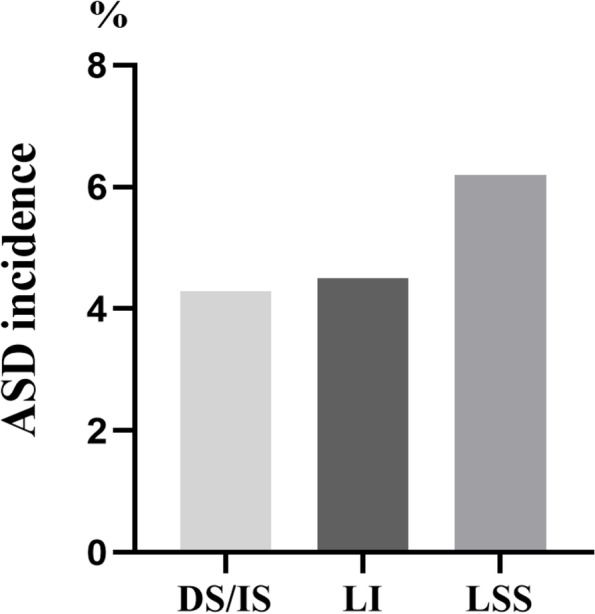
Results: Data were missing for 26 patients, while a total of 718 patients were successfully monitored after MIS-TLIF. Of the 718 individuals participated in the study, 34 (4.7%) patients plagued by ASD required surgical intervention. The average onset time of ASD was 62.7 ± 15.1 months. Univariate analysis results shows that age, bone mineral density (BMD), body mass index (BMI), preoperative adjacent intervertebral disc height and preoperative adjacent segment disc degeneration were significantly different between the ASD and N-ASD groups (p < 0.05). The logistic regression analysis results demonstrated that BMD (p = 0.039, OR = 0.986, 95% CI 0.899-1.115), BMI (p = 0.041, OR = 1.119, 95% CI 1.103-2.397), and preoperative adjacent intervertebral disc degeneration (p = 0.023, OR = 1.215, 95% CI 1.015-1.986) may be seen as risk factors for ASD after MIS-TLIF.
Conclusions: The incidence of ASD was about 4.7% in patients suffer from degenerative lumbar diseases after MIS-TLIF. BMD, BMI and preoperative adjacent intervertebral disc degeneration might be the risk factors for the occurrence of ASD after MIS-TLIF. Our research also suggested that patients with lower BMD, higher BMI and disc preoperative adjacent segment disc degeneration were more likely to develop ASD after MIS-TLIF.
Keywords: Adjacent segment disease; Degenerative lumbar diseases; Minimally invasive transforaminal lumbar interbody fusion; Risk factors.
© 2022. The Author(s).
Conflict of interest statement
The authors declare that they have no conflict of interests.
Figures
References
-
- Vos T, Flaxman AD, Naghavi M, et al. Years lived with disability (YLDs) for 1160 sequelae of 289 diseases and injuries 1990-2010: a systematic analysis for the Global Burden of Disease Study 2010 [published correction appears in Lancet. 2013;381(9867):628. AlMazroa, Mohammad A [added]; Memish, Ziad A [added]]. Lancet. 2012;380(9859):2163–96. - PMC - PubMed
-
- Seldomridge JA, Phillips FM. Minimally invasive spine surgery. Minim Invasive Neurosurg. 2010;35(5):271–273.
-
- Kim C W. Scientific basis of minimally invasive spine surgery: prevention of multifidus muscle injury during posterior lumbar surgery. Spine. 2010;35(26 Suppl):S281. - PubMed
-
- Tian W, Xu YF, Liu B, et al. Computer-assisted Minimally Invasive Transforaminal Lumbar Interbody Fusion May Be Better Than Open Surgery for Treating Degenerative Lumbar Disease. Clin Spine Surg. 2017;30(6):237–42. - PubMed
MeSH terms
LinkOut - more resources
Full Text Sources
