


Potential abiotic stress targets for modern genetic manipulation
- PMID: 36377770
- PMCID: PMC9806601
- DOI: 10.1093/plcell/koac327
Potential abiotic stress targets for modern genetic manipulation
Abstract
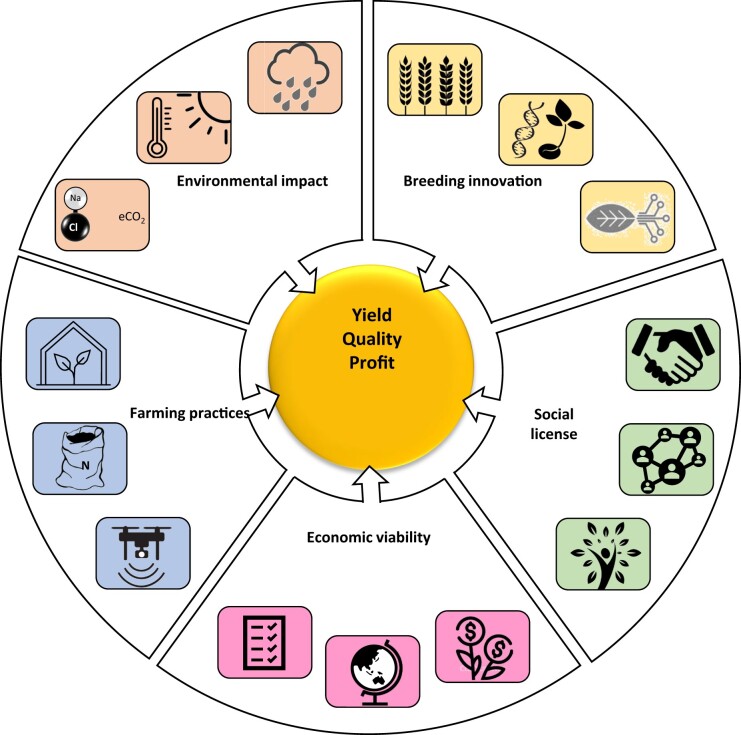
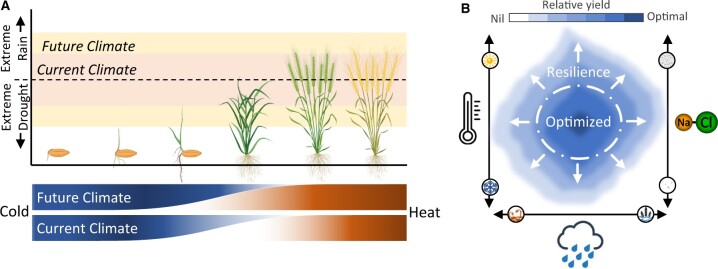
Research into crop yield and resilience has underpinned global food security, evident in yields tripling in the past 5 decades. The challenges that global agriculture now faces are not just to feed 10+ billion people within a generation, but to do so under a harsher, more variable, and less predictable climate, and in many cases with less water, more expensive inputs, and declining soil quality. The challenges of climate change are not simply to breed for a "hotter drier climate," but to enable resilience to floods and droughts and frosts and heat waves, possibly even within a single growing season. How well we prepare for the coming decades of climate variability will depend on our ability to modify current practices, innovate with novel breeding methods, and communicate and work with farming communities to ensure viability and profitability. Here we define how future climates will impact farming systems and growing seasons, thereby identifying the traits and practices needed and including exemplars being implemented and developed. Critically, this review will also consider societal perspectives and public engagement about emerging technologies for climate resilience, with participatory approaches presented as the best approach.
© American Society of Plant Biologists 2022. All rights reserved. For permissions, please email: journals.permissions@oup.com.
Figures
References
-
- Abdelraheem A, Thyssen GN, Fang DD, Jenkins JN, McCarty JC, Wedegaertner T, Zhang JF (2021) GWAS reveals consistent QTL for drought and salt tolerance in a MAGIC population of 550 lines derived from intermating of 11 Upland cotton (Gossypium hirsutum) parents. Mol Genet Genomics 296: 119–129 - PubMed
-
- Aguilar EA, Turner DW, Gibbs DJ, Armstrong W., Sivasithamparam K (2003) Oxygen distribution and movement, respiration and nutrient loading in banana roots (Musa spp. L.) subjected to aerated and oxygen-depleted environments. Plant Soil 253: 91–102
-
- Ainsworth EA, Long SP (2021) 30 years of free‐air carbon dioxide enrichment (FACE): What have we learned about future crop productivity and its potential for adaptation? Global Change Biol 27: 27–49 - PubMed
-
- Ali Z, Abul-faraj A, Li LX, Ghosh N, Piatek M, Mahjoub A, Aouida M, Piatek A, Baltes NJ, Voytas DF, et al. (2015) Efficient virus-mediated genome editing in plants using the CRISPR/Cas9 system. Mol Plant 8: 1288–1291 - PubMed
-
- Alley RB, Marotzke J, Nordhaus WD, Overpeck JT, Peteet DM, Pielke RA, Pierrehumbert RT, Rhines PB, Stocker TF, Talley LD, et al. (2003) Abrupt climate change. Science 299: 2005–2010 - PubMed
Publication types
MeSH terms
Substances
LinkOut - more resources
Full Text Sources
Miscellaneous
