


Incidence, prevalence, and comorbidities of juvenile idiopathic arthritis in Germany: a retrospective observational cohort health claims database study
- PMID: 36384690
- PMCID: PMC9670409
- DOI: 10.1186/s12969-022-00755-x
Incidence, prevalence, and comorbidities of juvenile idiopathic arthritis in Germany: a retrospective observational cohort health claims database study
Abstract
Background: Juvenile idiopathic arthritis (JIA) describes heterogenous categories of chronic inflammatory rheumatic conditions of unknown origin in children and adolescents. Epidemiological data in the literature vary, depending on geographic location, ethnicity and the case definition used. We evaluated epidemiology, especially that of the categories defined by the International League of Associations for Rheumatology (ILAR).
Methods: Using data from two different longitudinal health claims databases (WIG2 and InGef) from January 1st, 2013 to December 31st, 2019, we looked at patients aged 2 to 15 years old with at least one main inpatient or two secondary inpatient/verified outpatient ICD-10 diagnoses in at least two different quarters within one calendar year. We calculated prevalence and incidence (per 100,000 patients) and extrapolated data to the entire German population, looking at differences in gender and age groups. Additionally, we collected data on "other" not necessary comorbidities in our JIA patient population.
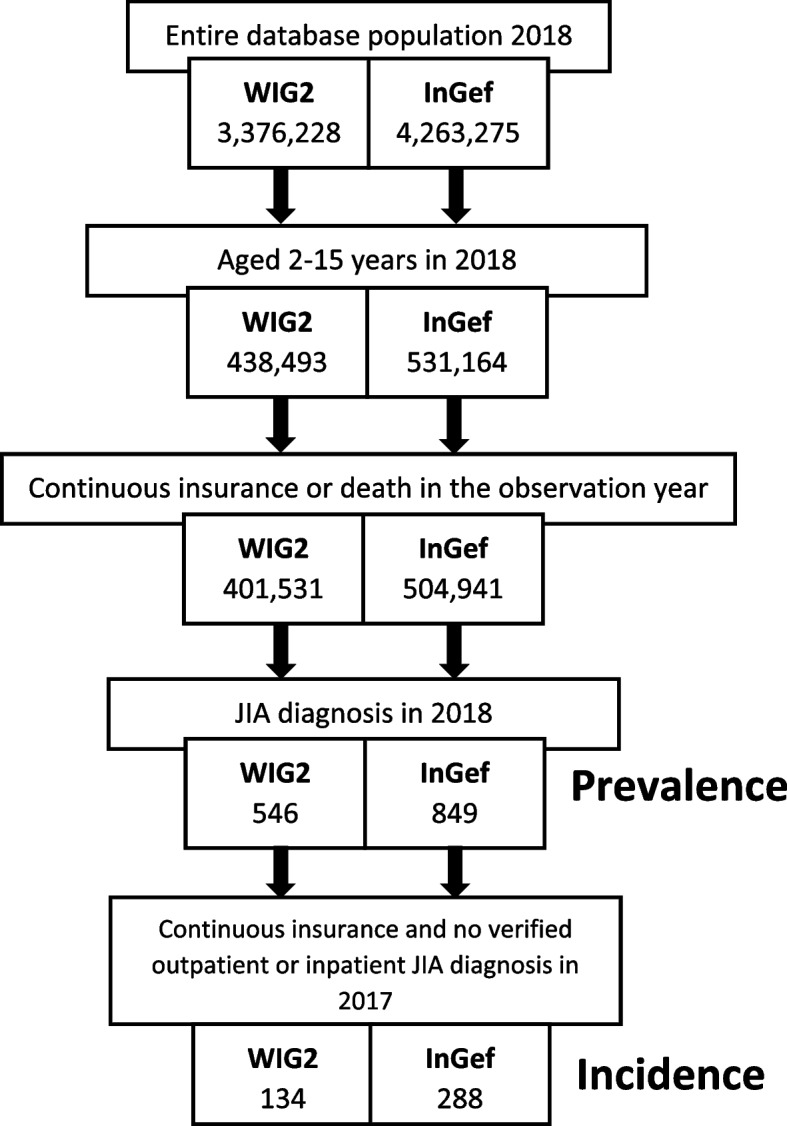
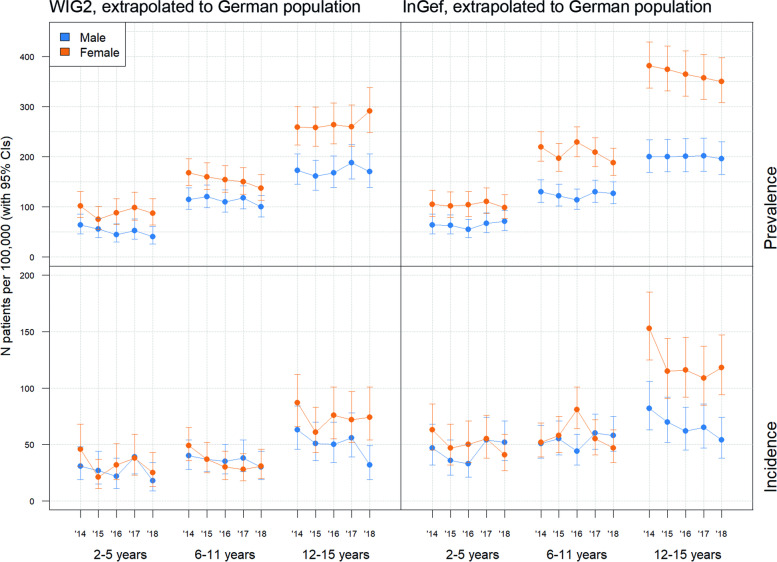
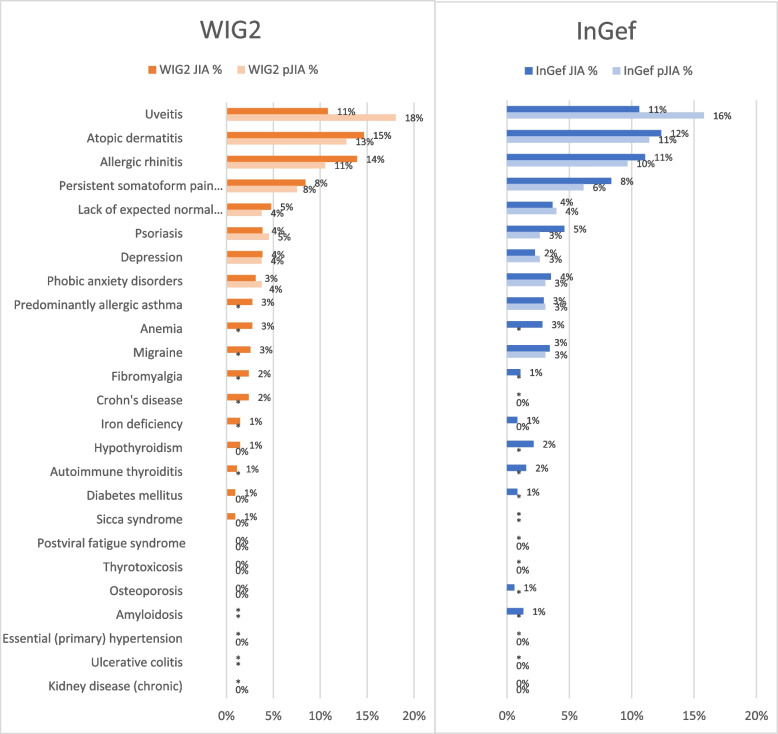
Results: Of the 3-4 million patients in the databases (respectively) in 2018, we found a total of 546 (WIG2) and 849 (InGef) patients that met our JIA case definition, with an incidence of 34 (29-41) and 60 (53-67) and prevalence of 133 (122-145) and 168 (157-179). Both incidence and prevalence throughout the age range were mostly higher in females than males, however the difference between females and males increased with increasing age. Of the ILAR categories, oligoarthritis was the most prevalent (70 and 91 per 100,000), with about half of our JIA patients in this category, followed by undifferentiated arthritis (49 and 56 cases per 100,000) and rheumatoid factor negative (RF-) (31 and 39 per 100,000). Incidence in 2018 was the highest in these three categories. Atopic dermatitis, vasomotor and allergic rhinitis, and uveitis were the pre-defined comorbidities seen most often in both databases.
Conclusion: This study provides current incidence and prevalence JIA data in Germany, contributing to knowledge on burden of disease and tools for healthcare planning.
Keywords: Burden of disease; Comorbidities; Incidence; JIA; Juvenile idiopathic arthritis; Polyarticular JIA; Prevalence.
© 2022. The Author(s).
Conflict of interest statement
All authors had complete autonomy for the process of designing the study, carrying out the analyses, interpreting the results and writing the manuscript. PK, CH, HD are employees of Pfizer Pharma GmbH. JB, RH, JD and TS are all employees of WIG2 GmbH, which is an independent institute and paid consultant to Pfizer Pharma GmbH for designing the study, carrying out the analyses, interpreting the results and writing the manuscript. GH received an honorarium from Pfizer Pharma GmbH in connection with designing the study and interpreting the results.
Figures
Similar articles
-
[Juvenile idiopathic arthritis-Diagnosis and management].Z Rheumatol. 2025 Mar;84(2):140-151. doi: 10.1007/s00393-025-01626-y. Epub 2025 Feb 17. Z Rheumatol. 2025. PMID: 39961862 Review. German.
-
Overlap of International League of Associations for Rheumatology and Preliminary Pediatric Rheumatology International Trials Organization Classification Criteria for Nonsystemic Juvenile Idiopathic Arthritis in an Established UK Multicentre Inception Cohort.Arthritis Care Res (Hoboken). 2024 Jun;76(6):831-840. doi: 10.1002/acr.25296. Epub 2024 Mar 15. Arthritis Care Res (Hoboken). 2024. PMID: 38212149
-
Clinical characteristics of juvenile idiopathic arthritis in an area of central Italy: a population-based study.Ann Ig. 2017 Jul-Aug;29(4):281-292. doi: 10.7416/ai.2017.2152. Ann Ig. 2017. PMID: 28569338
-
Epidemiology of juvenile idiopathic arthritis in Oman.Pediatr Rheumatol Online J. 2015 Aug 1;13:33. doi: 10.1186/s12969-015-0030-z. Pediatr Rheumatol Online J. 2015. PMID: 26232056 Free PMC article.
-
Disease of the year: juvenile idiopathic arthritis-associated uveitis--classification and diagnostic approach.Ocul Immunol Inflamm. 2014 Feb;22(1):56-63. doi: 10.3109/09273948.2013.871565. Epub 2014 Jan 10. Ocul Immunol Inflamm. 2014. PMID: 24410427 Review.
Cited by
-
Ethnic heterogeneity of juvenile arthritis in the Republic of Sakha (Yakutia) related to a high human leukocyte antigen B27 frequency.World J Clin Pediatr. 2025 Jun 9;14(2):101873. doi: 10.5409/wjcp.v14.i2.101873. eCollection 2025 Jun 9. World J Clin Pediatr. 2025. PMID: 40491744 Free PMC article.
-
Epidemiology and comorbidity of juvenile idiopathic arthritis in Poland- a nationwide study.Pediatr Rheumatol Online J. 2025 Mar 28;23(1):33. doi: 10.1186/s12969-025-01065-8. Pediatr Rheumatol Online J. 2025. PMID: 40156029 Free PMC article.
-
[Juvenile idiopathic arthritis-Diagnosis and management].Z Rheumatol. 2025 Mar;84(2):140-151. doi: 10.1007/s00393-025-01626-y. Epub 2025 Feb 17. Z Rheumatol. 2025. PMID: 39961862 Review. German.
-
Effects of Multimodal Rheumatologic Complex Treatment in Childhood and Adolescence.Children (Basel). 2025 Apr 7;12(4):472. doi: 10.3390/children12040472. Children (Basel). 2025. PMID: 40310131 Free PMC article.
-
Systemic Juvenile Idiopathic Arthritis and Secondary Macrophage Activation Syndrome in Latvia from 2009 to 2020: A Nationwide Retrospective Study.Medicina (Kaunas). 2023 Apr 20;59(4):798. doi: 10.3390/medicina59040798. Medicina (Kaunas). 2023. PMID: 37109756 Free PMC article.
References
-
- Petty RE, Southwood TR, Manners P, Baum J, Glass DN, Goldenberg J, et al. International League of Associations for Rheumatology classification of juvenile idiopathic arthritis: second revision, Edmonton, 2001. J Rheumatol. 2004;31:390–392. - PubMed
Publication types
MeSH terms
LinkOut - more resources
Full Text Sources
Medical
Miscellaneous
