Maternal mortality in eight European countries with enhanced surveillance systems: descriptive population based study
- PMID: 36384872
- PMCID: PMC9667469
- DOI: 10.1136/bmj-2022-070621
Maternal mortality in eight European countries with enhanced surveillance systems: descriptive population based study
Abstract
Objective: To compare maternal mortality in eight countries with enhanced surveillance systems.
Design: Descriptive multicountry population based study.
Setting: Eight countries with permanent surveillance systems using enhanced methods to identify, document, and review maternal deaths. The most recent available aggregated maternal mortality data were collected for three year periods for France, Italy, and the UK and for five year periods for Denmark, Finland, the Netherlands, Norway, and Slovakia.
Population: 297 835 live births in Denmark (2013-17), 301 169 in Finland (2008-12), 2 435 583 in France (2013-15), 1 281 986 in Italy (2013-15), 856 572 in the Netherlands (2014-18), 292 315 in Norway (2014-18), 283 930 in Slovakia (2014-18), and 2 261 090 in the UK (2016-18).
Outcome measures: Maternal mortality ratios from enhanced systems were calculated and compared with those obtained from each country's office of vital statistics. Age specific maternal mortality ratios; maternal mortality ratios according to women's origin, citizenship, or ethnicity; and cause specific maternal mortality ratios were also calculated.
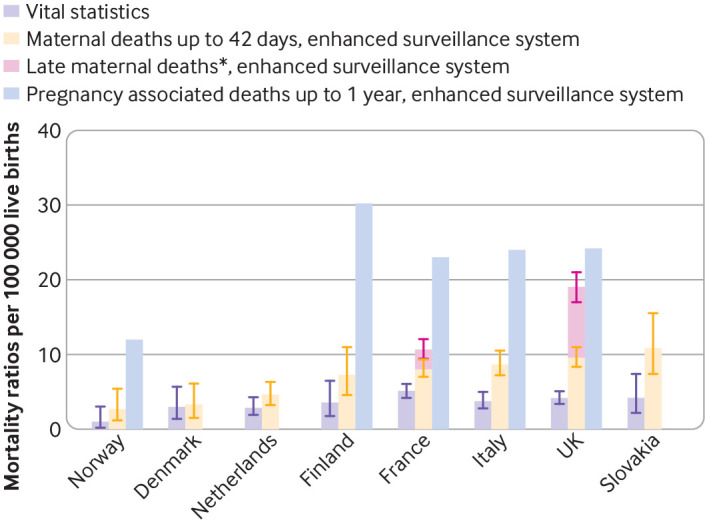
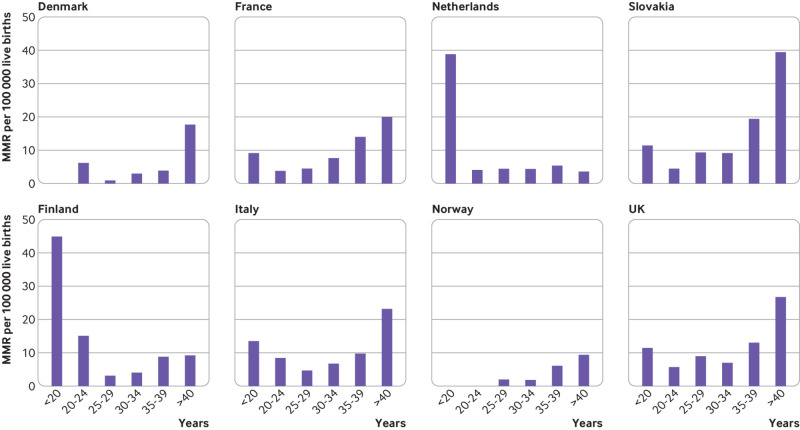
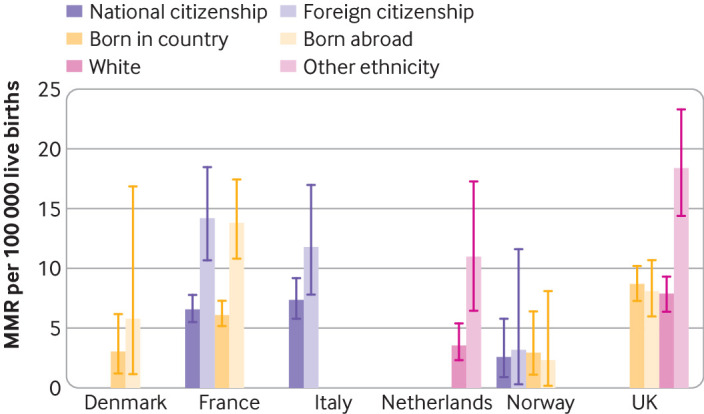
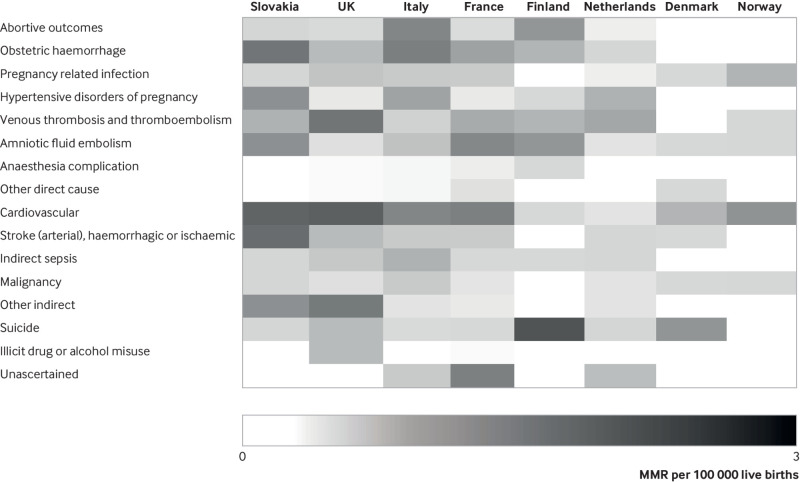
Results: Methods for identifying and classifying maternal deaths up to 42 days were very similar across countries (except for the Netherlands). Maternal mortality ratios up to 42 days after end of pregnancy varied by a multiplicative factor of four from 2.7 and 3.4 per 100 000 live births in Norway and Denmark to 9.6 in the UK and 10.9 in Slovakia. Vital statistics offices underestimated maternal mortality by 36% or more everywhere but Denmark. Age specific maternal mortality ratios were higher for the youngest and oldest mothers (pooled relative risk 2.17 (95% confidence interval 1.38 to 3.34) for women aged <20 years, 2.10 (1.54 to 2.86) for those aged 35-39, and 3.95 (3.01 to 5.19) for those aged ≥40, compared with women aged 20-29 years). Except in Norway, maternal mortality ratios were ≥50% higher in women born abroad or of minoritised ethnicity, defined variously in different countries. Cardiovascular diseases and suicides were leading causes of maternal deaths in each country. Some other conditions were also major contributors to maternal mortality in only one or two countries: venous thromboembolism in the UK and the Netherlands, hypertensive disorders in the Netherlands, amniotic fluid embolism in France, haemorrhage in Italy, and stroke in Slovakia. Only two countries, France and the UK, had enhanced methods for studying late maternal deaths, those occurring between 43 and 365 days after the end of pregnancy.
Conclusions: Variations in maternal mortality ratios exist between high income European countries with enhanced surveillance systems. In-depth analyses of differences in the quality of care and health system performance at national levels are needed to reduce maternal mortality further by learning from best practices and each other. Cardiovascular diseases and mental health in women during and after pregnancy must be prioritised in all countries.
© Author(s) (or their employer(s)) 2019. Re-use permitted under CC BY-NC. No commercial re-use. See rights and permissions. Published by BMJ.
Conflict of interest statement
Competing interests: All authors have completed the ICMJE uniform disclosure form at https://www.icmje.org/disclosure-of-interest/ and declare: no support from any organisation for the submitted work; no financial relationships with any organisations that might have an interest in the submitted work in the previous three years; no other relationships or activities that could appear to have influenced the submitted work.
Figures
Comment in
-
Accurate surveillance of maternal deaths is an international priority.BMJ. 2022 Nov 16;379:o2691. doi: 10.1136/bmj.o2691. BMJ. 2022. PMID: 36384947 No abstract available.
References
-
- World Health Organization, UNICEF, UNFPA, World Bank Group, United Nations. Maternal mortality: levels and trends, 2000 to 2017. 2019. https://www.who.int/publications/i/item/9789241516488.
-
- Donati S, Buoncristiano M, Lega I, D’Aloja P, Maraschini A, ItOSS working group . The Italian Obstetric Surveillance System: Implementation of a bundle of population-based initiatives to reduce haemorrhagic maternal deaths. PLoS One 2021;16:e0250373. 10.1371/journal.pone.0250373 - DOI - PMC - PubMed
-
- Knight M, Bunch K, Tuffnell D, et al., eds. MBRRACE-UK. Saving Lives, Improving Mothers’ Care - Lessons learned to inform maternity care from the UK and Ireland Confidential Enquiries into Maternal Deaths and Morbidity 2016-18. National Perinatal Epidemiology Unit. University of Oxford, 2020.
MeSH terms
LinkOut - more resources
Full Text Sources
Medical