. 2022 Nov 16;13(1):7011.
doi: 10.1038/s41467-022-34506-z.

Compensatory epistasis maintains ACE2 affinity in SARS-CoV-2 Omicron BA.1

Affiliations

Compensatory epistasis maintains ACE2 affinity in SARS-CoV-2 Omicron BA.1

Alief Moulana et al. Nat Commun. .

Abstract

The Omicron BA.1 variant emerged in late 2021 and quickly spread across the world. Compared to the earlier SARS-CoV-2 variants, BA.1 has many mutations, some of which are known to enable antibody escape. Many of these antibody-escape mutations individually decrease the spike receptor-binding domain (RBD) affinity for ACE2, but BA.1 still binds ACE2 with high affinity. The fitness and evolution of the BA.1 lineage is therefore driven by the combined effects of numerous mutations. Here, we systematically map the epistatic interactions between the 15 mutations in the RBD of BA.1 relative to the Wuhan Hu-1 strain. Specifically, we measure the ACE2 affinity of all possible combinations of these 15 mutations (215 = 32,768 genotypes), spanning all possible evolutionary intermediates from the ancestral Wuhan Hu-1 strain to BA.1. We find that immune escape mutations in BA.1 individually reduce ACE2 affinity but are compensated by epistatic interactions with other affinity-enhancing mutations, including Q498R and N501Y. Thus, the ability of BA.1 to evade immunity while maintaining ACE2 affinity is contingent on acquiring multiple interacting mutations. Our results implicate compensatory epistasis as a key factor driving substantial evolutionary change for SARS-CoV-2 and are consistent with Omicron BA.1 arising from a chronic infection.


Conflict of interest statement

A.M.P. and M.M.D. have or have recently consulted for Leyden Labs. J.D.B. has or has recently consulted for Apriori Bio, Oncorus, Moderna, and Merck. J.D.B., A.J.G., and T.N.S. are inventors on Fred Hutch licensed patents related to viral deep mutational scanning. The other authors declare no competing interests.

Figures
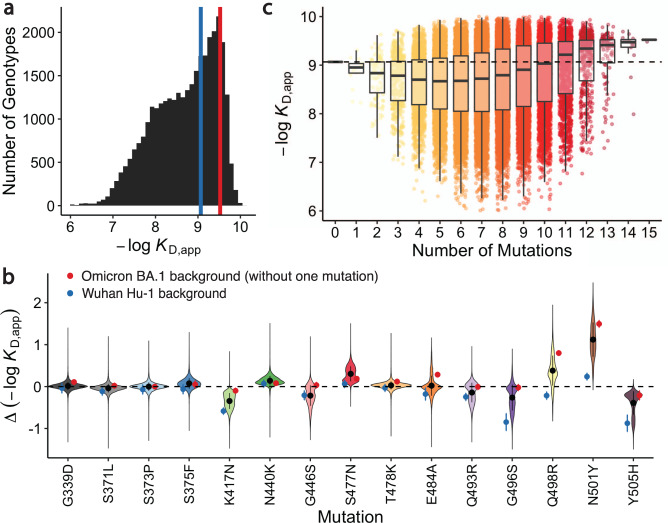
Fig. 1
Fig. 1. Binding affinity landscape.
a Distribution of binding affinities to ACE2 across all N=32,768 RBD genotypes tested. Binding affinities are shown as -logKD,app; vertical blue and red lines indicate the -logKD,app for Wuhan Hu-1 and Omicron BA.1, respectively. b Distributions of the effect of each mutation on ACE2 affinity (defined as the change in -logKD,app resulting from mutation) across all possible genetic backgrounds at the other 14 loci. Black line segments indicate 25th and 75th percentiles of the effect distributions and points represent distribution means, n=16384 backgrounds. Blue and red points specify effects on Wuhan Hu-1 and most-mutated backgrounds, respectively. c Distribution of binding affinities grouped by number of Omicron BA.1 mutations. Binding affinity of the Wuhan Hu-1 variant is indicated by horizontal dashed line. The boxes correspond to the range between 25th and 75th percentiles, and the whiskers extend to the largest/smallest value no further than 1.5 times the inter-quartile range.
Fig. 2
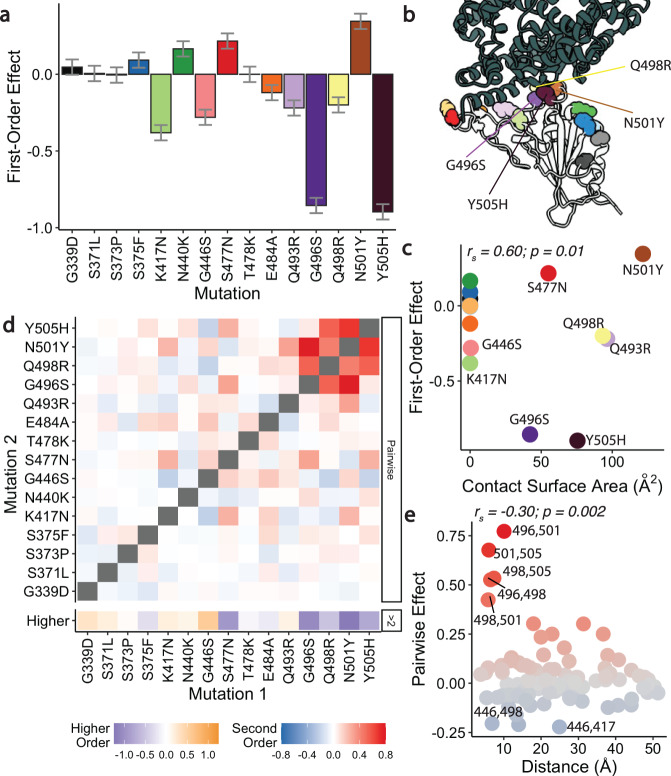
Fig. 2. Linear and epistatic effects of mutations.
a First-order effects in best-fitting epistatic interaction model (up to fifth order). Error bars represent standard errors from the model fit, and are centered on the mean, n=16,384. b Co-crystal structure of Omicron BA.1 RBD and ACE2 receptor (PDB ID 7WPB). Mutated residues shown as spheres colored as in (a). c First-order effects for each mutation plotted against contact surface area between corresponding BA.1 RBD residue and ACE2. Mutations colored as in (a). The Spearman’s rank correlation coefficient (rs) between first-order effect and contact surface area is indicated in the top-left. d Second-order epistatic interaction coefficients and higher order interaction coefficients. For each mutation, higher order interaction coefficient (shown at bottom of heat map plot) is calculated by summing over all third- and fourth-order interaction coefficients involving the mutation. e Pairwise interaction coefficients plotted against the distances between the respective alpha-carbons. Mutations are colored by pairwise coefficient as in (d). The Spearman’s rank correlation coefficient (rs) is indicated in the top-left.
Fig. 3
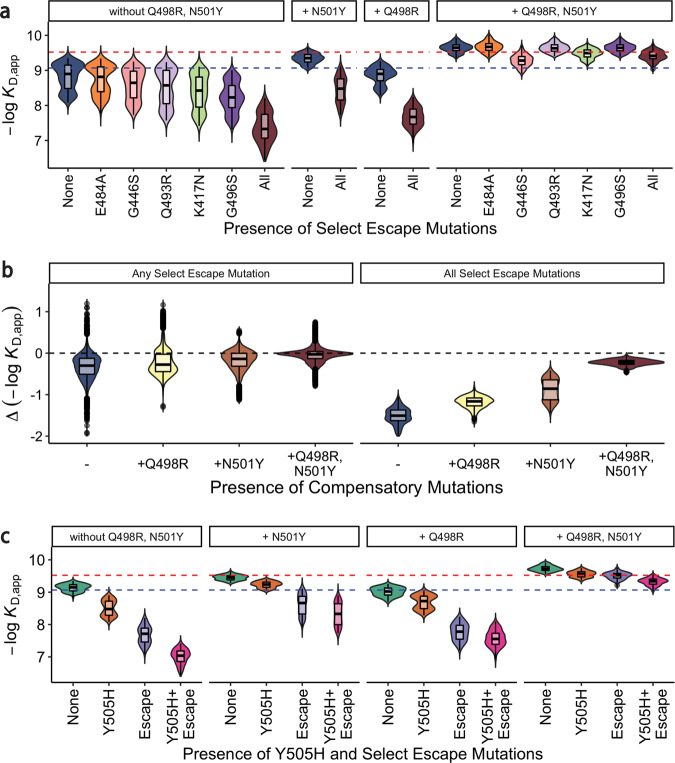
Fig. 3. Epistasis compensates for reductions in ACE2 affinity.
a ACE2 binding affinities for variants containing mutations that have a strong effect on antibody escape: K417N, G446S, E484A, Q493R, and G496S grouped by the presence of compensatory mutations (Q498R and N501Y). Dashed blue (resp. red) line indicates Wuhan Hu-1 (resp. Omicron BA.1) ACE2 binding affinity. Boxes represent the interquartile range. b The changes in ACE2 binding affinities for variants containing any one (or all) of select escape mutations grouped by the presence of compensatory mutations (Q498R and N501Y). Dashed line indicates no affinity change. Boxes represent the interquartile range. c ACE2 binding affinities for variants containing Y505H and antibody escape mutations presented as in (a).
Fig. 4
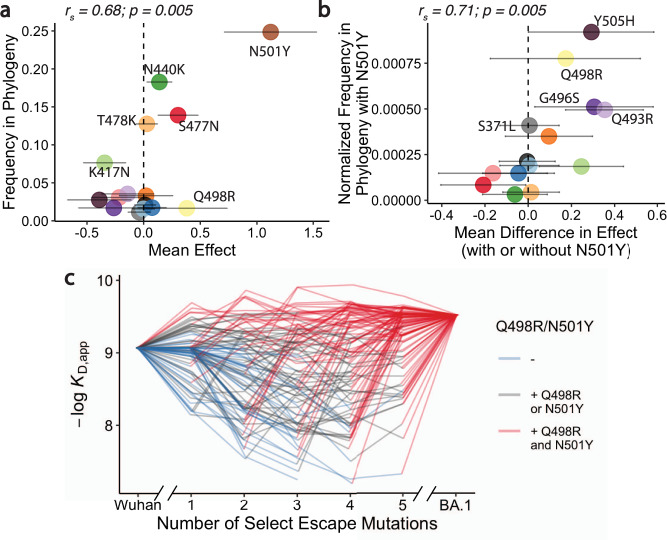
Fig. 4. Trajectory of Omicron BA.1 evolution.
a Frequency of occurrences for each mutation across SARS-CoV-2 sequences available on GISAID (see “Methods”) as a function of their average effect on ACE2 affinity in our data. Error bars indicate standard deviation of effect sizes and are centered on the mean (n=16384 backgrounds). The Spearman’s rank correlation coefficient (rs) is indicated in the top-left. (b) Normalized frequency of mutations co-occurring with N501Y across SARS-CoV-2 sequences available on GISAID (calculated based on the frequency at which each mutation occurs on the same branch as N501Y, normalized by their overall frequency; see “Methods”) as a function of the difference in their effect on ACE2 affinity in the presence of N501Y. Error bars indicate standard deviation of effects and are centered on the mean (n=8096 backgrounds). The Spearman’s rank correlation coefficient (rs) is indicated in the top-left. c ACE2 affinity trajectories for 100 randomly selected pathways (involving all 15 mutations), shown as a function of the number of mutations with strong effect on antibody escape (K417N, G446S, E484A, Q493R, and G496S) and the presence or absence of compensatory mutations Q498R and N501Y (shown with colors). Each trajectory represents a possible mutation order, starting at the Wuhan Hu-1 genotype and ending at Omicron BA.1.

References

    1. Viana R, et al. Rapid epidemic expansion of the SARS-CoV-2 Omicron variant in southern Africa. Nature. 2022;603:679–686. - PMC - PubMed
    1. Dejnirattisai W, et al. SARS-CoV-2 Omicron-B.1.1.529 leads to widespread escape from neutralizing antibody responses. Cell. 2022;185:467–484.e15. - PMC - PubMed
    1. Cameroni E, et al. Broadly neutralizing antibodies overcome SARS-CoV-2 Omicron antigenic shift. Nature. 2022;602:664–670. - PMC - PubMed
    1. Cao Y, et al. Omicron escapes the majority of existing SARS-CoV-2 neutralizing antibodies. Nature. 2022;602:657–663. - PMC - PubMed
    1. Liu L, et al. Striking antibody evasion manifested by the Omicron variant of SARS-CoV-2. Nature. 2022;602:676–681. - PubMed

Publication types

MeSH terms

Substances

Supplementary concepts