


The impact of prevention-effective PrEP use on HIV incidence: a mathematical modelling study
- PMID: 36385504
- PMCID: PMC9670193
- DOI: 10.1002/jia2.26034
The impact of prevention-effective PrEP use on HIV incidence: a mathematical modelling study
Abstract
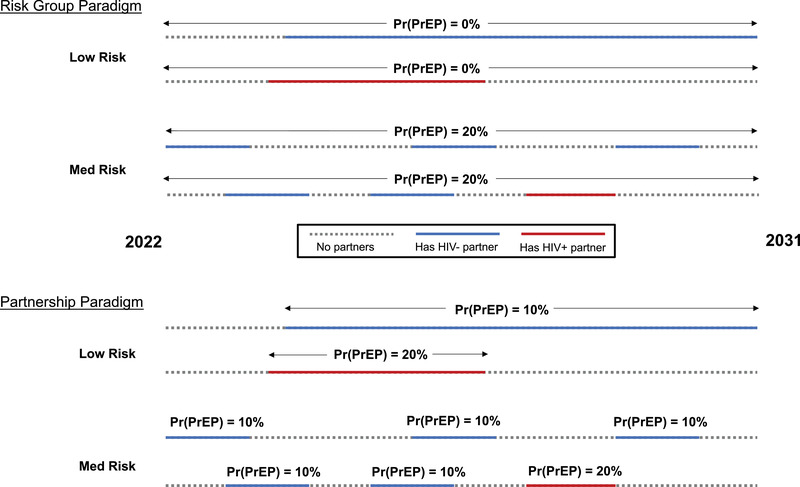
Introduction: Models that project the impact and cost-effectiveness of HIV pre-exposure prophylaxis (PrEP) must specify how PrEP use aligns with HIV exposure. We hypothesized that varying PrEP use according to individual-level partnership dynamics rather than prioritization to population subgroups based on average risk will result in larger incidence reductions and greater efficiency.
Methods: We used an individual-based network transmission model calibrated to HIV dynamics in Eswatini to simulate PrEP use among individuals ages 15-34 between 2022 and 2031 under two paradigms of PrEP delivery: "Risk Group" and "Partnership." In the "Risk Group" paradigm, we varied PrEP coverage by risk groups (low, medium and high) defined by average partnership frequency and concurrency. In the "Partnership" paradigm, all individuals are potentially eligible for PrEP, but we assumed use occurs only during partnerships and varied prioritization by partner HIV status (no prioritization to high prioritization with HIV-positive partners). We calculated person-time on PrEP and incidence relative to a no PrEP scenario and estimated efficiency as the person-years of PrEP needed to avert one additional infection (NNT).
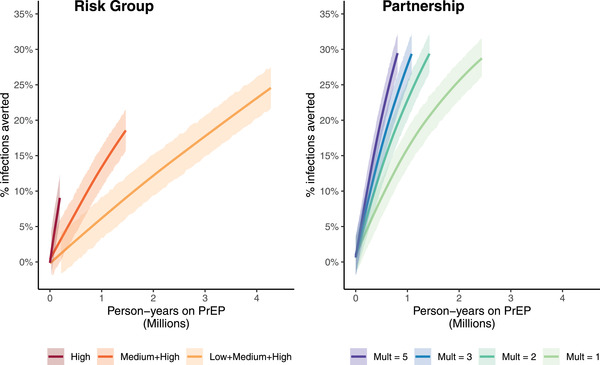
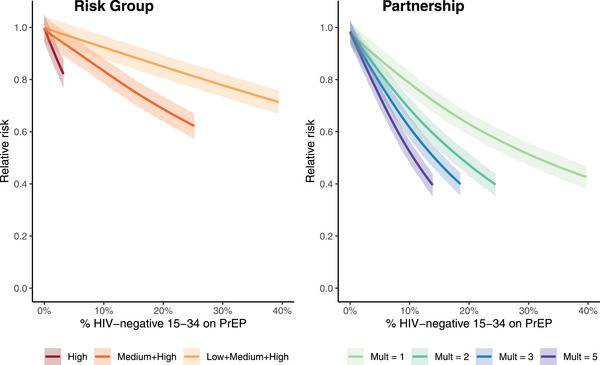
Results: In the Risk Group paradigm, restricting PrEP to the high-risk group was the most efficient (NNT = 17), but the number of infections averted was limited by the small size of the high-risk group. Expanding PrEP use to all risk groups averted up to three times more infections but with lower efficiency (NNT = 202). PrEP use under the Partnership paradigm was 2-6 times more efficient (NNT = 33-102) than the Risk Group paradigm with all groups eligible for PrEP. A 33% reduction in incidence among 15- to 34-year-olds was achieved at 46% (95% CI: 39-52%) PrEP coverage in the Risk Group paradigm and 6% (95% CI: 5-7%) to 17% (95% CI: 14-20%) in the Partnership paradigm.
Conclusions: Modelling PrEP use based on risk groups resulted in a sharp trade-off between PrEP efficiency and impact, whereas PrEP use predicated on partnerships resulted in much higher efficiency for widespread PrEP availability. Model estimates of PrEP impact and cost-effectiveness in generalized epidemics are strongly influenced by assumptions about how PrEP use aligns with individual-level HIV exposure heterogeneity.
Keywords: Africa; HIV prevention; PrEP; adherence; cost-effectiveness; modelling.
© 2022 The Authors. Journal of the International AIDS Society published by John Wiley & Sons Ltd on behalf of the International AIDS Society.
Conflict of interest statement
RVB reports grants from the Bill & Melinda Gates Foundation (BMGF) and the National Institutes of Health (NIH); and Regeneron Pharmaceuticals for conference abstract and manuscript writing support, outside the submitted work. JEH reports grants from the National Institutes of Health (NIH); and consultative fees from Merck outside the submitted work. No other authors report competing interests.
Figures
References
-
- UNAIDS . UNAIDS Estimates. (2020) [Internet]. [cited 2021 Jan 14]. Available from: https://aidsinfo.unaids.org/
-
- Irungu EM, Baeten JM. PrEP rollout in Africa: status and opportunity. Nat Med. 2020;26(5):655–64. - PubMed
-
- PrEPWatch: Country Updates [Internet]. PrEPWatch. [cited 2021. Dec 15]. Available from: https://www.prepwatch.org/in‐practice/country‐updates/
Publication types
MeSH terms
Grants and funding
LinkOut - more resources
Full Text Sources
Medical
Miscellaneous
