


Neurobiological mechanisms of mood disorders: Stress vulnerability and resilience
- PMID: 36386785
- PMCID: PMC9650072
- DOI: 10.3389/fnbeh.2022.1006836
Neurobiological mechanisms of mood disorders: Stress vulnerability and resilience
Abstract
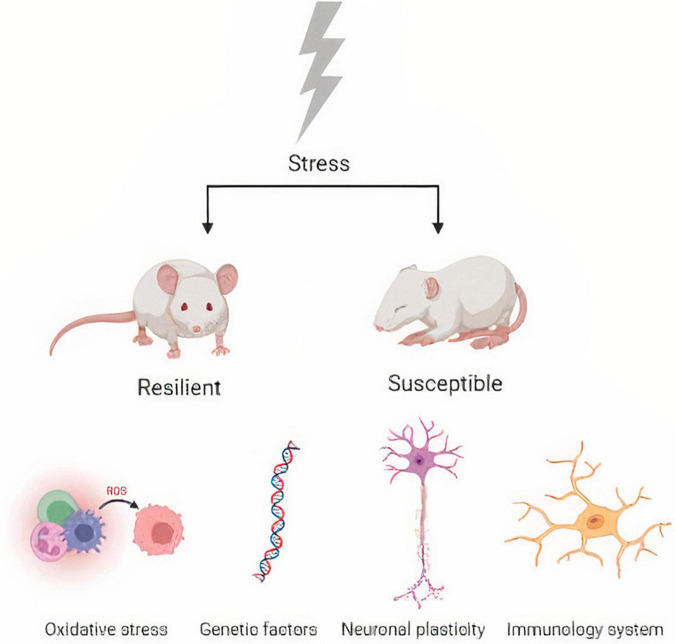
Stress is an important factor in the development of several human pathologies. The response of rodents and humans to stress depends on many factors; some people and rodents develop stress-related mood disorders, such as depression and anxiety in humans, depression-like and anxiety-like behavior in mice and rats, while others report no new psychological symptoms in response to chronic or acute stress, and are considered susceptible and resilient to stress, respectively. Resilience is defined as the ability to thrive in the face of adversity and is a learned process that can help protect against occupational stressors and mental illnesses. There is growing interest in the underlying mechanisms involved in resilience and vulnerability to depression caused by stress, and some studies have demonstrated that individual variability in the way animals and humans respond to stress depends on several mechanisms, such as oxidative stress, neuronal plasticity, immunology and genetic factors, among others not discussed in this review, this review provides a general overview about this mechanism.
Keywords: anxiety; depression; resilience; stress; vulnerability.
Copyright © 2022 Marcolongo-Pereira, Castro, Barcelos, Chiepe, Rossoni Junior, Ambrosio, Chiarelli-Neto and Pesarico.
Conflict of interest statement
The authors declare that the research was conducted in the absence of any commercial or financial relationships that could be construed as a potential conflict of interest.
Figures
References
-
- Ajayi A. M., Ben-Azu B., Ogunkolade G. E., Melete J., Oyedele A. T., Umukoro S. (2022). Repeated social defeat stress exacerbates lipopolysaccharide-induced behavioural deficits in mice: Ameliorative role of Chrysophyllum albidum fruit extract through anti-neuroinflammation, antioxidant and neurochemical balance. Metab. Brain Dis. [Epub ahead of print]. 10.1007/s11011-022-01053-x - DOI - PubMed
-
- Alim T. N., Feder A., Graves R. E., Wang Y., Weaver J., Westphal M., et al. (2008). Trauma, resilience, and recovery in a high-risk African-American population. Am. J. Psychiatry 165 1566–1575. - PubMed
-
- Amitai M., Kaffman S., Kroizer E., Lebow M., Magen I., Benaroya-Milshtein N., et al. (2022). Neutrophil to-lymphocyte and platelet-to-lymphocyte ratios as biomarkers for suicidal behavior in children and adolescents with depression or anxiety treated with selective serotonin reuptake inhibitors. Brain Behav. Immun. 104 31–38. - PubMed
-
- André C., O’Connor J. C., Kelley K. W., Lestage J., Dantzer R., Castanon N. (2008). Spatio-temporal differences in the profile of murine brain expression of proinflammatory cytokines and indoleamine 2,3-dioxygenase in response to peripheral lipopolysaccharide administration. J. Neuroimmunol. 200 90–99. 10.1016/j.jneuroim.2008.06.011 - DOI - PMC - PubMed
-
- Andreazza A. C., Kale R. P., Duong A., Molina F., Tye S. J. (2019). “Mitochondrial function and inflammation pathways in the neuroprogression of mental disorders,” in Neuroprogression in Psychiatry, eds Kapczinski F., Berk M., da Silva Magalhães P. V. (Oxford: Oxford University Press; ), 35–62.
Publication types
LinkOut - more resources
Full Text Sources
