


A network analysis of anxiety, depressive, and psychotic symptoms and functioning in children and adolescents at clinical high risk for psychosis
- PMID: 36386985
- PMCID: PMC9650363
- DOI: 10.3389/fpsyt.2022.1016154
A network analysis of anxiety, depressive, and psychotic symptoms and functioning in children and adolescents at clinical high risk for psychosis
Abstract
Objective: Youths at clinical high risk for psychosis (CHR-P) are characterized by a high prevalence of anxiety and depressive disorders. The present study aimed at developing and analyzing a network structure of CHR-P symptom domains (i.e., positive, negative, disorganization, and general subclinical psychotic symptoms), depressive and anxiety symptoms, and general functioning.
Methods: Network analysis was applied to data on 111 CHR-P children and adolescents (M age = 14.1), who were assessed using the Structured Interview for Prodromal Syndromes, the Children's Depression Inventory, the Children's Global Assessment Scale, and the Multidimensional Anxiety Scale for Children.
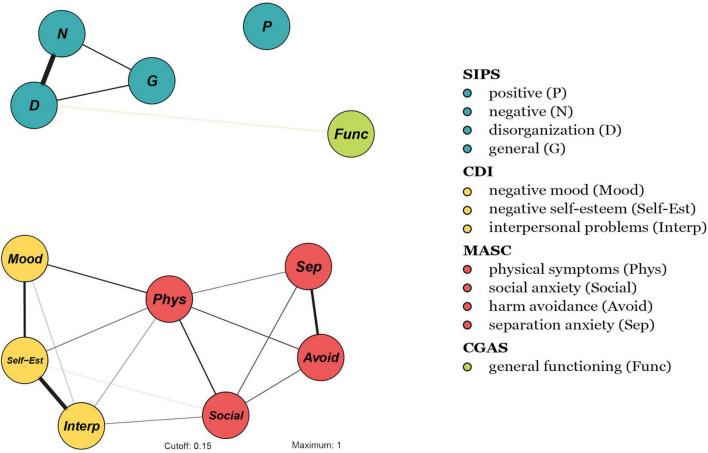
Results: In the network, negative and disorganization symptoms showed the strongest association (r = 0.71), and depressive and anxiety symptoms showed dense within-domain connections, with a main bridging role played by physical symptoms of anxiety. The positive symptom cluster was not associated with any other node. The network stability coefficient (CS) was slightly below 0.25, and observed correlations observed ranged from 0.35 to 0.71.
Conclusion: The lack of association between subclinical positive symptoms and other network variables confirmed the independent nature of subclinical positive symptoms from comorbid symptoms, which were found to play a central role in the analyzed network. Complex interventions should be developed to target positive and comorbid symptoms, prioritizing those with the most significant impact on functioning and the most relevance for the young individual, through a shared decision-making process. Importantly, the results suggest that negative and disorganization symptoms, as well as depressive and anxiety symptoms, may be targeted simultaneously.
Keywords: anxiety symptoms; attenuated psychotic symptoms; clinical high risk for psychosis (CHR-P); comorbidity; depressive symptoms; general functioning; network analysis.
Copyright © 2022 Lo Buglio, Pontillo, Cerasti, Polari, Schiano Lomoriello, Vicari, Lingiardi, Boldrini and Solmi.
Conflict of interest statement
Author MS received honoraria and has been a consultant for Angelini, Lundbeck, Otsuka, outside the submitted work. The remaining authors declare that the research was conducted in the absence of any commercial or financial relationships that could be construed as a potential conflict of interest.
Figures


References
-
- Catalan A, Salazar de Pablo G, Vaquerizo Serrano J, Mosillo P, Baldwin H, Fernández-Rivas A, et al. Annual research review: prevention of psychosis in adolescents – systematic review and meta-analysis of advances in detection, prognosis and intervention. J Child Psychol Psychiatry. (2021) 62:657–73. 10.1111/jcpp.13322 - DOI - PubMed
LinkOut - more resources
Full Text Sources
