. 2022 Oct 25;4(1):100345.
doi: 10.1016/j.xinn.2022.100345. eCollection 2023 Jan 30.

Cut-dip-budding delivery system enables genetic modifications in plants without tissue culture

Affiliations

Cut-dip-budding delivery system enables genetic modifications in plants without tissue culture

Xuesong Cao et al. Innovation (Camb). .

Abstract

Of the more than 370 000 species of higher plants in nature, fewer than 0.1% can be genetically modified due to limitations of the current gene delivery systems. Even for those that can be genetically modified, the modification involves a tedious and costly tissue culture process. Here, we describe an extremely simple cut-dip-budding (CDB) delivery system, which uses Agrobacterium rhizogene to inoculate explants, generating transformed roots that produce transformed buds due to root suckering. We have successfully used CDB to achieve the heritable transformation of plant species in multiple plant families, including two herbaceous plants (Taraxacum kok-saghyz and Coronilla varia), a tuberous root plant (sweet potato), and three woody plant species (Ailanthus altissima, Aralia elata, and Clerodendrum chinense). These plants have previously been difficult or impossible to transform, but the CDB method enabled efficient transformation or gene editing in them using a very simple explant dipping protocol, under non-sterile conditions and without the need for tissue culture. Our work suggests that large numbers of plants could be amenable to genetic modifications using the CDB method.


Conflict of interest statement

The authors declare no competing interests.

Figures
None
Graphical abstract
Figure 1
Figure 1
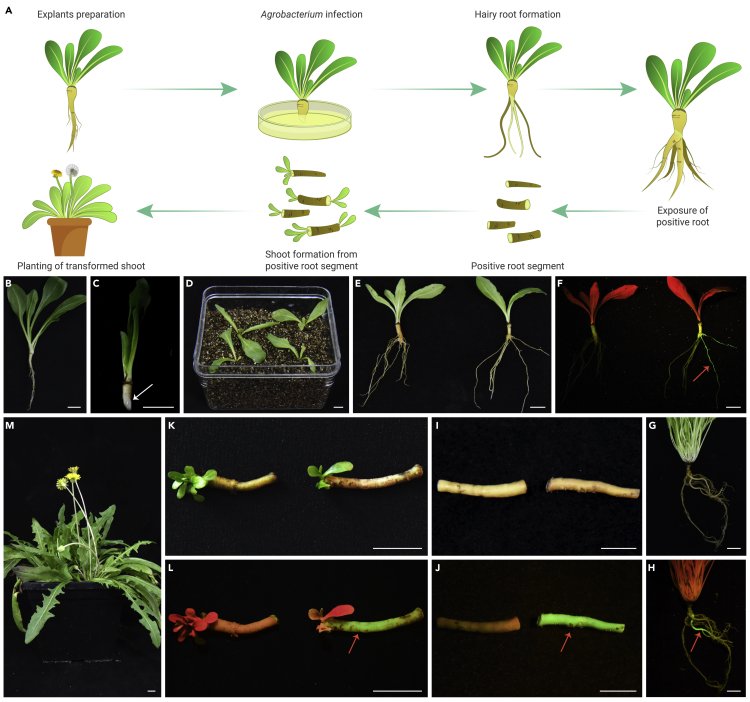
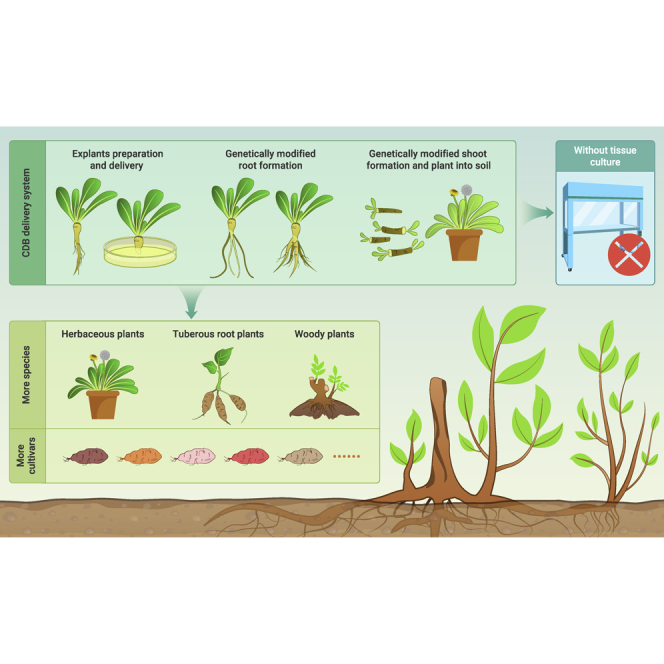
The CDB delivery system and genetic transformation of TKS (A) CDB delivery system workflow. Seedlings that were 3–4 weeks old were cut and used as explants. The reporter gene or gene-editing constructs were delivered to plant cells near the cut site via A. rhizogenes. Hairy roots were formed after several weeks. The GFP-positive roots were segmented and cultured to give rise to transgene-positive or gene-edited shoots. (B) A 3- to 4-week-old seedling. (C) Explant. Gray arrow indicates the site of infection. (D) Explants inoculated with Agrobacterium were cultured in vermiculite. (E and F) Formation of GFP-positive hairy root of TKS. (G and H) Positive hairy roots continued to develop. (I and J) GFP-positive root segment. (K and L) Transgene-positive shoots formed on a GFP-positive root segment. (M) Transformed shoots that were planted into soil grew normally to the reproductive stage. In (E), (F), (I), (J), (L), and (I), the sample on the left is untransformed control. In (F), (H), (J), and (I), samples were illuminated with fluorescent light. Red arrow indicates GFP fluorescence in transformed tissue. Bar: 1 cm.
Figure 2
Figure 2
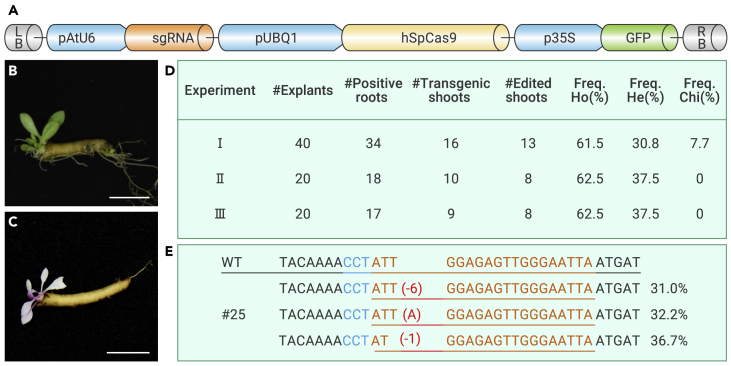
Gene editing in TKS using the CDB deliver system (A) Schematic of the TKS gene-editing vector. (B) A shoot that was formed on a wild-type root segment. (C) Albino phenotype of a homozygous TkPDS knockout shoot. (D) The CDB delivery system efficiently delivered gene-editing tools and generated edited shoots in three independent experiments. (E) Sequencing results of a representative TkPDS knockout albino seedling. The sgRNA target sequence is shown in orange, the protospacer-adjacent motif is shown in blue, and mutations are shown in red. Bar: 1 cm.
Figure 3
Figure 3
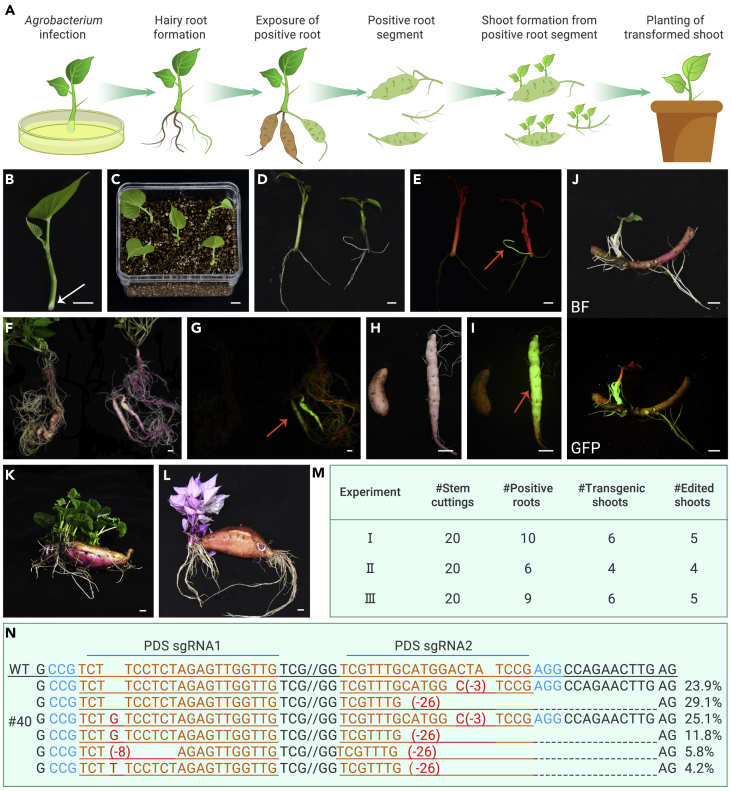
CDB-mediated gene editing in sweet potato (A) Illustration of the CDB delivery process in sweet potato. Transgenes were delivered by A. rhizogene to sweet potato apical stem tissue, resulting in the induction of hairy roots under non-sterile conditions. After approximately 10 weeks, some of these hairy roots developed into tuberous roots. Transgenic (GFP-positive, indicated in brown color) roots (including tuberous roots) were harvested and allowed to bud. Transgene-positive shoots formed were transplanted into soil. (B) Photograph of an explant used in the experiment; gray arrow points to the site of infection by A. rhizogene. (C) Inoculated explants were inserted into vermiculite and cultured under a high-moisture environment. (D and E) Transgenic hairy roots formed. (F and G) Hairy roots were allowed to grow and some developed into tuberous roots. (H and I) GFP-positive roots were cut into segments. (J) Transgene-positive shoots formed on a root fragment. (K) Shoots formed on a wild-type root segment. (L) Albino shoots of a homozygous PDS knockout mutant. (M) CDB delivery system efficiently delivered gene-editing tools into sweet potato and generated edited shoots in three independent experiments. (N) Sequencing of the target region in PDS in an albino plant. The sgRNA target sequence is shown in orange, the protospacer-adjacent motif is shown in blue, and mutations are shown in red. Red arrows in (E), (G), and (I) point to a GFP-positive signal. Bar: 1cm.
Figure 4
Figure 4
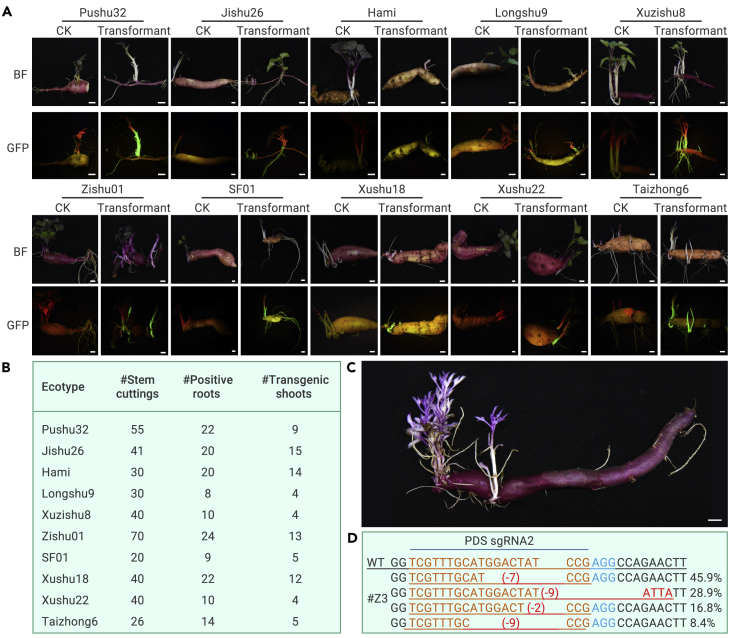
CDB delivery system is genotype-independent in sweet potato (A) GFP was transformed into 10 sweet potato cultivars via the CDB delivery system. (B) The number of transgenic shoots obtained from each of the 10 sweet potato cultivars. (C) Albino shoots indicating homozygous PDS knockout in the Xuzishu8 cultivar. (D) Sequencing results of the albino shoot of Xuzhishu8. Bar: 1cm.
Figure 5
Figure 5
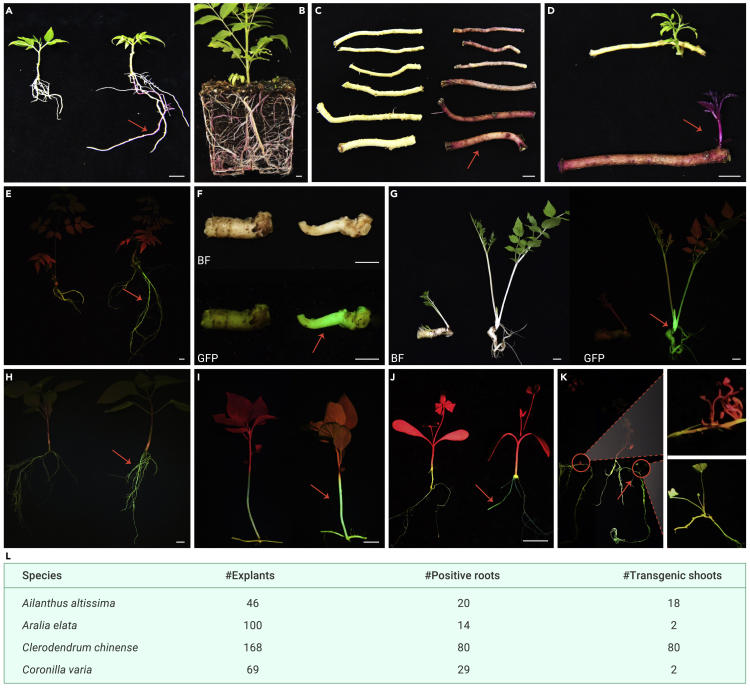
CDB delivery system was effective in transforming three woody plant species and a leguminous pasture plant (A–D) Transformation of Ailanthus altissima (Mill) Swingle (Aa) via the CDB system. (A) Hairy root formation on Aa explants. (B) Hairy roots of Aa developed into normal-appearing roots. (C) Segments of transgene (RUBY)-positive Aa roots. (D) Transgene-positive shoot formed on an Aa root segment. (E–G) Transformation of Aralia elata Seem. (Ae) via the CDB system. (E) Hairy root formation and development into normal-appearing roots of Ae. (F) Segments of transgene (GFP)-positive Ae roots. (G) Transgene-positive shoot formed on an Ae root segment. (H and I) Transformation of Clerodendrum chinense Mabb. (Cc) via the CDB system. (J and K) Transformation of Coronilla varia L. (Cv) via the CDB system. (L) Statistics for the three woody plant species (Aa, Ae, and Cc) and the leguminous pasture plant Cv transformed via the CDB delivery system. Red arrow indicates transformed tissue. Bar: 1 cm.

References

    1. Mao Y., Botella J.R., Liu Y., Zhu J.K. Gene editing in plants: progress and challenges. Natl. Sci. Rev. 2019;6:421–437. - PMC - PubMed
    1. Ji X., Yang B., Wang D. Achieving plant genome editing while bypassing tissue culture. Trends Plant Sci. 2020;25:427–429. - PubMed
    1. Lowe K., La Rota M., Hoerster G., et al. Rapid genotype "independent" Zea mays L. (maize) transformation via direct somatic embryogenesis. In Vitro Cell Dev. Biol. Plant. 2018;54:240–252. - PMC - PubMed
    1. Mookkan M., Nelson-Vasilchik K., Hague J., et al. Selectable marker independent transformation of recalcitrant maize inbred B73 and sorghum P898012 mediated by morphogenic regulators BABY BOOM and WUSCHEL2. Plant Cell Rep. 2017;36:1477–1491. - PMC - PubMed
    1. Wang K., Shi L., Liang X., et al. The gene TaWOX5 overcomes genotype dependency in wheat genetic transformation. Nat. Plants. 2022;8:110–117. - PubMed

LinkOut - more resources