Case Reports
. 2022 Nov 8:15:639-646.
doi: 10.2147/IMCRJ.S382872. eCollection 2022.

Cervical Spondylosis as a Hidden Contributing Factor to Fibromyalgia: A Case Report

Affiliations
Case Reports

Cervical Spondylosis as a Hidden Contributing Factor to Fibromyalgia: A Case Report

Eric Chun-Pu Chu et al. Int Med Case Rep J. .

Abstract

The present case study describes the long-term symptomatic remission in a patient with fibromyalgia (FM) after multimodal spinal manipulation. A 44-year-old woman presented with a chronic headache, severe neck pain, shoulder pain, and back pain lasting for 2 years after experiencing domestic violence. She had sleep disorders, fatigue, and depressive mood. Her primary care physician diagnosed her with FM and comorbid depression. Despite treatment with non-steroidal anti-inflammatory drugs, muscle relaxants, anti-depressants, anti-epileptics, acupuncture, and aqua-therapy, she experienced no appreciable relief from her symptoms. The patient then sought a chiropractic evaluation and potential treatment for her symptoms. At presentation, widespread tenderness was palpable over the neck, shoulder, back, anterior chest, abdominal wall, and buttock. Radiographs showed loss of cervical lordosis, widespread degenerative spondylosis, and osteitis pubis. Surface electromyography (sEMG) revealed neck and thoracic paraspinal muscular spasms. The patient was diagnosed with FM based on the American College of Rheumatology diagnostic criteria and the associated comorbidities. Multimodal chiropractic approaches, which consisted of spinal manipulation, massage, and intermittent motorized cervical traction, were used twice weekly to relieve soft-tissues and intervertebral joints and stretch core musculatures. The patient's physical and mental complaints were mostly resolved near the end of 9 months of treatment. Her symptom alleviation was associated with corresponding change in normalized sEMG signal and cervical spine realignment at the 16th- and 26th-month follow-ups. Widespread pain in FM can lead to confused thinking and a lack of awareness of cervical spondylosis. In this example, it is assumed that the noxious cervical inputs triggered an ongoing FM process. Chiropractic treatment blocked noxious inputs coming from pain sources, corrected pain thresholds, and lowered excitability, thereby eradicating FM symptoms.

Keywords: chiropractic; degenerative spondylosis; electromyography; fibromyalgia; neck pain.


Conflict of interest statement

The authors declare that they have no conflicts of interest.

Figures
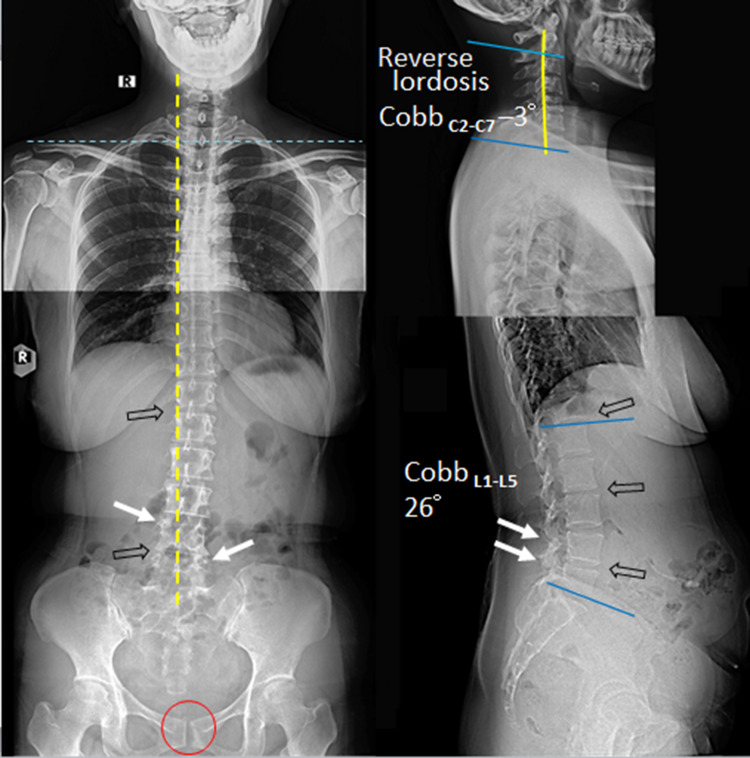
Figure 1
Figure 1
Standing plain radiographs at initial presentation. Antero-posterior (left) and lateral neutral (right) views shows disc space narrowing (hollow black arrows), degenerative hypertrophy of facets (white arrows), and anterior marginal lipping of vertebrae that is compatible with degenerative spondylosis. Reverse cervical lordosis and mild lumbar levoconvexity are noted. Joint irregularity, subchondral erosion, and sclerosis of the left pubic symphysis (encircled in red) are likely sequelae of postpartum osteitis pubis. The central sacral line (dashed yellow line) represents the global axis, and the posterior vertebral line (yellow line) highlights the cervical curvature. The reference value for an adult is 38.1°–45.6° for lumbar L1–L5 curve by means of the Cobb method.
Figure 2
Figure 2
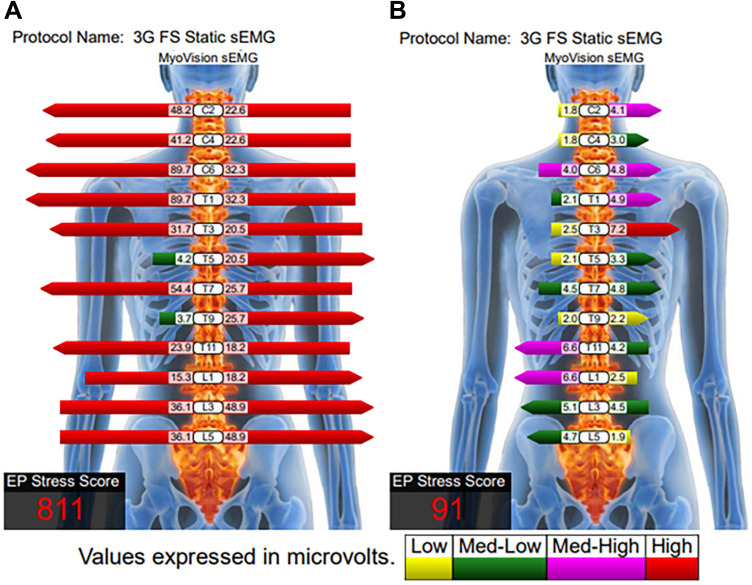
Surface electromyography (sEMG) comparison of pre- and post-intervention. (A) At initial presentation, high readings reflect spasm in the bilateral trapezius and sacrospinalis (erector spinae) muscle groups. (B) The normalized sEMG signal of the muscle groups and the dropped electrophysiological (EP) stress score positively correspond to patient’s symptom relief after the 16-month chiropractic therapy. The EP stress score is the sum of all muscle activity on the spine measured in microvolts.
Figure 3
Figure 3
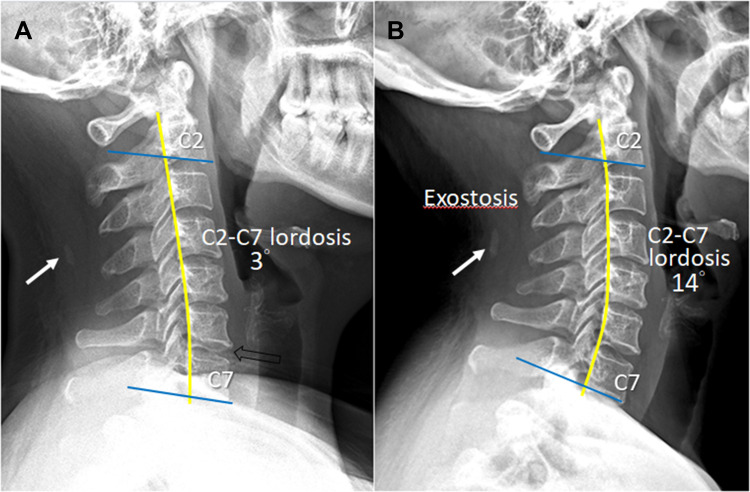
Comparison of cervical alignment over time in the same patient shown in Figure 1. (A) At the 16th month evaluation, the sagittal Cobb C2-C7 is 3°. The posterior vertebral line (yellow line) highlights the cervical curvature. (B) Repeat radiographs radiograph at the 26th month evaluation demonstrates a regain of cervical lordosis to Cobb 14°. The exostoses in the spinous process C2/C3 interspace and sesamoid ossicles (white arrow) of the nuchal ligament indicate a mechanical stress of the nuchal osteo-ligamentous attachment.
Figure 4
Figure 4
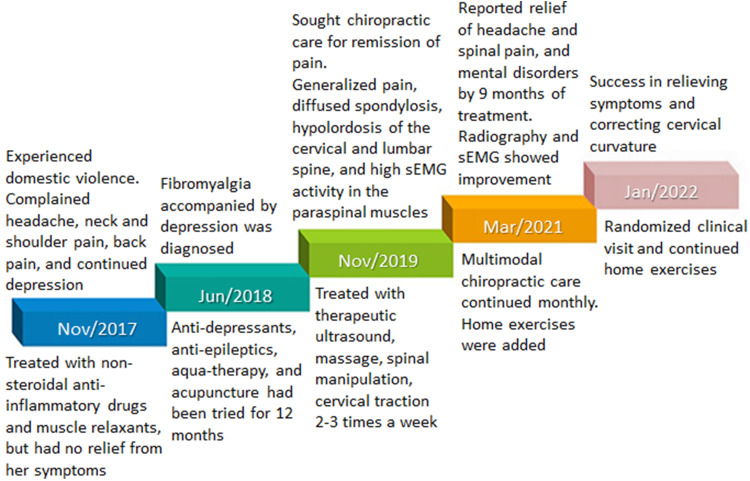
Clinical timeline of the presenting case.

References

    1. Kang JH, Choi SE, Park DJ, Lee SS. Disentangling diagnosis and management of fibromyalgia. J Rheum Dis. 2022;29(1):4–13. doi: 10.4078/jrd.2022.29.1.4 - DOI - PMC - PubMed
    1. Harte SE, Harris RE, Clauw DJ. The neurobiology of central sensitization. J Appl Behav Res. 2018;23(2):e12137. doi: 10.1111/jabr.12137 - DOI
    1. Siracusa R, Paola RD, Cuzzocrea S, Impellizzeri D. Fibromyalgia: pathogenesis, mechanisms, diagnosis and treatment options update. Int J Mol Sci. 2021;22(8):3891. doi: 10.3390/ijms22083891 - DOI - PMC - PubMed
    1. Wolfe F, Clauw DJ, Fitzcharles MA, et al. 2016 Revisions to the 2010/2011 fibromyalgia diagnostic criteria. Semin Arthritis Rheum. 2016;46(3):319–329. doi: 10.1016/j.semarthrit.2016.08.012 - DOI - PubMed
    1. Nicholas M, Vlaeyen JWS, Rief W, et al.; IASP Taskforce for the Classification of Chronic Pain. The IASP classification of chronic pain for ICD-11: chronic primary pain. Pain. 2019;160(1):28–37. doi: 10.1097/j.pain.0000000000001390. - DOI - PubMed

Publication types