. 2022 Oct 21;25(11):105411.
doi: 10.1016/j.isci.2022.105411. eCollection 2022 Nov 18.

Temperature-mediated flower size plasticity in Arabidopsis

Affiliations

Temperature-mediated flower size plasticity in Arabidopsis

Andrew Wiszniewski et al. iScience. .

Abstract

Organisms can rapidly mitigate the effects of environmental changes by changing their phenotypes, known as phenotypic plasticity. Yet, little is known about the temperature-mediated plasticity of traits that are directly linked to plant fitness such as flower size. We discovered substantial genetic variation in flower size plasticity to temperature both among selfing Arabidopsis thaliana and outcrossing A. arenosa individuals collected from a natural growth habitat. Genetic analysis using a panel of 290 A. thaliana accession and mutant lines revealed that MADS AFFECTING FLOWERING (MAF) 2-5 gene cluster, previously shown to regulate temperature-mediated flowering time, was associated to the flower size plasticity to temperature. Furthermore, our findings pointed that the control of plasticity differs from control of the trait itself. Altogether, our study advances the understanding of genetic and molecular factors underlying plasticity on fundamental fitness traits, such as flower size, in response to future climate scenarios.

Keywords: Plant biology; Plant genetics; Plant morphology; Plant physiology.


Conflict of interest statement

The authors declare no competing interests.

Figures

None
Graphical abstract
Figure 1
Figure 1
Natural populations of selfing and outcrossing Arabidopsis species (A) A. thaliana and A. arenosa flowers from natural populations grown under controlled conditions. Scale bar represents 5 mm. (B) Distribution of flower diameter at 17°C and 23°C for A. thaliana and A. arenosa flowers. (C) Box plot of the percentage of change between 23°C and 17°C. Statistical difference between means (t-test, p-value < 0.05) is represented with ∗. (D) Proportion of variance contributed for flower diameter in selfing A. thaliana and outcrossing A. arenosa by genotype (G), environment (E), G x E, and residual error.
Figure 2
Figure 2
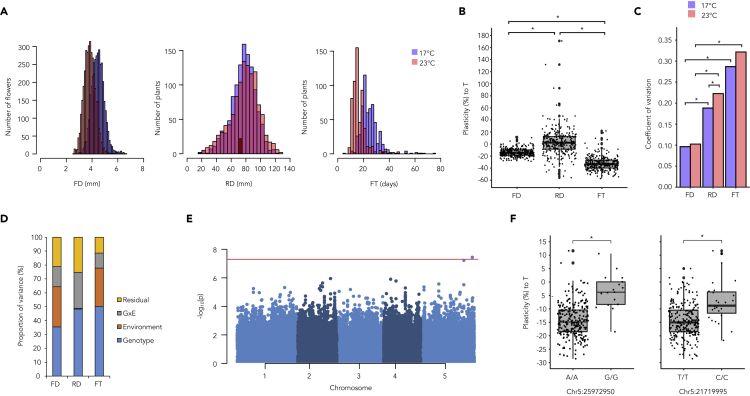
Genetic basis of flower size plasticity in A. thaliana. (A) Distribution of flower diameter (FD), flowering time (FT), and rosette diameter (RD) at 17°C and 23°C for 290 Arabidopsis accessions. T-test with p-value <0.05 was used to test the difference in means of FD, FT, and RD at 17°C and 23°C. (B) Trait plasticity as determined by percentage of change in a trait value between 23°C and 17°C for the same accessions. Wilcoxon rank-sum test with p-value < 0.01 was used to test significance of the distributions. (C) Coefficient of variation (CV) for the traits under differing temperature conditions. Significance was tested using bootstrap test (Amiri and Zwanzig, 2011) with p-value < 0.01 and B = 10,000). (D) Proportion of variance contributed for each flower diameter (FD), flowering time (FT), and rosette diameter (RD) trait by genotype (G), environment (E), G x E, and residual error for 290 Arabidopsis accessions grown at varying temperature. (E) Manhattan plot of significant SNPs in genomic wide association analysis for plasticity of FD. (F) Distribution of the flower size (FD) plasticities (percentage of difference in FD between 23°C and 17°C) to temperature change for the major and minor alleles for the two most significant SNPs. (t-test with ∗p < 0.05).
Figure 3
Figure 3
The role of MAF2-5 locus in flower size plasticity (A) Plasticity (% of difference between 23°C and 17°C) in flower size to temperature in the maf mutants and wild type (Col-0). Significance was tested using bootstrap test (Amiri and Zwanzig, 2011) with p-value < 0.01 and B = 10,000). (B) Flower diameter for maf mutants and wild type (Col-0) grown at 23°C and 17°C. Error bars represent standard deviation, t-test with ∗p < 0.05, ∗∗p < 0.01 (n ≥ 12). (C) Genomic structure of the MAF2 locus in Col-0 and Bozen-1.2 with sequenced splicing variants MAF2 var1 and var2 cDNAs mapped to the sequenced genomic region. Scale bar denotes 0.5 kb. (D) Flower diameter for selected accessions with either premature stop codons or absent start codons in the MAF2 gene (n ≥ 12). Error bars represent standard deviation, t-test with ∗p < 0.05, ∗∗p < 0.01. (E) Box plots for plasticity (% of difference between 23°C and 17°C) in FD in accessions with Col-0 like MAF2 or impaired MAF2 gene (Wilcoxon rank-sum test with p-value < 0.05). (F) Log2 fold-change of MAF1-5 genes in Col-0, Tu-KS-7, and Bozen-1.2 at 23°C compared to 17°C measured with quantitative RT-PCR. n = 4, p-value < 0.05 (t-test).
Figure 4
Figure 4
Flower and rosette size plasticities to temperature are uncoupled (A) Pearson correlation with Bonferroni correction of traits for the 290 accessions at 23°C and 17°C; corrected p-value < 0.05. (B) Box plot of flower diameter in plants grown either 17°C, 23°C or at polytunnel greenhouse. (p-value < 0.01, Wilcoxon rank-sum test). (C) Coefficient of variation (CV) of flower diameter across the accessions grown in each of the conditions. (D) A graph showing the minimum, maximum, and average temperature during the experiment. (E) Trait plasticity comparing optimal and limited nitrogen for 39 A. thaliana accessions covering the range of flower size plasticities to temperature change. (p-value < 0.01, Wilcoxon rank-sum test). (F) Coefficient of variation for the traits under differing nitrogen conditions. In C and F, the significance was tested using a bootstrap method (Amiri and Zwanzig, 2011 with p-value < 0.01 and B = 10,000).
Figure 5
Figure 5
Transcriptional and cellular mechanisms associated with flower size plasticity (A) Box plots showing the percentage of difference between 23°C and 17°C in meristem diameter (MD) and flower diameter (FD). (B) Pearson correlation of meristem and flower diameters in plants grown at 23°C and 17°C and their plasticities. p-value < 0.05. (C and D) FD and D) cell size (CS) in seven A. thaliana accessions grown at 23°C and 17°C. T-test with p-value < 0.01 was used for significance (∗∗). (E) Transcript profiling of open flowers using quantitative RT-PCR of 26 genes with known involvement in temperature dependent growth or development, in Col-0, Tü-KS-7, and Bozen-1.2. To test significance, t-test with p-value < 0.01 (∗∗) and < 0.01 (∗) between 23°C and 17°C in each accession was used. (F) Venn diagram comparing the transcript showing significantly more expression (t-test, p-value < 0.05) in Col-0, Tü-KS-7, or Bozen-1.2 flowers of plants grown at 23°C than in flowers grown at 17°C.

References

    1. Airoldi C.A., Mckay M., Davies B. MAF2 is regulated by temperature-dependent splicing and represses flowering at low temperatures in parallel with FLM. PLoS One. 2015;10 doi: 10.1371/journal.pone.0126516. - DOI - PMC - PubMed
    1. Alseekh S., Aharoni A., Brotman Y., Contrepois K., D'Auria J., Ewald J., Ewald J.C., Fraser P.D., Giavalisco P., Hall R.D., et al. Mass spectrometry-based metabolomics: a guide for annotation, quantification and best reporting practices. Nat. Methods. 2021;18:747–756. doi: 10.1038/s41592-021-01197-1. - DOI - PMC - PubMed
    1. Amiri S., Zwanzig S. Assessing the coefficient of variations of chemical data using bootstrap method. J. Chemom. 2011;25:295–300. doi: 10.1002/cem.1350. - DOI
    1. Arvidsson S., Kwasniewski M., Riaño-Pachón D.M., Mueller-Roeber B. QuantPrime - a flexible tool for reliable high-throughput primer design for quantitative PCR. BMC Bioinf. 2008;9:465. doi: 10.1186/1471-2105-9-465. - DOI - PMC - PubMed
    1. Barnes A.C., Rodríguez-Zapata F., Juárez-Núñez K.A., Gates D.J., Janzen G.M., Kur A., Wang L., Jensen S.E., Estévez-Palmas J.M., Crow T.M., et al. An adaptive teosinte mexicana introgression modulates phosphatidylcholine levels and is associated with maize flowering time. Proc. Natl. Acad. Sci. USA. 2022;119 doi: 10.1073/pnas.2100036119. - DOI - PMC - PubMed

LinkOut - more resources