


Oral Contraceptive Use and Alveolar Osteitis Following Third Molar Extraction: A Systematic Review and Meta-Analysis
- PMID: 36389647
- PMCID: PMC9643054
- DOI: 10.1155/2022/7357845
Oral Contraceptive Use and Alveolar Osteitis Following Third Molar Extraction: A Systematic Review and Meta-Analysis
Abstract
Purpose: Alveolar osteitis (AO) is a common postoperative complication of third molar extractions that is thought to be associated with the intake of oral contraceptives (OCPs). This meta-analysis sought to evaluate the risk of AO associated with OCP use and sex independently and whether this risk was affected by the use of postoperative analgesics or antibiotics.
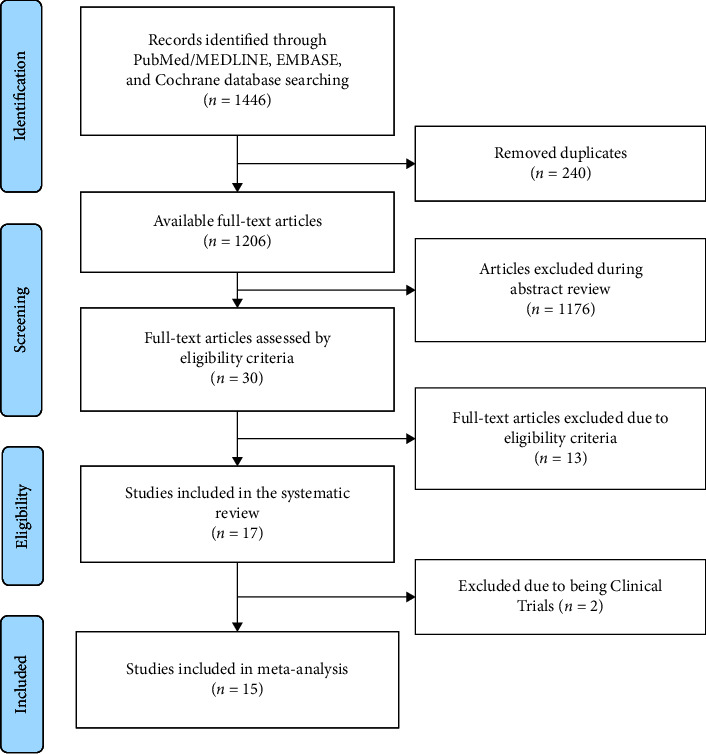
Methods: PubMed/Medline, EMBASE, and Cochrane databases were searched for articles pertaining to OCP use and the incidence of AO using MESH terms. The measured outcome was the development of AO following a third molar extraction. Additional variables such as sex, analgesic, and antibiotic use were documented and included in the analysis. The data were analyzed in R using the Mantel-Haenszel method.
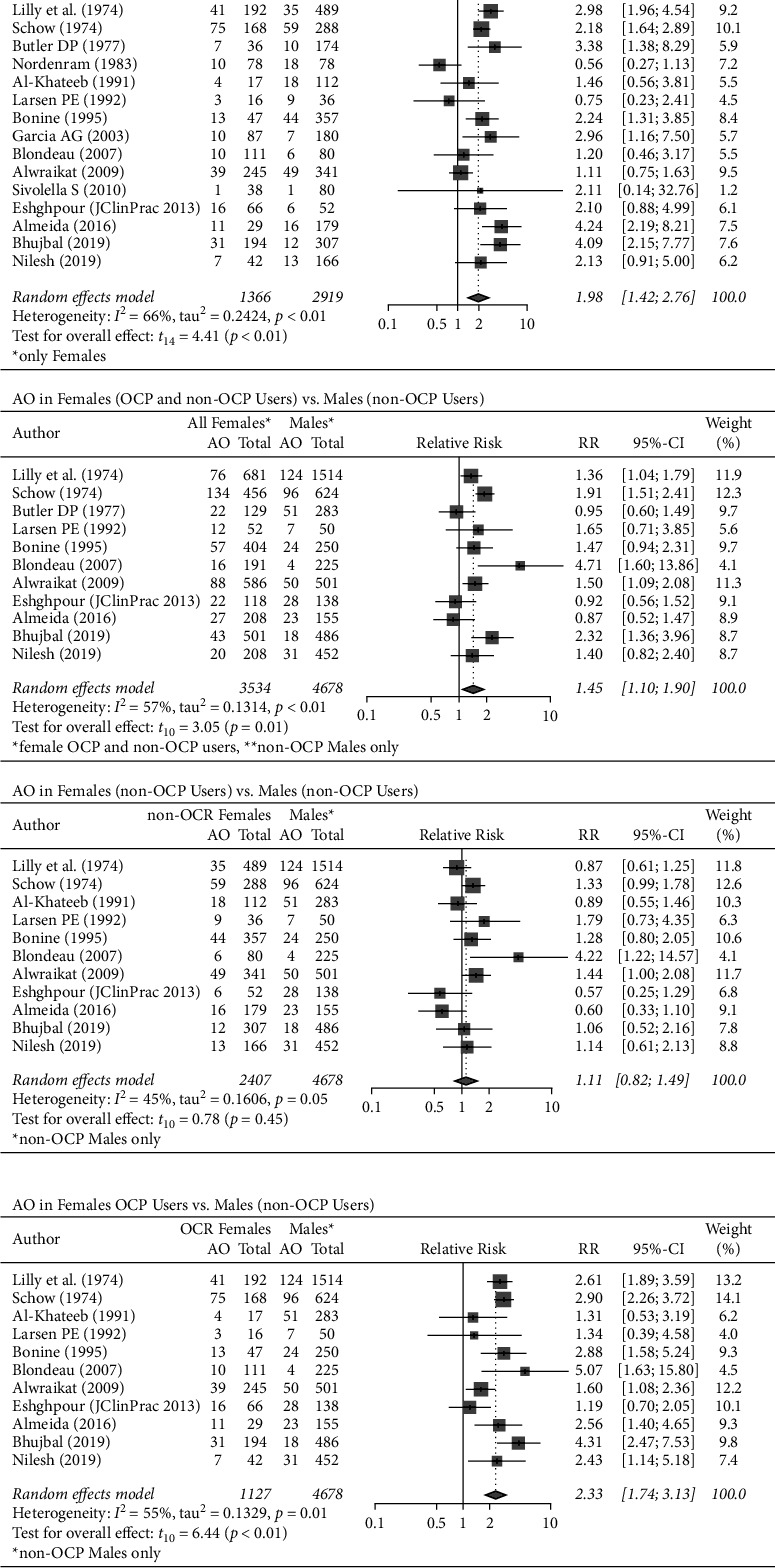
Results: Fifteen studies with a total of 1366 female participants who were OCP users and 2919 nonuser female participants were included in this meta-analysis. OCP users were approximately twice (pooled-RR: 1.98, 95% CI: 1.42-2.76) as likely to develop AO following a third molar extraction when compared to nonuser females. The increased incidence of AO in the OCP group was statistically significant (p < 0.01). The pooled-RR of AO in females not taking OCPs was not significantly different from males (p=0.45).
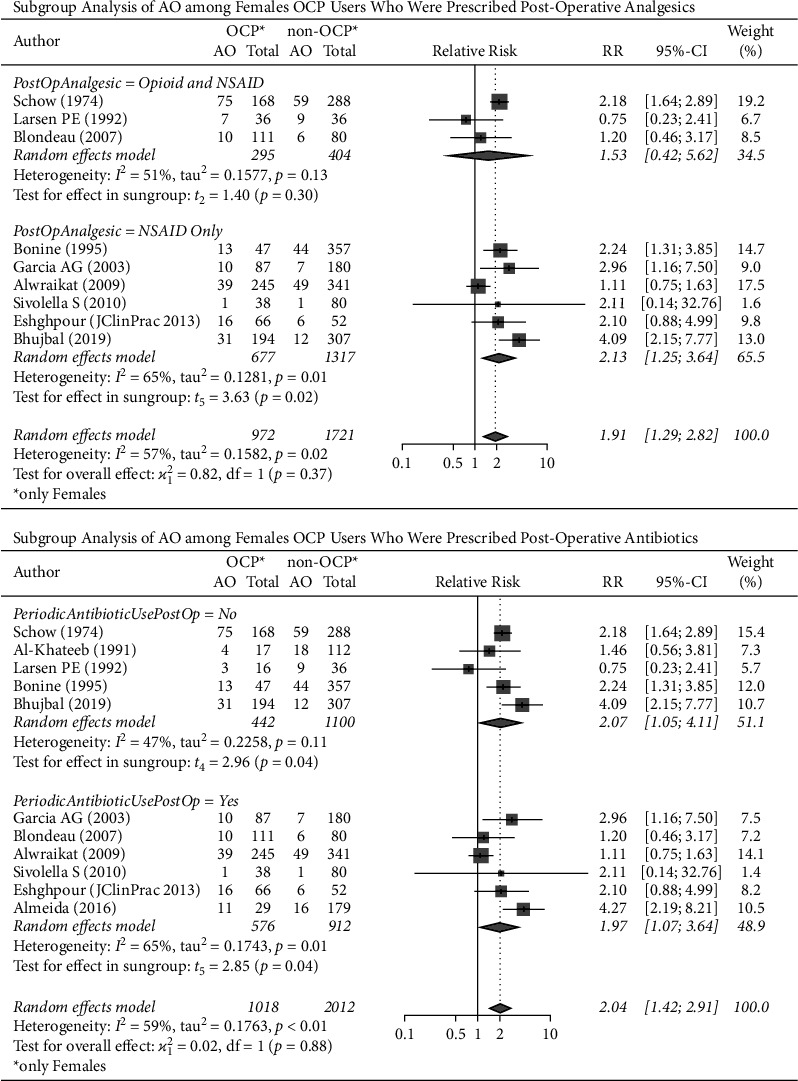
Conclusions: OCP use significantly elevated the risk of AO in females. Females who did not take OCPs had a similar risk of developing AO compared to males, suggesting that OCP use is a potential effect modifier. Neither postoperative antibiotics use nor the type of postoperative analgesic significantly affected AO incidence in those taking OCPs.
Copyright © 2022 Madison Tang et al.
Conflict of interest statement
The authors declare that they have no conflicts of interest.
Figures
References
-
- Bui C. H., Seldin E. B., Dodson T. B. Types, frequencies, and risk factors for complications after third molar extraction. Journal of Oral and Maxillofacial Surgery . 2003;61(12):1379–1389. - PubMed
-
- Kolokythas A., Olech E., Miloro M. Alveolar osteitis: a comprehensive review of concepts and controversies. International Journal of Dental . 2010;2010:p. 10. doi: 10.1155/2010/249073. https://www.ncbi.nlm.nih.gov/pmc/articles/PMC2905714/ 249073 - DOI - PMC - PubMed
-
- Hupp J., Tucker M., Ellis E. Contemporary Oral and Maxillofacial Surgery, 7th. Amsterdam, Netherland: Elsevier; 2018. p. p. 721.
-
- Neville B. W. Oral & Maxillofacial Pathology . Philadelphia: W. B. Saunders; 2002. http://archive.org/details/oralmaxillofacia00nevi .
-
- Akinbami B. O., Godspower T. Dry socket: incidence, clinical features, and predisposing factors. International Journal of Dentistry . 2014;2014:p. 7. doi: 10.1155/2014/796102. https://www.ncbi.nlm.nih.gov/pmc/articles/PMC4060391/ 796102 - DOI - PMC - PubMed
Publication types
LinkOut - more resources
Full Text Sources
