Clinical Trial
. 2022 Oct 27:13:1022104.
doi: 10.3389/fimmu.2022.1022104. eCollection 2022.

Anakinra Pilot - a clinical trial to demonstrate safety, feasibility and pharmacokinetics of interleukin 1 receptor antagonist in preterm infants

Affiliations
Clinical Trial

Anakinra Pilot - a clinical trial to demonstrate safety, feasibility and pharmacokinetics of interleukin 1 receptor antagonist in preterm infants

Elys A Green et al. Front Immunol. .

Abstract

Background: Bronchopulmonary dysplasia (BPD), its complication pulmonary hypertension (BPD-PH) and preterm brain and gut injury lead to significant morbidity and mortality in infants born extremely prematurely. There is extensive evidence that the pro-inflammatory cytokine interleukin 1 (IL-1) plays a key role in the pathophysiology of these illnesses. Two decades of clinical use in paediatric and adult medicine have established an excellent safety and efficacy record for IL-1 blockade with IL-1 receptor antagonist (IL-1Ra, medication name anakinra). Building on robust pre-clinical evidence, the Anakinra Pilot trial aims to demonstrate safety and feasibility of administering anakinra to preterm infants, and to establish pharmacokinetics in this population. Its ultimate goal is to facilitate large studies that will test whether anakinra can ameliorate early-life inflammation, thus alleviating multiple complications of prematurity.

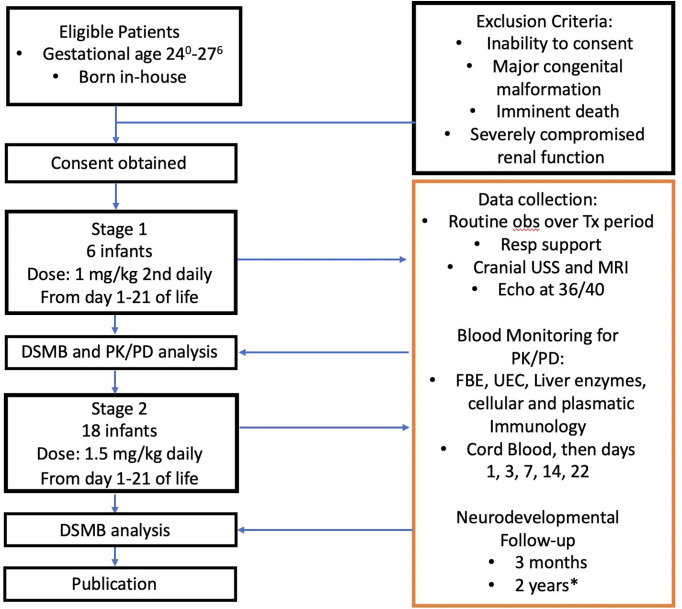
Methods and analysis: Anakinra Pilot is an investigator-initiated, single arm, safety and feasibility dose-escalation trial in extremely preterm infants born between 24 weeks 0 days (240) and 276 weeks of gestational age (GA). Enrolled infants will receive anakinra intravenously over the first 21 days after birth, starting in the first 24 h after birth. In the first phase, dosing is 1 mg/kg every 48 h, and dosage will increase to 1.5 mg/kg every 24 h in the second phase. Initial anakinra dosing was determined through population pharmacokinetic model simulations. During the study, there will be a interim analysis to confirm predictions before undertaking dose assessment. Anakinra therapy will be considered safe if the frequency of adverse outcomes/events does not exceed that expected in infants born at 240-276 weeks GA.

Clinical trial registration: https://clinicaltrials.gov/, identifier NCT05280340.

Keywords: anti-inflammatory therapy; clinical trial; drug repurposing; inflammation; interleukin 1 receptor antagonist; preterm infant; protocol anakinra pilot; translational research.


Conflict of interest statement

The authors declare that the research was conducted in the absence of any commercial or financial relationships that could be construed as a potential conflict of interest. The handling editor GT declared a shared parent affiliation with the author AG at the time of review.

Figures
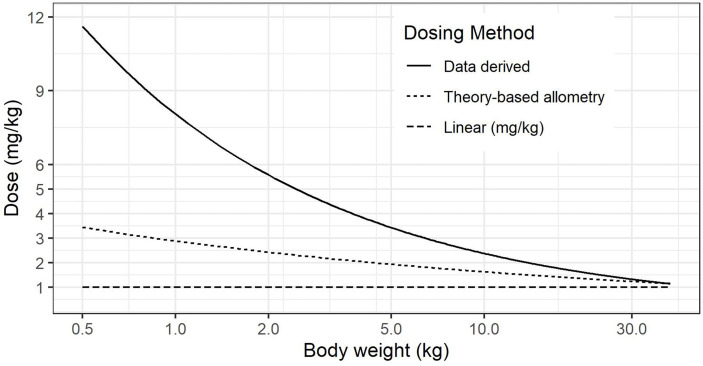
Figure 1
Figure 1
Comparison of calculated dose (mg/kg) for linear, theory-based allometry and data-driven methods (28).
Figure 2
Figure 2
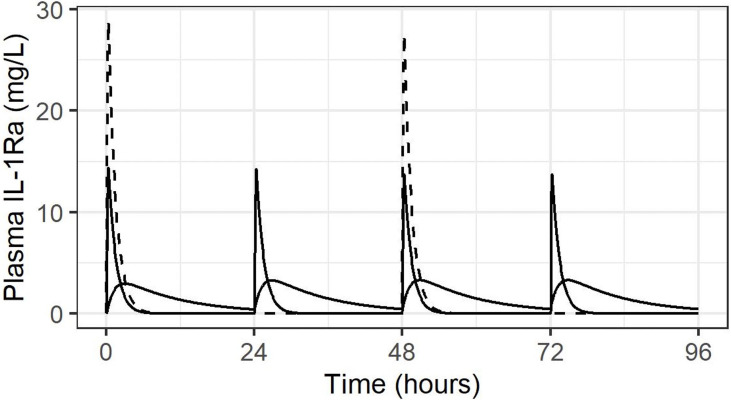
Concentration-time course following IV administration alternate daily (dashed line), or daily at 50% dose, both IV (solid line with high peaks and SC (solid line with lower, rounded peaks).
Figure 3
Figure 3
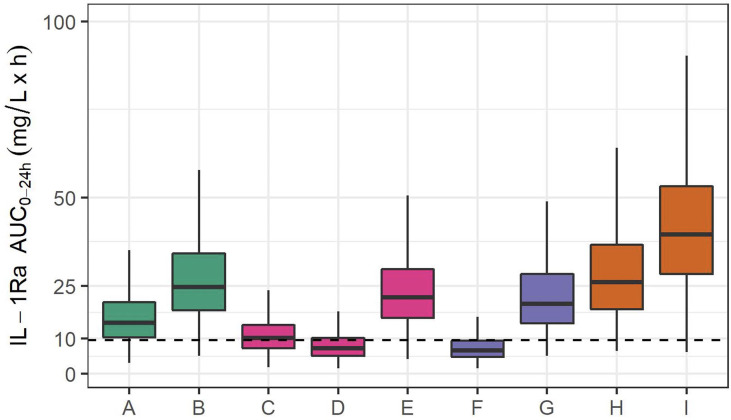
IL-1Ra plasma exposure (AUC0-24) from 1000 simulations, in studied populations and extrapolated to extremely premature neonates. Simulated exposure for (A) a 70 kg adult receiving 100 mg daily, (B) a 70 kg adult with severe renal impairment receiving 100 mg daily, (C) a 70 kg adolescent receiving 1 mg/kg daily, (D) a 2-year-old child weighing 12 kg and receiving 1 mg/kg daily, (E) a 12 kg 2-year-old child receiving 3 mg/kg daily. Simulations in extrapolated PK: (F) an extremely premature neonate (25-weeks GA, 850 g) with mature non-renal clearance receiving 1 mg/kg alternate daily, (G) an extremely premature neonate receiving 1.5 mg/kg daily, (H) an extremely premature neonate with 25% function of non-renal clearance receiving 1 mg/kg alternate daily, and (I) an extremely premature neonate with 25% function of non-renal clearance receiving 1.5 mg/kg daily. The dashed line indicates the threshold of 9.6 mg/l x h identified in (28) as the exposure above which sufficient suppression in auto-immune disease is achieved.
Figure 4
Figure 4
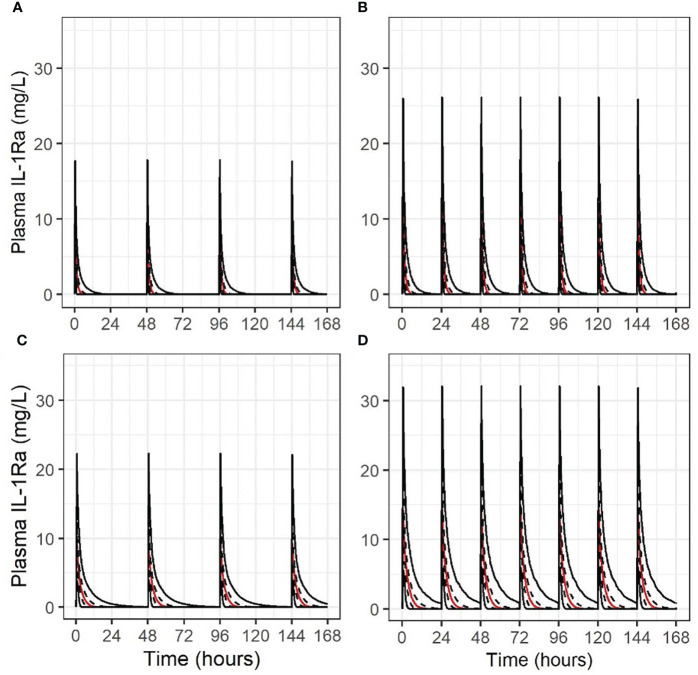
Concentration-time course for 1000 simulations (2.5th/25th/50th/75th/97.5th centiles, indicated by solid, dashed, red, dashed and solid lines in this order, respectively), for different scenarios of anakinra IV dosing in an extremely premature neonate. (A) 1 mg/kg alternate daily, mature non-renal clearance; (B) 1.5 mg/kg daily, mature non-renal clearance; (C) 1 mg/kg alternate daily, non-renal clearance at 25% maturity; (D) 1.5 mg/kg daily, non-renal clearance at 25% maturity.
Figure 5
Figure 5
Anakinra Pilot flow chart. DSMB, Data Safety Monitoring Board; USS, ultrasound study; MRI, magnetic resonance imaging; PK/PD, pharmacokinetic/pharmacodynamic analysis; FBE, full blood examination; UEC, urea, electrolytes, creatinine. *, Publication will not await these result, 2 year follow-up results will be published separately.

References

    1. Kelly SB, Green E, Hunt RW, Nold-Petry CA, Gunn AJ, Nold MF, et al. Interleukin-1: An important target for perinatal neuroprotection? Neural Regener Res (2023) 18(1):47–50. doi: 10.4103/1673-5374.341044 - DOI - PMC - PubMed
    1. Galinsky R, Lear CA, Dean JM, Wassink G, Dhillon SK, Fraser M, et al. Complex interactions between hypoxia-ischemia and inflammation in preterm brain injury. Dev Med Child Neurol (2018) 60(2):126–33. doi: 10.1111/dmcn.13629 - DOI - PubMed
    1. Galinsky R, Davidson JO, Dean JM, Green CR, Bennet L, Gunn AJ. Glia and hemichannels: Key mediators of perinatal encephalopathy. Neural Regener Res (2018) 13(2):181–9. doi: 10.4103/1673-5374.226378 - DOI - PMC - PubMed
    1. Lao JC, Bui CB, Pang MA, Cho SX, Rudloff I, Elgass K, et al. Type 2 immune polarization is associated with cardiopulmonary disease in preterm infants. Sci Transl Med (2022) 14(639):eaaz8454. doi: : 10.1126/scitranslmed.aaz8454 - DOI - PubMed
    1. Nold MF, Mangan NE, Rudloff I, Cho SX, Shariatan N, Samarasinghe TD, et al. Interleukin-1 receptor antagonist prevents murine bronchopulmonary dysplasia induced by perinatal inflammation and hyperoxia. Proc Natl Acad Sci USA (2013) 110(35):14384–9. doi: 10.1073/pnas.1306859110 - DOI - PMC - PubMed

Publication types

Substances

Associated data