Review
. 2022 Nov 17;10(1):85.
doi: 10.1186/s40364-022-00428-7.

Cervical cancer heterogeneity: a constant battle against viruses and drugs

Affiliations
Review

Cervical cancer heterogeneity: a constant battle against viruses and drugs

Qian Sun et al. Biomark Res. .

Abstract

Cervical cancer is the first identified human papillomavirus (HPV) associated cancer and the most promising malignancy to be eliminated. However, the ever-changing virus subtypes and acquired multiple drug resistance continue to induce failure of tumor prevention and treatment. The exploration of cervical cancer heterogeneity is the crucial way to achieve effective prevention and precise treatment. Tumor heterogeneity exists in various aspects including the immune clearance of viruses, tumorigenesis, neoplasm recurrence, metastasis and drug resistance. Tumor development and drug resistance are often driven by potential gene amplification and deletion, not only somatic genomic alterations, but also copy number amplifications, histone modification and DNA methylation. Genomic rearrangements may occur by selection effects from chemotherapy or radiotherapy which exhibits genetic intra-tumor heterogeneity in advanced cervical cancers. The combined application of cervical cancer therapeutic vaccine and immune checkpoint inhibitors has become an effective strategy to address the heterogeneity of treatment. In this review, we will integrate classic and recently updated epidemiological data on vaccination rates, screening rates, incidence and mortality of cervical cancer patients worldwide aiming to understand the current situation of disease prevention and control and identify the direction of urgent efforts. Additionally, we will focus on the tumor environment to summarize the conditions of immune clearance and gene integration after different HPV infections and to explore the genomic factors of tumor heterogeneity. Finally, we will make a thorough inquiry into completed and ongoing phase III clinical trials in cervical cancer and summarize molecular mechanisms of drug resistance among chemotherapy, radiotherapy, biotherapy, and immunotherapy.

Keywords: Drug resistance; Human papillomavirus; Immunotherapy; Tumor heterogeneity; Tumor microenvironment.


Conflict of interest statement

The authors declare that they have no competing interests.

Figures
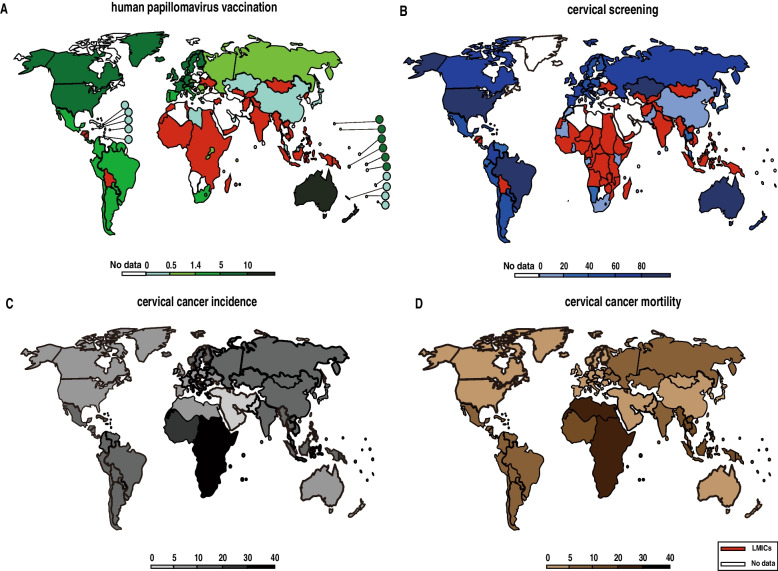
Fig. 1
Fig. 1
Global map of epidemiological data for tertiary prevention of cervical cancer. A vaccination coverage rates and B cervical cancer screening rates by country in 2014. C incidence and D mortality age-standardized rates per 100,000 by region in 2020. The full-course coverage data among the total female population are illustrated. 78 low-income and lower-middle-income countries involved in the WHO cervical cancer elimination project are highlighted in red. Source: GLOBOCAN 2020
Fig. 2
Fig. 2
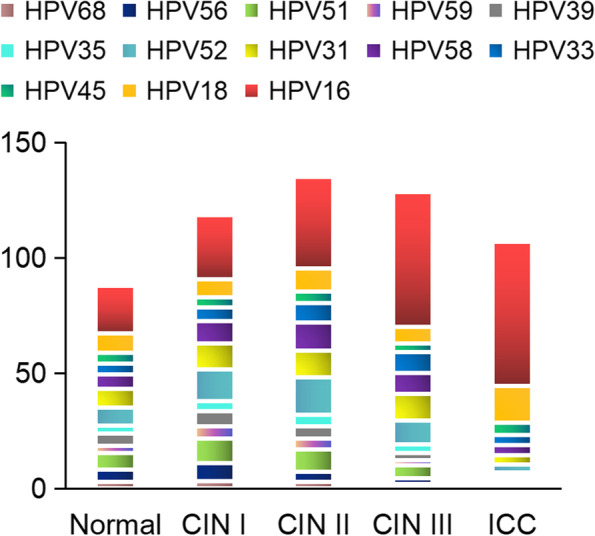
Histogram chart of HR-HPV infection distributions by different disease states. Normal: disease-free state; CIN: cervical intraepithelial neoplasia; ICC: invasive cervical cancer
Fig. 3
Fig. 3
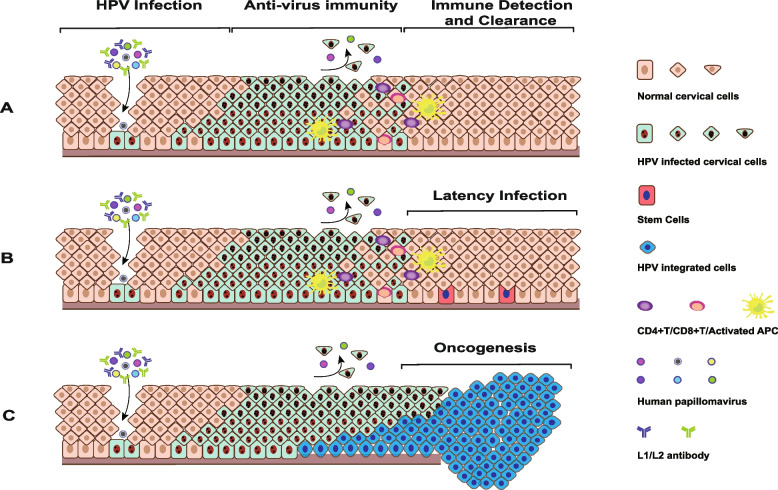
Clinical outcomes of different anti-viral immune states after HPV infection. A HPVs are completely eliminated by the body’s immunity; B A majority of HPVs is eliminated, a small percentage of latent basal layer stem cells still exist; C HPVs induce immunosuppression, gene integration, CIN and carcinogenesis
Fig. 4
Fig. 4
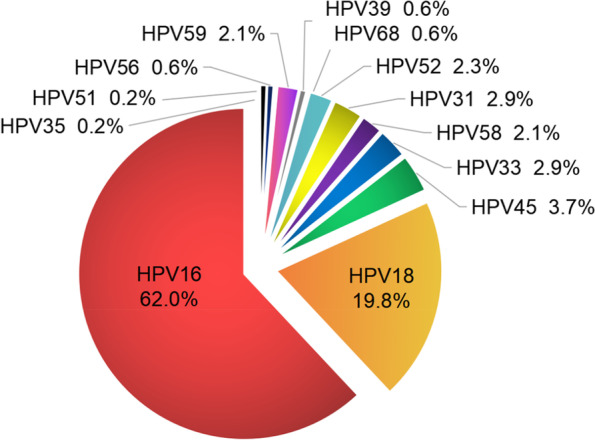
Pie chart of proportional distribution of reported HPV integration events by HR-HPV types. Only integration events detected through NGS or WGS data from human cervical cancer specimens are included (references: [–43] and [44])
Fig. 5
Fig. 5
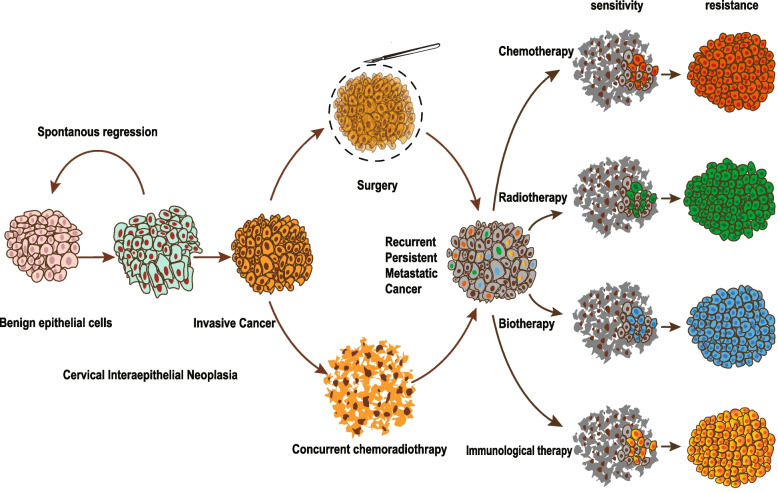
Model of clonal progression of cervical cancer. Normal cervical cells may harbor genomic alterations and HPV integration after HPV infection. Some cells regress to normal spontaneously, while others round into clonally invasive carcinoma cells. Overwhelming majority cancer cells are removed or killed during conventional surgery and chemoradiotherapy. A few dormant or new subclones develop into recurrent, persist or metastatic cancer lesions. Systemic therapies (chemotherapy, radiotherapy, biotherapy and immunological therapy) can induce intrinsic or adapted resistant subclones. Resistant subclones contribute to uncontrolled disease and treatment failure
Fig. 6
Fig. 6
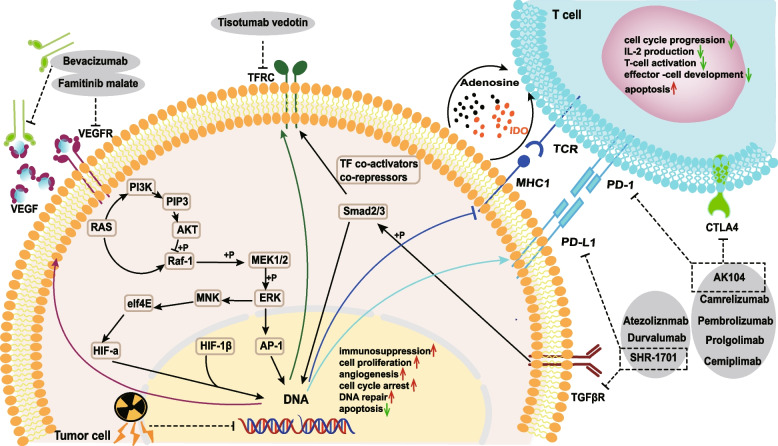
The potential resistance mechanisms and currently on-going phase III clinical trials’ agents in cervical cancer. The drug resistance in tumor cells showed as up-regulation of immunosuppression, cell proliferation, angiogenesis, cell cycle arrest, DNA repair and down-regulation of apoptosis. T cell anti-tumor immunity may be suppressed through down-regulation of cell cycle progression, IL-2 production, T-cell activation, effector-cell development and up-regulation of apoptosis. Agents of clinical trials have focused on novel immune checkpoint inhibitors including PD-1, CTLA4, PD-L1 and TGFβ

References

    1. Pett M, Coleman N. Integration of high-risk human papillomavirus: a key event in cervical carcinogenesis? J Pathol. 2007;212(4):356–367. - PubMed
    1. Castellsague X. Natural history and epidemiology of HPV infection and cervical cancer. Gynecol Oncol. 2008;110(3 Suppl 2):S4–7. - PubMed
    1. Marusyk A, Janiszewska M, Polyak K. Intratumor Heterogeneity: The Rosetta Stone of Therapy Resistance. Cancer Cell. 2020;37(4):471–484. - PMC - PubMed
    1. Cook OF. The Mendelian Inheritance of Mutations. Science. 1908;28(707):86–88. - PubMed
    1. Williams MJ, Werner B, Barnes CP, Graham TA, Sottoriva A. Identification of neutral tumor evolution across cancer types. Nat Genet. 2016;48(3):238–244. - PMC - PubMed

LinkOut - more resources