


'Mindful eating' for reducing emotional eating in patients with overweight or obesity in primary care settings: A randomized controlled trial
- PMID: 36397211
- PMCID: PMC10100015
- DOI: 10.1002/erv.2958
'Mindful eating' for reducing emotional eating in patients with overweight or obesity in primary care settings: A randomized controlled trial
Abstract
Objective: The primary aim of this study was to analyse the efficacy of a 'mindful eating' programme for reducing emotional eating in patients with overweight or obesity.
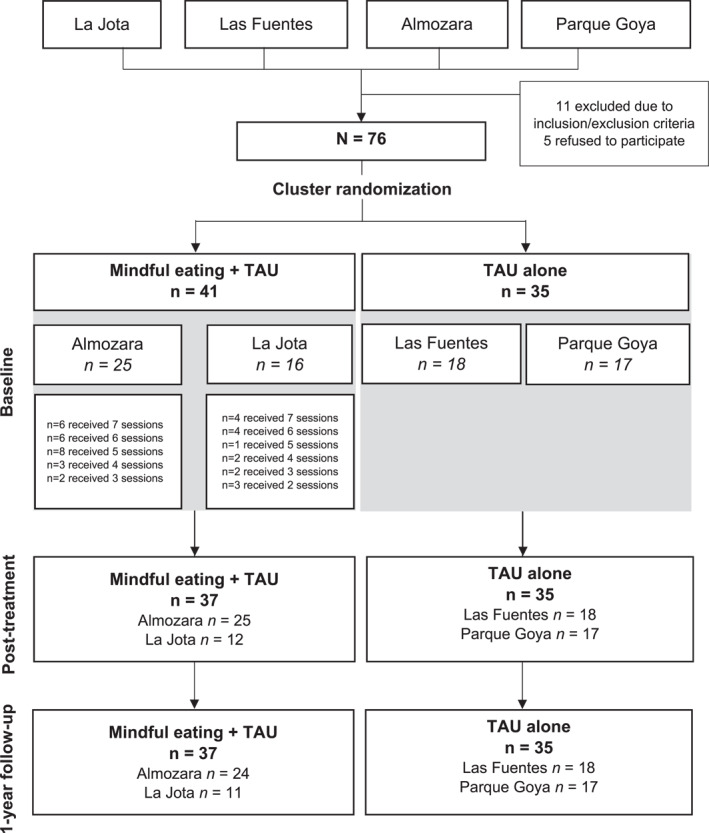
Method: A cluster randomized controlled trial (reg. NCT03927534) was conducted with 76 participants with overweight/obesity who were assigned to 'mindful eating' (7 weeks) + treatment as usual (TAU), or to TAU alone. They were assessed at baseline, posttreatment and 12-month follow-up. The main outcome was 'emotional eating' (Dutch Eating Behaviour Questionnaire, DEBQ); other eating behaviours were also assessed along with psychological and physiological variables.
Results: 'Mindful eating' + TAU reduced emotional eating both at posttreatment (B = -0.27; p = 0.006; d = 0.35) and follow-up (B = -0.53; p < 0.001; d = 0.69) compared to the control group (TAU alone). 'External eating' (DEBQ) was also significantly improved by the intervention at both timepoints. Significant effects at follow-up were observed for some secondary outcomes related to bulimic behaviours, mindful eating, mindfulness, and self-compassion. Weight and other physiological parameters were not significantly affected by 'mindful eating' + TAU.
Conclusions: These findings support the efficacy of the 'mindful eating' + TAU programme for reducing emotional and external eating, along with some other secondary measures, but no significant changes in weight reduction were observed.
Keywords: RCT; emotional eating; mindful eating; mindfulness; obesity; overweight.
© 2022 The Authors. European Eating Disorders Review published by Eating Disorders Association and John Wiley & Sons Ltd.
Conflict of interest statement
The author declares that there is no conflict of interest that could be perceived as prejudicing the impartiality of the research reported.
Figures
References
-
- Asensio‐Martínez, Á. , Masluk, B. , Montero‐Marin, J. , Olivan‐Blázquez, B. , Navarro‐Gil, M. T. , García‐Campayo, J. , & Magallón‐Botaya, R. (2019). Validation of Five Facets Mindfulness Questionnaire—Short form, in Spanish, general health care services patients sample: Prediction of depression through mindfulness scale. PLoS One, 14(4), e0214503. 10.1371/journal.pone.0214503 - DOI - PMC - PubMed
Publication types
MeSH terms
LinkOut - more resources
Full Text Sources
