


Coping in the Emergency Medical Services: Associations With the Personnel's Stress, Self-Efficacy, Job Satisfaction, and Health
- PMID: 36397746
- PMCID: PMC9667341
- DOI: 10.32872/cpe.6133
Coping in the Emergency Medical Services: Associations With the Personnel's Stress, Self-Efficacy, Job Satisfaction, and Health
Abstract
Background: Emergency Medical Services personnel (EMSP) are recurrently exposed to chronic and traumatic stressors in their occupation. Effective coping with occupational stressors plays a key role in enabling their health and overall well-being. In this study, we examined the habitual use of coping strategies in EMSP and analyzed associations of coping with the personnel's health and well-being.
Method: A total of N = 106 German Red Cross EMSP participated in a cross-sectional survey involving standardized questionnaires to report habitual use of different coping strategies (using the Brief-COPE), their work-related stress, work-related self-efficacy, job satisfaction, as well as mental and physical stress symptoms.
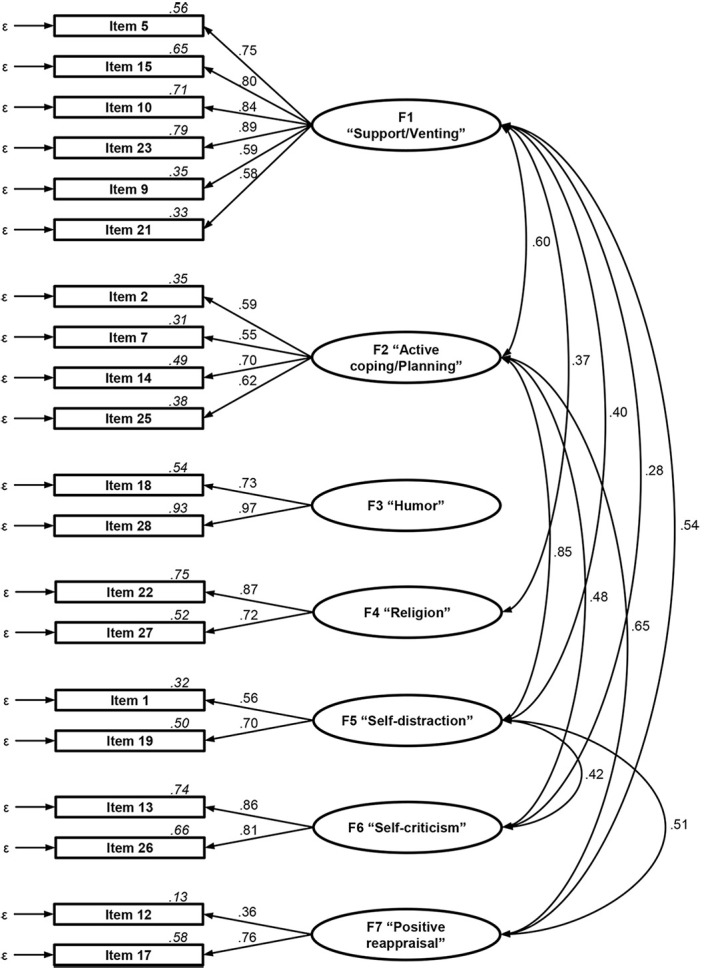
Results: A confirmatory factor analysis corroborated seven coping factors which have been identified in a previous study among Italian emergency workers. Correlation analyses indicated the coping factor "self-criticism" is associated with more work-related stress, lower job satisfaction, and higher depressive, posttraumatic, and physical stress symptoms. Although commonly viewed as adaptive coping, the coping factors "support/venting", "active coping/planning", "humor", "religion", and "positive reappraisal" were not related to health and well-being in EMSP. Exploratory correlation analyses suggested that only "acceptance" was linked to better well-being and self-efficacy in EMSP.
Conclusion: Our results emphasize the need for in-depth investigation of adaptive coping in EMSP to advance occupation-specific prevention measures.
Keywords: Emergency Medical Services; coping strategies; job satisfaction; stress; work-related self-efficacy.
Conflict of interest statement
The authors have declared that no competing interests exist.
Figures
References
-
- Rojas R., Hickmann M., Wolf S., Kolassa I.-T., Behnke A. (2022). Supplementary materials to "Coping in the Emergency Medical Services: Associations with the personnel’s stress, self-efficacy, job satisfaction, and health" [Additional information]. PsychOpen. 10.23668/psycharchives.5585 - DOI - PMC - PubMed
-
- Aasa, U., Brulin, C., Angquist, K.-A., & Barnekow-Bergkvist, M. (2005). Work-related psychosocial factors, worry about work conditions and health complaints among female and male ambulance personnel. Scandinavian Journal of Caring Sciences, 19(3), 251–258. 10.1111/j.1471-6712.2005.00333.x - DOI - PubMed
LinkOut - more resources
Full Text Sources