. 2023 Jan 6;51(D1):D1353-D1359.
doi: 10.1093/nar/gkac1046.

The next-generation Open Targets Platform: reimagined, redesigned, rebuilt

Affiliations

The next-generation Open Targets Platform: reimagined, redesigned, rebuilt

David Ochoa et al. Nucleic Acids Res. .

Abstract

The Open Targets Platform (https://platform.opentargets.org/) is an open source resource to systematically assist drug target identification and prioritisation using publicly available data. Since our last update, we have reimagined, redesigned, and rebuilt the Platform in order to streamline data integration and harmonisation, expand the ways in which users can explore the data, and improve the user experience. The gene-disease causal evidence has been enhanced and expanded to better capture disease causality across rare, common, and somatic diseases. For target and drug annotations, we have incorporated new features that help assess target safety and tractability, including genetic constraint, PROTACtability assessments, and AlphaFold structure predictions. We have also introduced new machine learning applications for knowledge extraction from the published literature, clinical trial information, and drug labels. The new technologies and frameworks introduced since the last update will ease the introduction of new features and the creation of separate instances of the Platform adapted to user requirements. Our new Community forum, expanded training materials, and outreach programme support our users in a range of use cases.


Figures

Figure 1.
Figure 1.
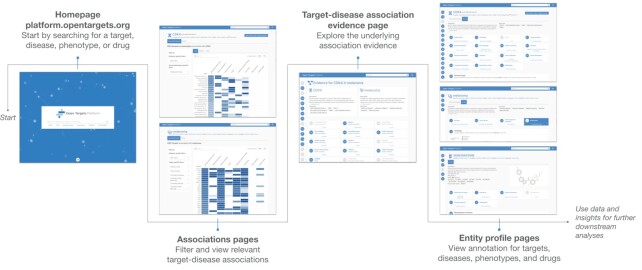
A journey through the Platform web interface. The Open Targets Platform web interface is the first point of access for most users, and was completely redesigned to create the Next Generation Platform. The unified search box is connected to a series of tools allowing users to query different therapeutic hypotheses. From the homepage, users can navigate to association pages, with prioritised lists of target–disease associations. From there, users can access target–disease evidence pages, detailing the available evidence for an association. Once the evidence for a target–disease association has been assessed, users can explore entity profile pages, containing annotation information for each target, disease/phenotype and drug in the Platform to further build their hypothesis. For targets, this includes investigating whether it is expressed in a suitable tissue, what type of modality may be suitable and whether modulation is likely to be safe, whether there are already known drugs or available chemical probes for validation experiments, and whether interacting proteins may be more suitable targets. For disease/phenotype, the user can investigate known drugs and their targets, or explore targets associated with disease phenotypes through ontology expansion. Drug annotation pages provide a user with the mechanism of action and safety information related to modulating a target.
Figure 2.
Figure 2.
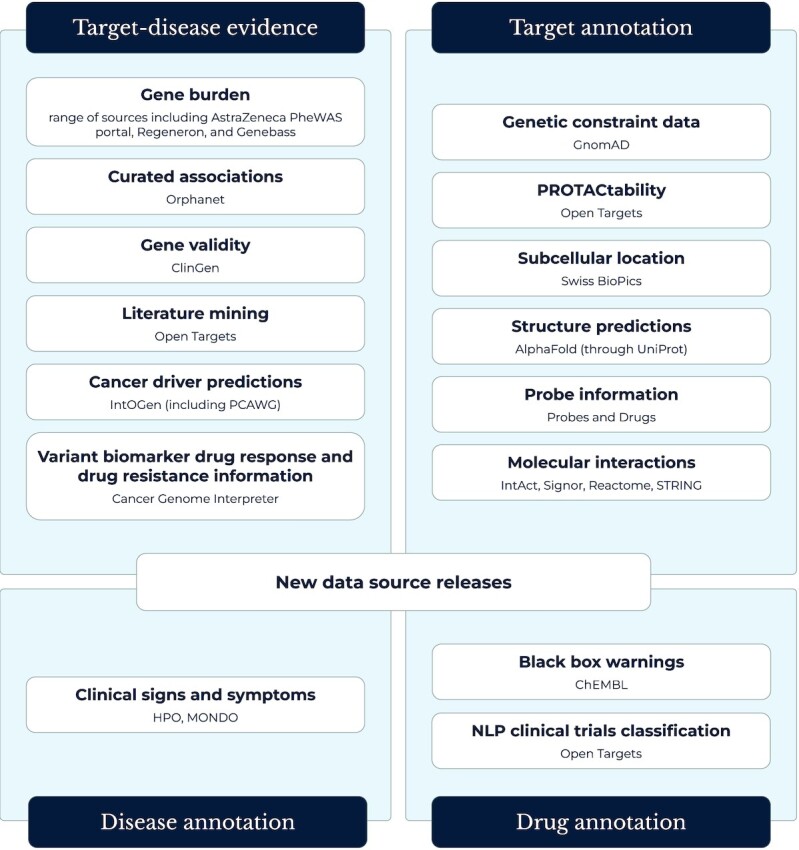
New data in the Open Targets Platform. Additional sources of target–disease evidence and new types of annotation for targets diseases and drugs during the last 2 years.
Figure 3.
Figure 3.
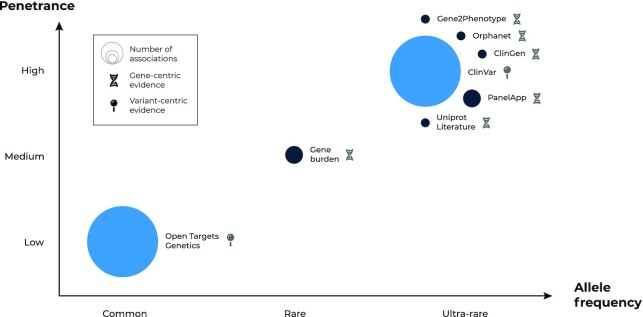
Schematic representation of germline genetic evidence in the Platform. Data sources—bubbles—are classified based on the predominant allelic frequency and penetrance of the reported genetic variation. The size of the bubbles represents the number of target–disease associations provided by each data source sorted into three bins: 1) 1000–10 000—from 1966 (ClinGen) to 8506 (Orphanet); 2) 10 000–100 000—with 27 162 target–disease associations from Gene Burden analyses to 40 446 from PanelApp; 3) and 100 000 + associations (Open Targets Genetics: 694 214; ClinVar: 1 541 903). Data sources are classified depending on whether they capture genetic variation at the variant (lighter blue) or gene level (dark blue).

References

    1. Ochoa D., Karim M., Ghoussaini M., Hulcoop D.G., McDonagh E.M., Dunham I.. Human genetics evidence supports two-thirds of the 2021 FDA-approved drugs. Nat. Rev. Drug Discov. 2022; 21:551. - PubMed
    1. Nelson M.R., Tipney H., Painter J.L., Shen J., Nicoletti P., Shen Y., Floratos A., Sham P.C., Li M.J., Wang J.et al. .. The support of human genetic evidence for approved drug indications. Nat. Genet. 2015; 47:856–860. - PubMed
    1. King E.A., Davis J.W., Degner J.F.. Are drug targets with genetic support twice as likely to be approved? Revised estimates of the impact of genetic support for drug mechanisms on the probability of drug approval. PLoS Genet. 2019; 15:e1008489. - PMC - PubMed
    1. Ochoa D., Hercules A., Carmona M., Suveges D., Gonzalez-Uriarte A., Malangone C., Miranda A., Fumis L., Carvalho-Silva D., Spitzer M.et al. .. Open targets platform: supporting systematic drug-target identification and prioritisation. Nucleic Acids Res. 2021; 49:D1302–D1310. - PMC - PubMed
    1. Attwood M.M., Fabbro D., Sokolov A.V., Knapp S., Schiöth H.B.. Trends in kinase drug discovery: targets, indications and inhibitor design. Nat. Rev. Drug Discov. 2021; 20:839–861. - PubMed